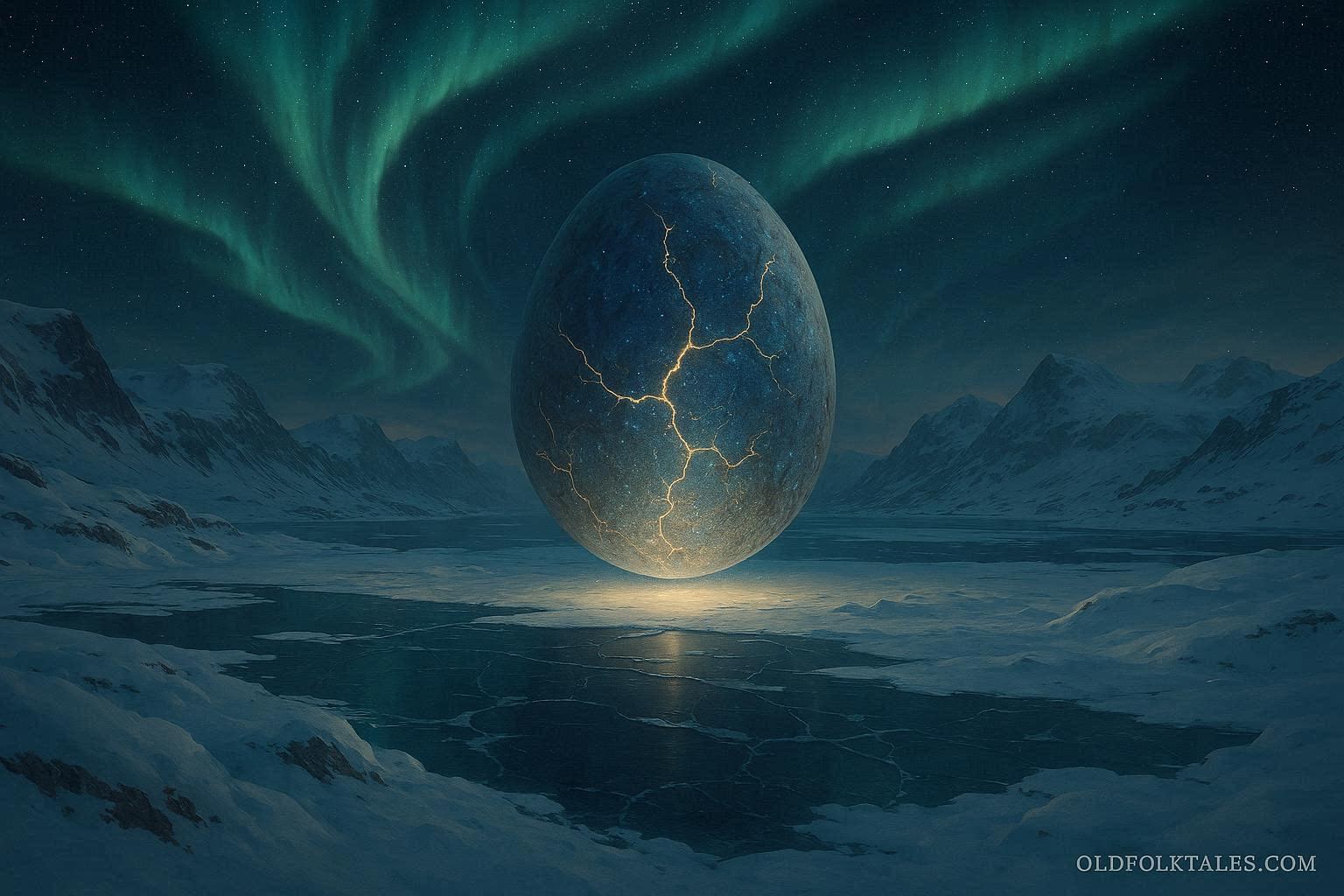
Far across the Arctic expanse, where ice stretches to the horizon and the sky dances with auroras, the Inuit tell of a time when nothing existed but a vast, endless darkness. The land, the sea, and the sky had not yet been formed, and life had not yet awakened. In this void floated a singular object of immense power and mystery: the cosmic egg. Within it lay the potential for everything that would come to be, holding light, life, and the forces of nature in delicate balance.
The egg was not merely an object; it was alive with energy. Its shell contained the essence of the world, compressed into a single, perfect sphere. Beneath its surface, elements of the universe shifted and swirled, waiting for the moment when creation could begin. The elders of Inuit communities describe it as pulsing with anticipation, a symbol of potential and cosmic order. It was both fragile and infinitely strong, containing the blueprint for land, water, animals, and humans alike.
One day, according to the stories, the egg fractured. The cracking was gradual at first, then sudden, releasing a brilliance that pierced the darkness. Light poured outward, illuminating the frozen void, and with it, the first forms of life emerged. The ice sheets and mountains took shape, waters filled valleys, and animals began to inhabit the new world. Even the northern lights are sometimes said to be reflections of that first cosmic radiance, still dancing across the sky as echoes of the egg’s initial burst of creation.
Discover African American wisdom, Native American spirit stories, and the humor of early pioneers in American Folktales
The breaking of the egg did more than illuminate the land. From its inner core, warmth spread across the icy expanse, making survival possible for creatures and humans. The sun and the moon were said to emerge from fragments of the shell, guiding the cycles of day and night. Stars scattered into the heavens, providing navigation for travelers and hunters alike. Each fragment contributed to balance in the world, creating both predictable patterns and mystery, light and shadow, order and chance.
Animals played a vital role in the formation of life following the egg’s rupture. The Inuit describe the emergence of birds, fish, seals, polar bears, and other creatures that inhabit the Arctic lands and seas. Each animal carried part of the cosmic energy, linking them to the primordial forces within the egg. Humans were the last to emerge, shaped by the energy of the egg and gifted with awareness and responsibility. They were meant to live in harmony with the natural world, respecting the balance that had been instilled at the moment of creation.
The cosmic egg myth also carries moral lessons embedded within its narrative. It teaches that life arises from balance and order, and that light and warmth are precious gifts to be respected. Humans are entrusted with the land, water, and animals, charged with maintaining harmony and using resources wisely. Just as the egg contained the blueprint of the world, so too does each person hold responsibility for preserving the delicate systems of nature in which they exist.
Over generations, the story of the cosmic egg has been passed down orally. Elders recount it during long winter nights, when families huddle in igloos or tents, telling children about the power of light, the fragility of life, and the importance of cooperation. Through narrative, Inuit culture preserves not only the origins of the world but also practical guidance for living in one of Earth’s harshest environments. Lessons about patience, observation, and respect for life are woven into the myth, linking survival with morality and cultural continuity.
The cosmic egg also represents mystery and potential. Its story invites wonder about beginnings, the unseen forces that shape reality, and the connection between humans, animals, and the land. Even today, scholars and storytellers alike marvel at the poetic simplicity of a world birthed from a single cosmic object, noting its resonance with universal themes of emergence, light from darkness, and the cyclical nature of life.
Natural phenomena in the Arctic may have reinforced the story. The breaking of ice, the glint of sunlight on snow, and the appearance of stars in the long polar night mirror aspects of the egg’s rupture. The aurora borealis, in particular, is interpreted as a visible reminder of the cosmic energy released at creation. Each year, as the seasons change and the environment cycles between darkness and light, the narrative of the cosmic egg remains vivid in cultural memory.
This myth ultimately teaches that creation is not random but deliberate, emerging from a combination of latent potential, energy, and careful balance. The world as we know it, with its ice, water, land, and living creatures, is the result of forces set in motion at a singular moment. Humans, in turn, carry responsibility for maintaining that balance, drawing wisdom from the story and the natural rhythms of their environment.
Explore ancient Native American creation myths and the symbolic tales that shaped America’s belief systems.
Moral Lesson
The cosmic egg myth reminds us that life emerges from balance and light. Humans are tasked with respecting nature, preserving harmony, and valuing the gifts of the world. Even in harsh or challenging environments, cooperation, mindfulness, and awareness are essential for survival and well-being.
Knowledge Check
- What object is central to this Inuit creation story?
A cosmic egg containing light, life, and the potential for the world. - How did the world emerge according to the myth?
The egg broke open, releasing light and forming land, water, animals, and humans. - Which natural features are said to come from the fragments of the egg?
The sun, moon, stars, mountains, and rivers. - What role do animals play in this myth?
Animals carry part of the cosmic energy and help maintain balance in the world. - What moral teaching is associated with the story?
Humans must respect nature and preserve balance for the survival of life. - How is the aurora borealis connected to the legend?
It is seen as a reflection of the light and energy released from the cosmic egg.
Source
Adapted from Inuit oral lore collections
Cultural Origin
Inuit Arctic cultures