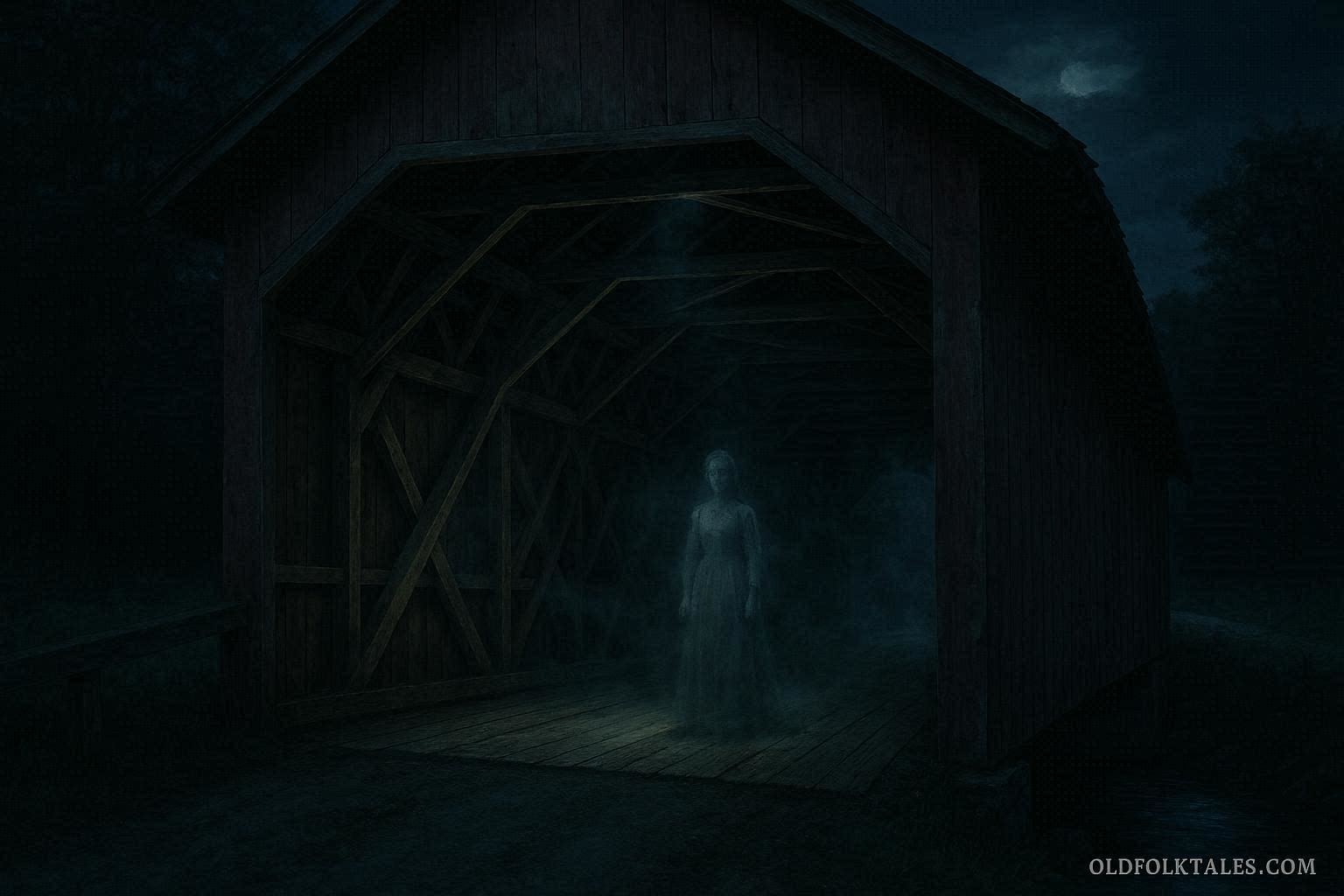
In the quiet mountain town of Stowe, Vermont, where rolling hills meet dense forest and narrow roads wind past old farms, there stands a wooden covered bridge that has become one of New England’s most whispered about landmarks. Officially known as Gold Brook Bridge, it is more commonly called Emily’s Bridge. By day, the structure appears charming and peaceful, painted in deep red with wooden beams stretching overhead. A shallow brook flows gently beneath it, reflecting sunlight that filters through the trees. Visitors stop to take photographs, admiring its nineteenth century craftsmanship. Yet as evening settles and shadows lengthen across the road, the bridge takes on a different presence.
The legend tells of a young woman named Emily who lived in the area during the nineteenth century. According to local folklore, Emily fell deeply in love with a man her family did not approve of. Determined to build a life together, the couple planned to elope. They agreed to meet at the covered bridge under the cover of night, where they would leave town and begin a new chapter far from disapproval. Emily arrived at the bridge as planned, her heart filled with both fear and hope. She waited beneath the wooden beams, listening to the soft rush of Gold Brook and the distant sounds of night insects.
Hours passed, and her promised companion never came. Whether delayed, afraid, or prevented from arriving, no one knows. Alone in the darkness, Emily’s hope turned to despair. Overcome with heartbreak and humiliation, the story claims she hanged herself from the rafters of the bridge before dawn. By morning, the quiet structure that had stood as a simple crossing became the site of tragedy.
Explore how American superstitions and rituals still influence modern life and local traditions.
As years passed, residents began sharing accounts of strange occurrences linked to the bridge. Travelers crossing at night reported hearing faint screams echoing through the wooden tunnel. Some described the cries as distant and sorrowful, carried by the wind through the beams overhead. Others claimed to hear soft sobbing near the entrance, only to find no one there when they stepped from their vehicles to investigate.
Drivers have also reported unexplained scratches appearing on their cars after passing through the bridge late at night. According to some stories, claw like marks were discovered on doors or trunks, though no branches or obstacles were present to cause them. These accounts, whether exaggerated or sincere, strengthened the belief that Emily’s spirit lingered beneath the roof of the old crossing.
Visitors walking through the bridge after dark often describe a sudden chill, even during warm summer evenings. The interior feels narrower at night, the wooden beams casting long shadows that shift with passing headlights. The creaking of aging timber echoes sharply in the enclosed space. Each sound seems amplified. A simple gust of wind can rattle the structure, creating the illusion of whispered movement overhead.
Skeptics point to natural explanations. Covered bridges are known to produce unusual acoustics. Wind traveling through narrow openings can create tones that resemble distant cries. Changes in humidity cause old wood to expand and contract, producing sharp cracks and groans. As for the scratches on vehicles, the tight passageway leaves little room for error, and side mirrors or branches near the entrance could account for minor damage.
Yet even with rational explanations available, the legend persists. Teenagers in Stowe have long dared one another to drive through the bridge at midnight with headlights turned off. Paranormal enthusiasts visit hoping to capture unexplained sounds or images. Some claim photographs taken inside reveal faint misty shapes hovering near the rafters. Others report feeling an overwhelming sadness upon stepping into the center of the bridge.
The power of the story lies not only in fear but in emotion. The image of a young woman waiting in vain beneath wooden beams speaks to universal themes of love, rejection, and heartbreak. Whether Emily truly existed or is a creation of folklore, her tale resonates because it reflects human vulnerability. The bridge, once simply a crossing over water, has become a symbol of longing and loss.
During autumn, when Vermont’s foliage turns brilliant shades of orange and red, Emily’s Bridge appears almost storybook beautiful. Leaves drift across the road, and cool air settles along the brook. Yet as dusk deepens and the forest grows quiet, the bridge’s interior darkens quickly. The entrance frames the fading light like a doorway into shadow. In those moments, it is easy to understand how imagination and history intertwine.
Emily’s Bridge remains standing today, preserved as both a historic structure and a local legend. Visitors continue to pass through its wooden tunnel, some unaware of its story, others listening carefully for the faintest echo. Whether haunted by a restless spirit or simply by the enduring power of folklore, the bridge holds its place in Vermont’s cultural memory. Beneath its beams, the sound of flowing water continues, steady and unchanged, as generations come and go.
Step into shadowy legends of restless spirits and ghostly travelers in American Ghost Stories.
Moral Lesson
The legend of Emily’s Bridge reminds us of the lasting impact of heartbreak and the importance of compassion. Stories of loss endure because they reflect real human emotions that connect us across time.
Knowledge Check
- In which town is Emily’s Bridge located?
It is located in Stowe, Vermont. - What is the official name of Emily’s Bridge?
It is officially known as Gold Brook Bridge. - What tragic event is associated with the legend?
The legend claims a young woman hanged herself after a failed elopement. - What unusual sounds do visitors report hearing?
They report hearing screams or soft sobbing. - What physical evidence do some drivers claim to find on their cars?
They claim to find unexplained scratches. - Why does the story continue to endure?
Because it reflects universal themes of love, loss, and heartbreak.
Source
Adapted from local historical society records and regional Vermont folklore archives
Cultural Origin
Stowe Vermont nineteenth century bridge legend