Winter changes the face of Lake Champlain. Ice forms across the surface, thickening slowly with the cold. On some mornings, the lake appears solid, unbroken, a vast white plane stretching to the horizon. Silence dominates. Not the kind of silence found in empty rooms, but one heavy with expectation.
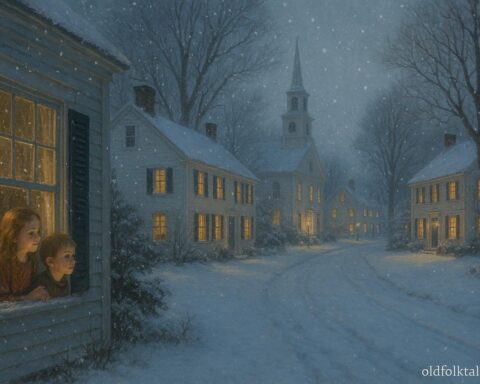
Beneath the frozen surface, a village rests. It is a place that no longer exists above water. Homes, shops, and streets lie submerged, claimed by flooding decades ago. Only memory preserves them now, carried in the minds of those who once lived there or heard stories from elders.
During the coldest months, locals report something unusual. A sound that defies explanation. A distant tolling, faint yet clear, like church bells ringing under ice. The sound rises at night, carried across the frozen lake. No tower stands above the ice. No person moves through the snow to strike a bell. Yet it is heard.
Step into shadowy legends of restless spirits and ghostly travelers in American Ghost Stories.
Those who pause and listen describe the sound as solemn and precise. The rhythm is unmistakable. Three rings, a pause, two rings, a long fade. Some report hearing more complex sequences, echoing hymns that were once sung in the village church.
The origin remains uncertain. Scientists suggest ice cracking, wind interacting with partially submerged structures, or water pressure shifting beneath the surface. None of these explanations fully account for the regularity or the tone that seems unmistakably bell-like.
Stories pass from generation to generation. Parents tell children to listen carefully when walking near the frozen lake. Hunters pause mid-step. Fishermen stop mid-ice-hole. Everyone who hears the bells senses not danger, but remembrance.
The village was once a hub of activity along the lake’s shores. Markets, festivals, and church services brought people together. When flooding arrived, homes were abandoned, streets vanished, and church towers sank beneath rising waters. Families dispersed. Memories lingered. Only the lake remembered everything.
Winter seems to awaken that memory. The frozen surface acts as a bridge, carrying sound upward from depths that no human can reach. The bells are not there to frighten. They are there to recall. To preserve what would otherwise be forgotten.
Some visitors have attempted to capture the phenomenon. Recordings often fail. Video cameras show nothing moving beneath the ice. Those who listen swear the bells come from beneath the frozen lake itself. They speak softly of echoes that awaken sorrow, community, and history simultaneously.
For those who grew up hearing the stories, the bells are a ritual of remembrance. Listening is an act of respect. They mark the lives lost to flood and displacement. They mark the resilience of a community that refused to vanish entirely from memory.
Legends say that the bells toll more clearly when the wind blows across the lake in a certain pattern. Ice shifts gently. The cold penetrates deeply. On such nights, people have left warm homes to walk the frozen surface and hear history speak.
A few accounts tell of names being heard faintly in the echoes. Not words of warning. Not threats. Just syllables carrying a sense of presence. Some believe these are the names of villagers who once rang the church bells, now calling across time and ice to remind the living that they were there.
The phenomenon inspires awe rather than fear. It is a haunting, yes, but one tied to memory, loss, and continuity rather than malice. Listeners often describe a profound sense of connection, as though the village itself communicates through the ice and frozen bells.
Local storytellers emphasize the lessons embedded in the legend. The bells remind everyone that history is never fully lost. Structures may sink. People may leave. Floods may erase physical traces. Yet the echoes of human life, care, and community endure, waiting for attentive ears to hear.
The legend persists because it matters. Even as winter thaws, and ice retreats to reveal open water, villagers speak of hearing distant bells, carried faintly on cold spring winds. Each year, when ice returns, the story gains new witnesses. And each year, those who hear it feel reminded that memory can take forms beyond sight, beyond writing, even beyond life itself.
The Frozen Bells of Lake Champlain remain a symbol of remembrance. They carry the voices of the past across space and time, bridging the gap between those who lived and those who continue to listen. They are not meant to frighten, only to remind, to echo a vanished world back to the present.
Click now to read all American Legends — heroic tales where truth and imagination meet, defining the American spirit.
Moral Lesson
Memory and history persist in unexpected ways. Even when physical structures and communities are lost, acts of remembrance allow the past to continue guiding and inspiring the living.
Knowledge Check
- What phenomenon is central to the legend?
Church bells ringing beneath the ice of Lake Champlain. - What village does the legend recall?
A community lost to flooding beneath the lake. - When are the bells said to appear?
During winter when the lake is frozen. - How do locals respond to hearing the bells?
With respect, reflection, and remembrance. - What do the bells symbolize?
Memory, loss, and the persistence of community. - Why do recordings fail to capture the sound clearly?
Because it is tied to memory, perception, and natural acoustic effects difficult to reproduce.
Source
Adapted from University of Vermont regional folklore archives
Cultural Origin
Northern New England lake communities