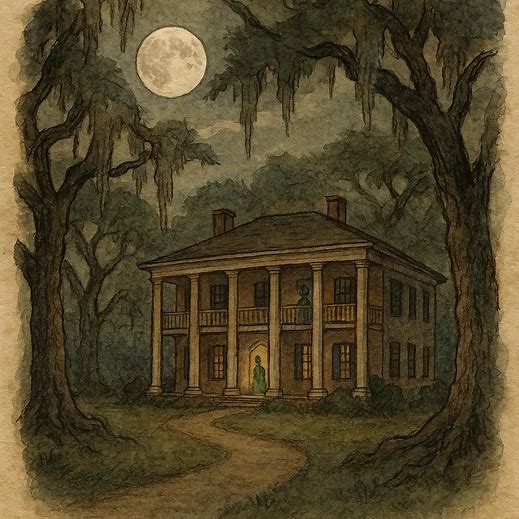
In the quiet town of St. Francisville, Louisiana, stands a grand home known as the Myrtles Plantation. Surrounded by ancient oak trees draped in Spanish moss, the house is beautiful in the soft southern light. its wide verandas, elegant windows, and magnolia-lined paths seem to hold the grace of another time. Yet beneath its charm lies a haunting stillness. For more than two centuries, this house has been whispered about as one of the most haunted places in America.
The Myrtles Plantation was built in 1796, in the days when Louisiana’s plantations were symbols of both prosperity and sorrow. Families came and went, generations passed, and the land bore witness to love, loss, and injustice. Some say that every wall, every brick, and every tree around the estate remembers the past. It is in those memories, both beautiful and tragic, that the haunting is said to dwell.
Among the many legends surrounding the Myrtles, none is more well known than that of Chloe. She was an enslaved woman who worked within the household of Judge Clark Woodruff and his family in the early 1800s. The story tells that Chloe was both trusted and feared. Some say she was favored by the judge and grew jealous of his wife, while others claim she lived in constant fear of punishment and sought protection through desperate means.
Encounter the strange and the unseen — from Bigfoot to regional monsters hiding in America’s forests
According to the tale, Chloe began eavesdropping on the judge’s private conversations, hoping to learn information that might save her from harsh treatment. When she was caught listening behind a door, the judge cut off one of her ears as punishment. From that day on, Chloe wore a green turban to hide the scar.
Seeking to win back her master’s favor, Chloe baked a cake for the judge’s wife and children. She added a small amount of crushed oleander leaves, perhaps thinking the poison would only make them ill and that she could then nurse them back to health and regain her place in the household. But the poison proved deadly. The wife and two of the children fell gravely ill and soon died.
The grief that followed turned swiftly to rage. The other enslaved workers, fearing for their own lives, took justice into their own hands. They dragged Chloe from her quarters and hanged her from a tree on the plantation grounds before throwing her body into the Mississippi River. The house, they say, has never forgotten that moment.
Since that day, strange things have happened at the Myrtles Plantation. Guests and caretakers have reported hearing the soft sound of footsteps in the empty halls, the faint laughter of children playing, and the rustle of skirts sweeping across the floors. The aroma of baking sometimes drifts through the air, though the kitchen has long been cold.
The most chilling encounters, however, center around mirrors. Visitors have claimed to see faces appear beside their own reflections faces that vanish when they turn around. One large mirror in the main hall is said to hold the spirits of the family Chloe unintentionally killed. Despite being cleaned and replaced over the years, faint handprints and cloudy shapes still seem to appear upon its surface, as if someone within is trying to reach out.
Outside, the moss-covered trees seem to bow toward the house, their long tendrils swaying like silent witnesses to what has passed. On moonlit nights, the windows glow faintly, though no lights burn inside. Some guests have seen a woman in a green turban wandering the veranda, her form flickering as if caught between one world and the next. Others have heard her weeping softly in the garden or singing a lullaby near the children’s rooms.
Over the years, the Myrtles Plantation changed hands many times. Each owner left with new stories to tell of locked doors that opened on their own, rocking chairs that moved without wind, and piano music playing in an empty parlor. Those who stayed long enough said the spirits were not vengeful but restless, bound to the house by memory rather than malice.
Today, the Myrtles stands as both a historical landmark and a place of legend. Visitors tour its rooms by daylight, learning about the people who lived and died there, but at night the air grows heavy, and shadows seem to thicken in the corners. The house creaks, the floors whisper, and the soft scent of magnolia mingles with something colder the echo of a time that refuses to fade.
The story of Chloe and the Myrtles Plantation remains one of the South’s most haunting tales, not only for its ghostly encounters but for the deep sorrow and injustice it carries. Whether one believes in ghosts or not, standing beneath the old magnolia trees, it is hard to deny that the past breathes here. The plantation holds more than history; it holds memory and it seems, never truly dies.
Discover chilling ghost tales and haunted places that echo through America’s towns and countryside.
Moral Lesson
The legend of the Myrtles Plantation reminds us that the past cannot be buried beneath beauty or time. Injustice, sorrow, and guilt linger in the places that bore witness to them. Until remembered and understood, their echoes continue to speak.
Knowledge Check
1. Where is the Myrtles Plantation located?
It stands in St. Francisville, Louisiana, surrounded by oak and magnolia trees.
2. Who is the most famous ghost of the plantation?
Chloe, an enslaved woman said to have poisoned her master’s family and suffered a tragic fate.
3. What mysterious events occur inside the house?
Visitors report seeing reflections in mirrors, hearing laughter and footsteps, and smelling phantom scents.
4. What does the green turban symbolize in the story?
It represents Chloe’s attempt to hide her scar and her lingering presence as a spirit of sorrow and guilt.
5. Why is the Myrtles considered haunted?
Because of the violent events, deaths, and emotional pain that occurred within its walls.
6. What deeper message does the legend carry?
That history leaves marks that cannot be erased, and true peace requires remembrance and understanding.
Source:
Adapted from The Myrtles Plantation: The True Story of America’s Most Haunted House by Frances Kermeen, 2002.
Cultural Origin:
United States (Louisiana / Southern regional haunting folklore)