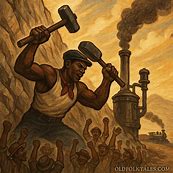
Long ago, during the great age of American railroads, when mountains were split open and tracks stretched from coast to coast, there lived a man whose strength and spirit became legend. His name was John Henry, and he was known across the land as the mightiest steel-driver who ever lived.
John Henry was a tall, powerful African American man with arms like iron and a heart that beat to the rhythm of his hammer. Every day he worked on the railroad, driving steel spikes deep into stone to carve tunnels for the trains that would soon carry people and goods across America. His hammer rang out like a song of thunder in the morning air, and his voice often joined its music. “This old hammer,” he sang, “it rings like silver and it shines like gold.”
John Henry believed that honest labor was sacred. He took pride in his work, and his fellow workers looked up to him as their leader. When others grew tired, John Henry’s steady rhythm gave them strength. He worked not for fame, but for the dignity that came from a job well done.
But one day, a change came to the railroad camps. The company brought a great iron machine, a steam-powered hammer that puffed and hissed like a living beast. The bosses boasted that this new machine could outwork any man. “It never eats, never sleeps, and never tires,” they said. “The age of men is over. The age of machines has begun.”
Fear spread through the workers. If the machine could do their jobs faster and longer, what would become of them? They gathered around John Henry and asked, “What will we do now?”
Discover African American wisdom, Native American spirit stories, and the humor of early pioneers in American Folktales.
John Henry stood tall, his great hammer resting on his shoulder. “A machine may have steam,” he said, “but it has no soul. It cannot sing. It cannot feel the pride of a day’s work. I’ll show them that a man is more than a machine.”
The railroad men whispered in awe. The company’s overseers laughed, thinking his words were foolish. But John Henry’s challenge could not be taken back. A contest was set the man against the machine. The greatest race in railroad history was about to begin.
On the morning of the race, workers came from miles around. Even the mountains seemed to hold their breath. On one side stood the smoking steam hammer, gleaming with metal gears and pipes. On the other stood John Henry, bare-chested beneath the rising sun, holding a hammer in each hand. His wife, Polly Ann, stood nearby, her eyes full of pride and worry.
At the signal, the contest began. The steam hammer roared to life, pounding steel into rock with a noise that shook the ground. But John Henry swung his hammers in perfect rhythm, faster and faster, his muscles glistening with sweat. Sparks flew with every strike. The tunnel echoed with the music of his labor.
“Go, John, go!” the workers cried. “You can do it!”
Hour after hour, man and machine battled for victory. The machine hissed and clanked, but John Henry’s song never stopped. His arms were strong, his heart steady, and his spirit unbroken. Dust filled the air, the mountain trembled, and still he swung his hammers, driving steel deeper into the rock.
When the final whistle blew, the crowd fell silent. The steam hammer sputtered and stopped, its fire exhausted. John Henry had beaten the machine. His tunnel stretched further through the mountain than any man or machine had ever gone before. The workers cheered wildly, lifting their hero high.
But John Henry’s face was pale, and his breath came hard. He smiled weakly at Polly Ann and whispered, “A man ain’t nothing but a man, but before I let a machine beat me, I’ll die with my hammer in my hand.” With one last breath, he collapsed, his hammers falling beside him. He had won the race but his strength was spent.
The workers built a grave for John Henry at the mouth of the tunnel he had finished. They laid his hammers across his chest, and they sang songs in his honor. The railroad company kept building, and the trains rolled on through the mountains, but every time one passed through John Henry’s tunnel, the workers said they could still hear the echo of his hammer striking steel.
Years later, his story spread through the land in songs sung by laborers and travelers. They sang of his courage, his pride, and his sacrifice. John Henry became a symbol of every worker who gave everything for their craft, of every person who stood up against the cold march of progress.
His legend still endures today. To some, John Henry represents strength. To others, he represents resistance against the rise of machines. But to all, he is remembered as a hero, a man who proved that the spirit of humanity is stronger than steel.
Click now to read all American Legends — heroic tales where truth and imagination meet, defining the American spirit.
Moral Lesson
The story of John Henry teaches that courage, endurance, and pride in one’s work are greater than any machine’s power. It reminds us that progress must never erase the dignity and heart that make human labor meaningful.
Knowledge Check
-
Who was John Henry?
John Henry was a strong African American steel-driver known for his skill and courage while building railroads. -
What new invention threatened the workers’ jobs?
A steam-powered hammer was introduced to replace human labor on the railroad. -
Why did John Henry decide to challenge the machine?
He wanted to prove that human strength and spirit were greater than mechanical power. -
What happened during the contest between John Henry and the machine?
John Henry worked tirelessly and managed to drive more steel than the machine, showing that man could still triumph over technology. -
What happened to John Henry after the race?
He won the contest but died from exhaustion, still holding his hammer in his hand. -
What is the lasting message of John Henry’s story?
It reminds us that courage, hard work, and human pride should always be valued above machines and progress.
Source
Adapted from American railroad folklore and traditional African American work songs celebrating John Henry’s legacy.
Cultural Origin
United States (African American folk and industrial-era legend)