Long ago, when America was still a patchwork of forests, rivers, and scattered cabins, there wandered a man unlike any other. His name was John Chapman, but to the people of the frontier, he was lovingly known as Johnny Appleseed.
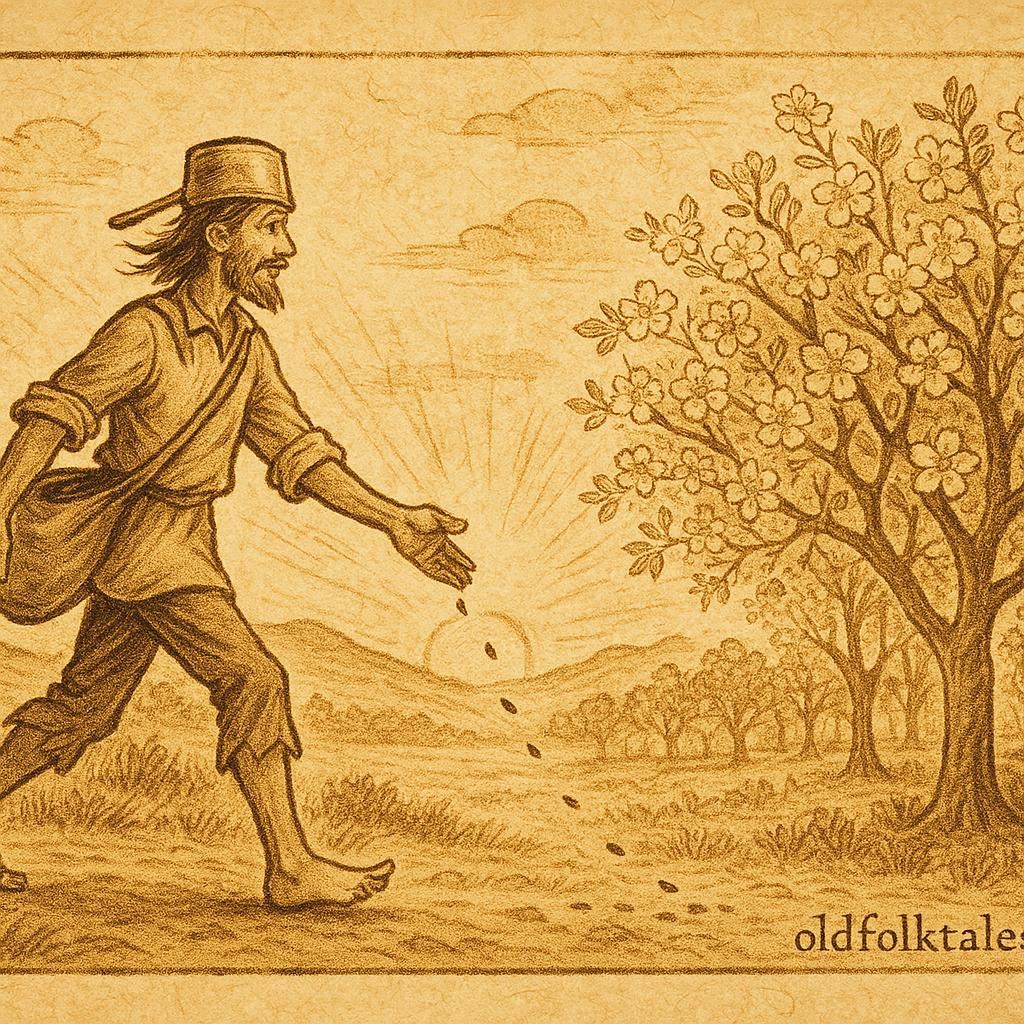
Johnny was a small, wiry man with gentle eyes and a calm voice. He wore simple clothes that were often patched and threadbare, and instead of a hat, he used a tin cooking pot on his head. On his back he carried a sack, not filled with gold or possessions, but with apple seeds. Wherever he went, he sowed the promise of new life.
Journey through the lives of folk heroes, war legends, and hometown champions in our American Legends collection.
Johnny walked barefoot across Pennsylvania, Ohio, Indiana, and Illinois, through meadows and over mountains, wading through rivers and sleeping under open skies. He lived close to the earth, finding joy in every living thing. Children would follow him down dusty roads, eager for stories about faraway places or the wonders of nature.
He loved all creatures, birds, deer, and even wolves, and it was said that wild animals trusted him completely. Settlers swore that he could heal the sick using herbs and that he spoke softly to the beasts of the forest as if they were old friends.
Wherever Johnny went, he carried his apple seeds and planted them along the edges of new settlements. He believed every seed should be planted with care and hope. “Someday,” he would say, “these trees will give shade to travelers, and fruit to children not yet born.”
He didn’t ask for payment, nor did he seek fame. Johnny gave his trees freely, asking only that people share and care for them. The settlers loved him for his gentle spirit and cheerful heart. He became a symbol of goodness, a man who believed that kindness and hard work could make the world bloom.
As the years passed, orchards grew where he had walked. Fields that were once bare now shimmered with blossoms in spring and heavy fruit in autumn. Every apple tree became a reminder of Johnny’s quiet faith in the land and in people’s ability to do good.
Even after he passed away, stories of Johnny Appleseed spread far and wide. Some said he could still be seen on moonlit nights, sowing apple seeds across the hills, his tin pot shining faintly under the stars.
To this day, in the orchards of the Midwest, the scent of apples carries with it the memory of a humble man who turned wilderness into gardens and strangers into friends.
Discover African American wisdom, Native American spirit stories, and the humor of early pioneers in American Folktales.
Moral Lesson
The story of Johnny Appleseed teaches lessons on selflessness, generosity, and harmony with nature. His simple acts remind us that lasting good comes not from wealth or power, but from the quiet seeds of kindness we plant in the world.
Knowledge Check
1. Who was Johnny Appleseed’s real name?
Johnny Appleseed’s real name was John Chapman, an American pioneer and orchardist.
2. What was Johnny Appleseed known for planting?
He planted apple orchards throughout the American Midwest for settlers and travelers.
3. Which regions did Johnny Appleseed travel through?
He journeyed across Pennsylvania, Ohio, Indiana, and Illinois in the early 1800s.
4. What moral value does the story highlight?
The tale emphasizes kindness, generosity, and living in harmony with nature.
5. What did Johnny wear on his head instead of a hat?
He famously wore a tin pot, which he also used for cooking.
6. Why is Johnny Appleseed remembered in American folklore?
He is remembered as a symbol of hope and goodness, spreading life through apple seeds and compassion.
Source: American folktale, United States.
Adapted from American Pioneers and Heroes by William M. Thayer (1872) and traditional Midwest folklore.