Long ago, when the forests of the East Coast stretched endlessly in every direction and the Penobscot people lived in harmony with the rhythms of the wild, whispers spread through villages of a creature that defied understanding. The elders spoke its name with reverence and dread, Katshituashku, the Stiff-Legged Bear. To speak of it was to acknowledge that, despite all human knowledge of the forest and its creatures, something walked among the trees that belonged to a different time, a different world.
The dense woodlands that covered the northeastern territories held countless mysteries. Towering pines blocked out the sun, creating twilight even at midday. Moss-covered rocks and fallen logs created a maze where one could easily lose direction. Streams babbled their ancient songs, and the wind whispered through branches with voices that sometimes sounded almost human. In this primordial realm, where nature reigned supreme, the Katshituashku made its domain.
Explore Native American beings, swamp creatures, and modern cryptid sightings across the country.
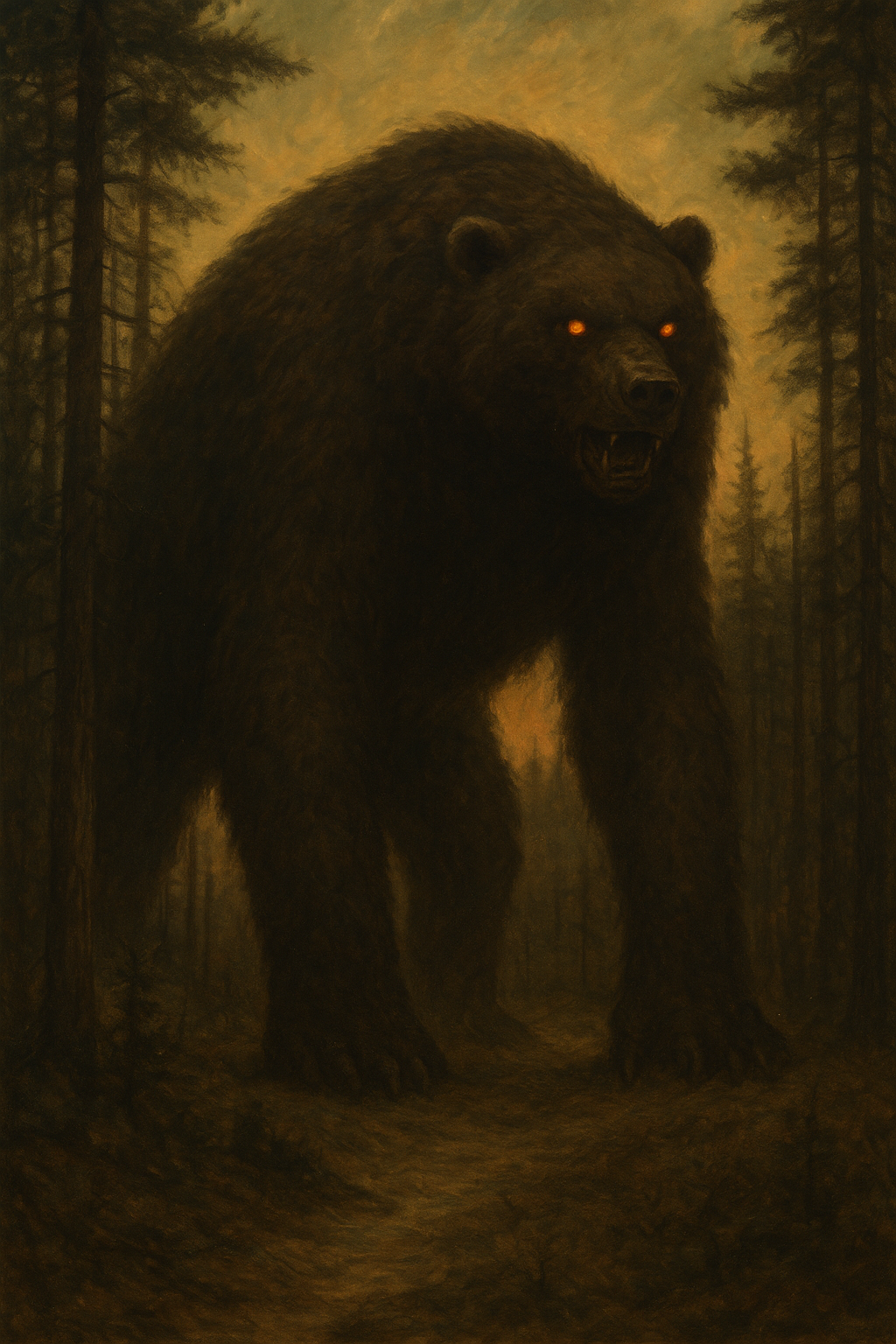
Those who claimed to have glimpsed the creature and lived to tell of it described something that haunted their dreams forever after. The Katshituashku resembled a bear in its basic form, four legs, a massive body covered in dark fur, and powerful shoulders built for tearing through obstacles. But there the resemblance ended and nightmare began. Its head was grotesquely enormous, far larger than any bear’s, with a skull that seemed too heavy for any neck to support. The jaws could open wide enough to swallow a man whole, and teeth like daggers lined its mouth.
Most disturbing of all were its legs. Unlike any living creature, the Katshituashku’s legs were thick as ancient tree trunks and utterly stiff, as if carved from wood rather than flesh and bone. These strange limbs did not bend at the joints as they should. When the creature moved, it did so with an unsettling gait, like a massive puppet animated by invisible strings. Yet despite this apparent handicap, the Stiff-Legged Bear moved with shocking swiftness. It crashed through the forest, snapping trees as thick as a man’s waist, leaving destruction in its wake that resembled the path of a violent storm.
The eyes, those who survived an encounter always spoke of the eyes first. They burned with an inner fire, glowing like embers in the darkness, radiating a hunger that went beyond mere animal appetite. When the Katshituashku fixed its gaze upon prey, those eyes promised something worse than death, they promised that you would be erased, consumed, forgotten, as if you had never existed at all.
Villages along the eastern forests lived with the constant shadow of Katshituashku. Travelers who ventured too deep into the wilderness sometimes never returned. Search parties would find nothing but enormous footprints pressed deep into the earth, each track as long as a man’s arm and wider than two hands spread. Trees would be knocked aside, their trunks splintered as if something massive had simply walked through them without bothering to go around. Sometimes, searchers heard distant roars that made their bones vibrate, sounds too deep and powerful to come from any known animal.
Mothers warned their children never to stray far from the village boundaries. Hunters traveled in groups and kept fires burning through the night when they made camp, knowing that flames might be their only defense if the Stiff-Legged Bear caught their scent. Warriors who prided themselves on their courage admitted to feeling fear when they ventured into the deepest parts of the forest, where the trees grew so thick that sound became muffled and shadows took on solid forms.
The Penobscot elders gathered around fires and debated the nature of Katshituashku. Some, weathered and wise, believed the creature was born of the earth itself, a spirit made manifest, walking the world in physical form to remind humans that they were not the masters of the wild. These elders taught that the forest had its own consciousness, its own will, and Katshituashku was its guardian and enforcer. When humans grew too proud, too careless with the sacred balance of nature, the Stiff-Legged Bear would emerge to restore humility.
Other elders, those who had seen the massive bones that sometimes emerged from riverbanks after spring floods or tumbled from eroding cliffs, held different theories. They spoke of animals that had walked the earth in ancient times, creatures so large they made modern bears look like cubs. Though the Penobscot had never seen elephants or mastodons, their oral traditions carried racial memory of something enormous beings that shook the ground when they walked, with tusks like curved spears and bodies that towered over the tallest men. Perhaps, these elders suggested, Katshituashku was the last of these ancient giants, changed by time and magic into something even more fearsome.
Hunters who survived encounters with the creature became legendary figures within their tribes. They returned with wild eyes and trembling hands, speaking of moments when death had breathed upon their necks. One hunter described crouching behind a fallen log while Katshituashku passed so close that he could feel the heat radiating from its massive body. Another told of shooting an arrow that struck the creature’s hide and simply bounced off, as if the beast’s fur was impervious to weapons. A third warrior swore he had watched the Stiff-Legged Bear tear apart a full-grown moose with casual ease, the crack of breaking bones echoing through the trees like thunder.
These survivors all spoke of the same overwhelming sensation the absolute certainty that they faced something beyond normal understanding. The Katshituashku moved with the inevitability of a rockslide or a flash flood, a force of nature given teeth and hunger. When it pursued prey, it was relentless. When it roared, the sound seemed to come from the earth itself, vibrating through the ground and into the very marrow of those who heard it. The forest trembled when Katshituashku walked, as if nature itself recoiled from the creature’s presence or bowed before it.
The Penobscot people learned to read the signs that suggested the Stiff-Legged Bear was near. Unusual silence in the forest, where even birds stopped singing. Trees knocked down in patterns that suggested something massive had passed through. Enormous tracks that appeared overnight. An smell like old earth and ancient bones that hung in the air. When these signs appeared, entire villages would increase their vigilance, keeping children close and fires bright.
Seasons turned into years, years into generations, and the legend of Katshituashku became woven into the fabric of Penobscot culture. It was more than just a monster story told to frighten children. It represented the eternal truth that humans, for all their intelligence and skill, remained small creatures in a vast and mysterious world. The Stiff-Legged Bear embodied the wild’s refusal to be fully known or controlled, a reminder that some forces would always exist beyond human dominion.
To this day, in the most remote corners of the northeastern forests where old growth trees still stand and modern human presence has not yet erased all traces of the ancient world, some say that Katshituashku still roams. When wind howls through the pines with a voice deeper than any storm, when massive shapes seem to move between the trees in the corner of one’s vision, when the forest feels suddenly alive with a presence both magnificent and terrible the memory of the Stiff-Legged Bear walks again. Whether physical creature or eternal spirit, Katshituashku endures in story and shadow, as terrifying and awe-inspiring as when the first Penobscot hunters whispered its name around their fires and feared what watched from the darkness beyond the light.
Click to read all American Cryptids & Monsters — creatures of mystery and fear said to inhabit America’s wild landscapes.
The Moral of the Story
The legend of Katshituashku teaches profound respect for nature’s power and the limits of human dominion over the wild. The Stiff-Legged Bear serves as a reminder that no matter how skilled or brave humans become, forces exist in the natural world that cannot be conquered or fully understood. The story emphasizes humility before nature’s mysteries and warns against the arrogance of believing humans are masters of the wilderness. It also preserves cultural memory of ancient times when massive creatures roamed the earth, teaching that the past holds lessons about our place in the natural order.
Knowledge Check
Q1: What was Katshituashku in Penobscot Native American folklore?
A: Katshituashku, meaning “Stiff-Legged Bear,” was a monstrous creature from Penobscot legend that stalked the dense forests of the East Coast. It resembled a bear but was much larger, with an enormous head, glowing eyes, and unnaturally stiff legs as thick as tree trunks. Despite its rigid limbs, the creature moved with surprising speed and was known as a relentless predator.
Q2: How did the Katshituashku move despite having stiff legs?
A: Despite its legs being stiff and immovable like tree trunks, the Katshituashku moved with shocking swiftness through the forest. It crashed through trees and obstacles with an unsettling gait, like a massive puppet, leaving destruction in its path. This unnatural movement made the creature even more terrifying to those who encountered it.
Q3: What theories did Penobscot elders have about Katshituashku’s origin?
A: Penobscot elders had two main theories about Katshituashku. Some believed it was a forest spirit born of the earth itself, meant to remind humans of their place in nature and enforce balance. Others thought it might be connected to ancient giant creatures like mastodons, whose bones sometimes surfaced in riverbeds, representing a living memory of prehistoric times.
Q4: What signs indicated that the Stiff-Legged Bear was near?
A: Signs that Katshituashku was nearby included unusual silence in the forest where even birds stopped singing, trees knocked down in patterns suggesting something massive had passed, enormous footprints appearing overnight, and a distinctive smell like old earth and ancient bones hanging in the air. These warnings prompted villages to increase vigilance.
Q5: What cultural lesson does Katshituashku teach about humanity’s relationship with nature?
A: Katshituashku teaches that humans, regardless of their skills or bravery, remain small creatures in a vast and mysterious world. The legend emphasizes that nature contains forces beyond human control or complete understanding, and that humility before the wild’s power is essential. It warns against the arrogance of believing humans can master or dominate the natural world.
Q6: Why is the Katshituashku legend important to Penobscot cultural heritage?
A: The Katshituashku legend is important because it preserves cultural memory of ancient times and embodies core values about respecting nature’s power. It serves as more than a monster story, it represents the eternal truth that some forces will always exist beyond human dominion, teaching humility and respect for the wilderness that the Penobscot people have lived alongside for generations.
Cultural Origin
This folktale originates from the Penobscot Nation, a Native American people who are part of the Wabanaki Confederacy and have inhabited the northeastern region of North America, particularly present-day Maine and the broader East Coast territories, for thousands of years. The Katshituashku legend reflects the Penobscot people’s deep spiritual connection to the forest and their understanding of nature as a powerful, sometimes dangerous force deserving of respect. The story likely preserves cultural memory of prehistoric megafauna like mastodons that once roamed North America, blending historical memory with spiritual teachings about humanity’s place in the natural world. The legend has been passed down through oral tradition for generations and remains an important part of Penobscot cultural heritage and northeastern Native American folklore.