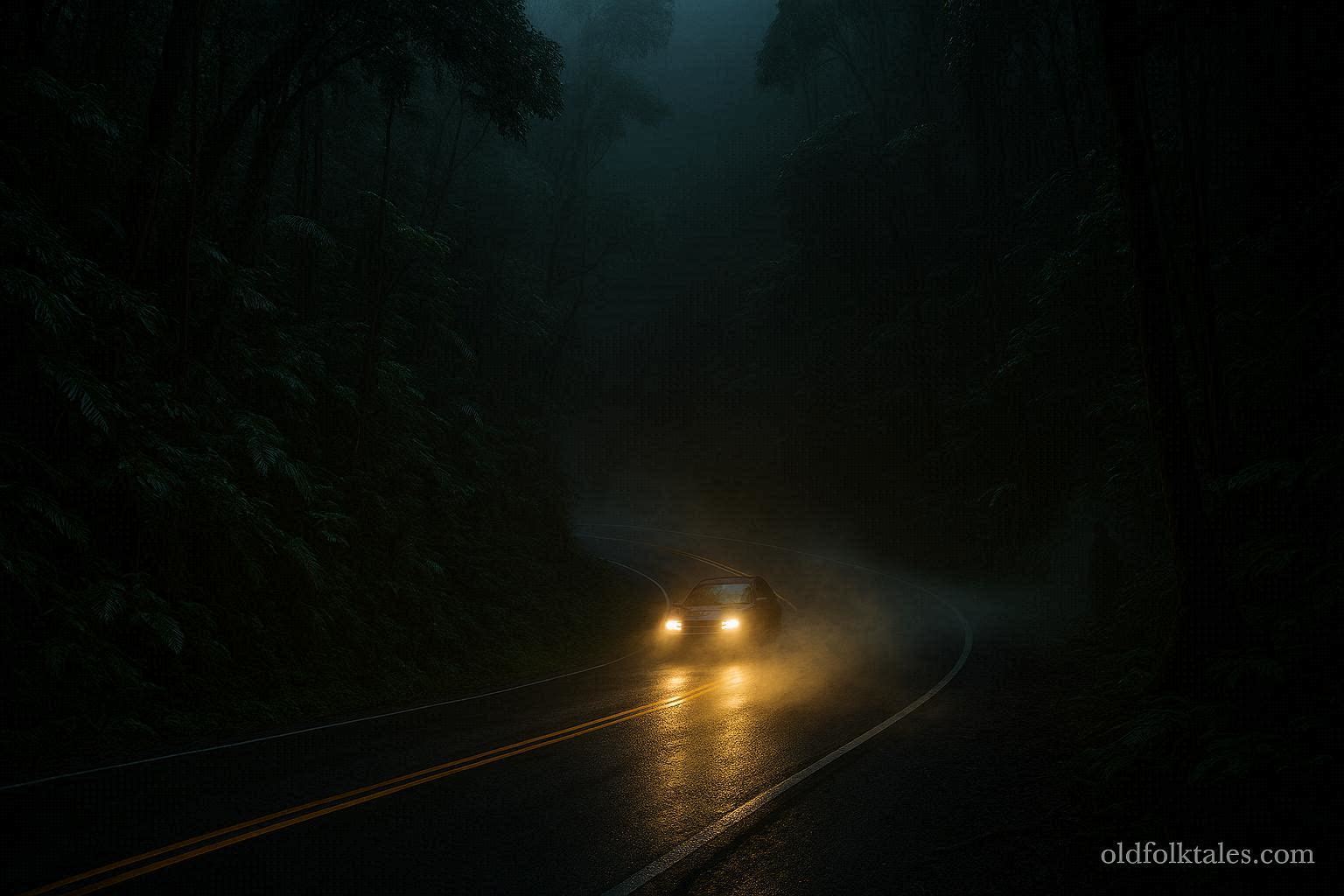
High in the lush, rain soaked mountains of Oʻahu, the old Nuuanu Pali Road winds through dense forest and steep cliffs. The air is often cool and heavy with mist drifting down from the ridges. During the day, sunlight filters through thick tropical trees, casting shifting patterns of green across the narrow pavement. Birds call from hidden branches, and the road feels like a quiet passage through untouched nature. Yet as evening approaches and shadows deepen, the atmosphere changes. At one sharp bend in the road, a place known as Morgan’s Corner, stories of tragedy and restless spirits have lingered for generations.
Morgan’s Corner is not marked by large signs or dramatic landmarks. It appears as a tight, dangerous curve surrounded by thick vegetation. The road slopes steeply, and visibility narrows as drivers approach the bend. In earlier decades, before modern road improvements, the curve was even more hazardous. Rain would slick the pavement, fog would roll in without warning, and headlights would struggle to cut through the darkness. Accidents were not uncommon. The danger of the road itself laid the foundation for fear long before ghost stories took hold.
The name Morgan’s Corner is widely believed to be connected to a tragic crime involving a law enforcement officer whose body was reportedly discovered near the area many years ago. The violent nature of the incident deeply disturbed the community. News of the event spread quickly, and the location became associated with sorrow and shock. Over time, the memory of that tragedy blended with other reports of accidents and deaths along the roadway. The bend was no longer just a difficult turn in the mountains. It became a place whispered about after sunset.
Explore the heart of America’s storytelling — from tall tales and tricksters to fireside family legends.
As years passed, additional stories emerged. One of the most enduring legends speaks of a young couple who disappeared after driving along the road late at night. In some versions of the tale, their car was found abandoned near the bend with no sign of struggle, the doors left slightly open as though they had stepped out and never returned. In other retellings, only fragments of evidence were discovered, leaving their fate unknown. Official records confirm that accidents and violent incidents occurred along Nuuanu Pali Road, but the precise details of the couple’s disappearance have become blurred by retelling. The uncertainty itself feeds the mystery.
Drivers who travel the road after dark often describe unsettling experiences. Some report hearing faint cries drifting through the forest, sounds that resemble distant sobbing or desperate calls for help. Others speak of seeing a shadowy figure standing near the trees just beyond the reach of their headlights. The figure is usually described as still and silent. When drivers slow down or blink in disbelief, the shape vanishes into darkness. A few individuals claim their car engines stalled briefly near the curve, restarting only after moments of rising panic.
The natural environment contributes strongly to these sensations. The forest surrounding Morgan’s Corner is thick and alive with movement. Wind pushes through tall trees, creating low moaning sounds that echo across the valley. Branches sway and scrape against one another. Small animals dart through undergrowth, their movement amplified in the stillness of night. Mist gathers quickly, distorting light and shape. A distant rustle can sound like footsteps. A bending tree can resemble a human figure for a fleeting second. In such an environment, imagination can easily awaken.
Cultural beliefs in Hawaii add another layer to the legend. Traditional Hawaiian spirituality holds deep respect for spirits and ancestral presence. Places connected to sudden or violent death are often approached with caution. It is believed by some that strong emotional energy can linger in certain locations. While Morgan’s Corner is a modern roadway rather than an ancient sacred site, the concept that tragedy leaves an imprint resonates strongly within local tradition. The haunting narrative grows naturally from this cultural understanding.
Teenagers and thrill seekers have long treated Morgan’s Corner as a place of daring. Stories circulate in schools and communities about late night challenges to drive the curve after midnight. Some groups claim to have heard unexplained whispers carried on the wind. Others insist they felt a sudden drop in temperature inside their vehicles. Whether these experiences are shaped by suggestion or by something less easily explained, the storytelling continues to renew itself with each generation.
Skeptics point to rational explanations. Old roads are naturally dangerous. Human memory tends to amplify dramatic details over time. Fear can heighten the senses, turning ordinary forest sounds into imagined cries. The mind, when primed with knowledge of tragedy, may interpret shadows as figures and silence as presence. These explanations offer comfort to some, yet they do not erase the emotional weight many feel when approaching the bend after dark.
Today, parts of Nuuanu Pali Road have been modernized, and traffic patterns have changed. Still, Morgan’s Corner remains part of local lore. The forest remains thick. The curve remains sharp. Rain still falls heavily in the mountains, and fog still gathers without warning. Drivers passing through late at night sometimes slow their speed, glancing toward the trees as if expecting movement.
Whether haunted by spirits or by memory alone, Morgan’s Corner stands as a powerful example of how real events shape storytelling. Tragedy, danger, environment, and cultural belief have woven together to create one of Hawaii’s most enduring road legends. The bend in the road may be ordinary in daylight, but once darkness settles over the mountains, the stories return with the mist, reminding all who pass that some places hold echoes of the past long after the events themselves have faded.
Click to explore all American Ghost Stories — haunting legends of spirits, lost souls, and mysterious places across the U.S.
Moral Lesson
The legend of Morgan’s Corner teaches that places connected to tragedy deserve respect and thoughtful remembrance. Fear may grow from imagination, but it often begins with real human loss that should never be forgotten.
Knowledge Check
- On which Hawaiian island is Morgan’s Corner located?
It is located on Oʻahu. - What type of location is Morgan’s Corner?
It is a sharp and dangerous bend on Old Nuuanu Pali Road. - What tragic event helped give the bend its name?
A violent crime involving a law enforcement officer was connected to the area. - What do some drivers claim to hear near the bend at night?
They report hearing eerie cries or distant sobbing sounds. - Why is the road naturally hazardous even without ghost stories?
Because it is narrow, steep, sharply curved, and often covered in mist or rain. - How have cultural beliefs influenced the legend?
Beliefs about lingering spiritual energy in places of tragedy have shaped the haunting narrative.
Source
Adapted from Hawaii state historical society archives and regional folklore collections
Cultural Origin
Oʻahu Hawaii twentieth century road legend