Long ago, in the quiet northern hills of Maine, where pine forests stretched endlessly toward the Canadian border and winter winds sang haunting songs through the valleys, there lay a deep, still lake that the locals called Deepwater. It was a place of mystery and beauty, its waters dark as midnight even under the brightest sun, its surface smooth as polished obsidian on calm days.
No one knew how far down the lake went. The oldest folks in the surrounding villages would tell you with absolute certainty that the bottom touched the very roots of the world itself. Fishermen who had spent their entire lives on those waters would shake their heads in wonder and say their weighted lines would sink down, down, down forever and never reach the end. Some claimed they’d let out two hundred feet of line, then three hundred, then five hundred, and still felt nothing but the pull of the depths drawing their hooks ever deeper into that liquid darkness.
Click to read all American Cryptids & Monsters — creatures of mystery and fear said to inhabit America’s wild landscapes.
The lake had always been there, as far as anyone could remember. Native peoples had fished its waters long before the settlers came, and they had their own stories about what lived in those unfathomable depths. But those were the old tales, half-forgotten now, whispered around dying fires on winter nights when the ice groaned and cracked across the frozen surface.
One cold October morning, when autumn had painted the hillsides in brilliant shades of crimson and gold, and the first frost had touched the grass with silver, a farmer named Jonas Pike was rowing his small wooden boat across Deepwater Lake. Jonas was a practical man, weathered and sturdy, not given to flights of fancy or superstitious nonsense. He’d lived by the lake all his forty-three years and knew its moods as well as he knew his own hands.
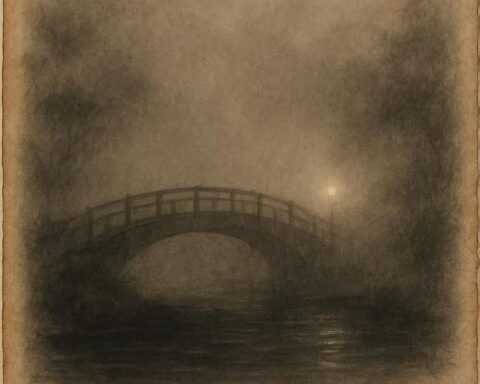
The morning mist hung heavy over the water, thick as wool, muffling all sound. Even the loons, which usually called their eerie cries across the water at dawn, were silent. Jonas pulled his oars through the glassy surface, the only sound the gentle splash and drip as the blades cut through the fog.
Then he saw it.
Rising from the foggy water, slow and graceful as a dream, came a long, elegant neck. It was pale as river stone, smooth and serpentine, easily as tall as a man standing upright. At the top of that impossible neck was a small, narrow head with eyes that shimmered like wet glass, catching what little light filtered through the mist. The creature regarded Jonas with those luminous eyes, curious but not threatening, ancient but not malevolent.
Jonas’s hands froze on the oars. His breath caught in his throat. His heart hammered against his ribs like a trapped bird. The creature made no sound at all, only rippled the mist around it like silk curtains stirring in a breeze. For what might have been a moment or might have been an eternity, man and creature looked at each other across the impossible divide between their worlds.
Then, as silently as it had appeared, the long neck curved gracefully downward and slid back into the depths, barely disturbing the surface of the water. The mist closed over the spot where it had been, and Jonas was alone again on the lake, wondering if his mind had played tricks on him in the fog.
He rowed to shore with trembling arms and ran home, his boots pounding on the dirt road, his breath coming in gasps. He burst through his kitchen door, startling his wife who was kneading bread at the table, and stammered out his story in broken, breathless phrases. “Something in the lake,” he gasped. “A creature… not of this earth… a neck like a swan but longer, so much longer… eyes that looked right through me…”
His wife listened with growing concern, wondering if her husband had taken ill or perhaps hit his head on something in the boat. When he finished his tale, she made him sit down, gave him hot tea, and suggested gently that perhaps the morning mist had created shadows and shapes that fooled the eye.
But Jonas knew what he had seen.
Word of Jonas Pike’s encounter spread through the community like ripples spreading from a thrown stone. At first, folks laughed and made jokes at Jonas’s expense. Old Man Fletcher said Jonas must have been sampling his corn whiskey before breakfast. The blacksmith suggested he’d seen nothing more than a large pike fish jumping, distorted by the fog. The schoolchildren giggled and whispered behind their hands.
But then others began to see it too.
Always at dawn, when the mist lay thickest over Deepwater Lake and the loons fell silent. Always just glimpses, never quite clear, but enough to know that something extraordinary lived in those depths.
Miss Sarah Whitmore, the schoolteacher, was rowing to the far shore to visit a sick student when her canoe suddenly slowed. She looked down and saw a massive shadow moving beneath her, something far larger than any fish that should exist in these waters. Then, gently as a whisper, something smooth and cool brushed against the bottom of her canoe. The boat rocked slightly, and the shadow glided away into the deeper darkness. Sarah’s hands shook so badly she could barely grip the oars to row to shore.
A trapper named Ezekiel Cross was checking his lines along the eastern shore at first light when he noticed a disturbance in the water about fifty yards out. A long, undulating form was moving through the lake, parallel to his position. It followed him for half a mile as he walked the shoreline, never once breaking the surface completely, but creating a distinctive wake that couldn’t be mistaken for anything natural. Ezekiel stood transfixed, watching until the creature finally turned and vanished into the center of the lake.
More sightings followed. A widow claimed she saw it from her window on a moonlit night, its form silhouetted against the silver water. A pair of boys swore they watched it catch fish, its long neck darting down with surprising speed. A minister insisted he’d seen it rise fully from the water one foggy morning, revealing a body as large as a whale before it sank back down.
The people of the Deepwater community began to call the creature Nessie, after the famous monster said to live in Loch Ness in the Scottish Highlands across the sea. Old Lila Carver, who was ninety if she was a day and claimed to remember stories her grandmother had told, said with absolute conviction, “Maybe she swam all the way here, when the oceans still spoke to each other and the world was younger. Maybe she came looking for peace and quiet, away from all those hunters and photographers in Scotland.”
The name stuck. Nessie of Deepwater Lake.
As word of the creature spread beyond the local community, outsiders began to arrive. Men came with expensive cameras and recording equipment, determined to capture proof of the creature’s existence. Hunters arrived with harpoons and nets, seeing dollar signs and fame in capturing such a beast. Scientists came with sonar equipment and theories, wanting to study and classify.
But the people of Deepwater Lake had grown protective of their mysterious resident. When strangers arrived with weapons or traps, the locals would misdirect them, sending them to the wrong parts of the lake or the wrong times of day. When photographers set up their equipment, someone would always seem to accidentally spook their shot at just the wrong moment. When scientists tried to use their sonar, they would find their boats mysteriously developing problems that required repairs.
“She’s part of this place,” the locals would say firmly. “She belongs here. She’s ours, and we’re hers. She’s not some trophy to be hunted or specimen to be studied. She’s a neighbor, and we protect our neighbors.”
The outsiders eventually gave up and went away, frustrated but unable to prove the locals were deliberately sabotaging their efforts. The people of Deepwater smiled and waved them off, then went back to their quiet lives beside the mysterious lake.
Years passed, as years do. Winters came and froze the lake solid, ice thick enough to drive a horse and wagon across. Summers melted it again, the water warming in the July sun. Children grew up and moved away or stayed and had children of their own. Jonas Pike grew old and died peacefully in his sleep. Miss Whitmore retired from teaching. Ezekiel Cross gave up trapping and took up fishing instead.
And Nessie was seen less and less.
Some said she had grown old and died, her bones resting somewhere in the unreachable depths. Others whispered that she had finally gone back to the sea, following some ancient instinct to return to the salt water from which she must have come. A few believed she had simply become more cautious, hiding herself better from the prying eyes of a changing world.
But old Lila Carver, before she died at the remarkable age of one hundred and three, shared a different theory. “She only appears to those who respect the lake,” Lila said, her cloudy eyes gazing out over the water from her porch. “Those who listen instead of hunt. Those who wonder instead of demand. She’s still there. She’ll always be there. But she chooses who sees her now.”
And perhaps Lila was right.
Because every now and then, even to this day, on a still morning when fog curls low over Deepwater Lake and the world feels hushed and reverent, someone will see a long shape gliding through the mist. The water will ripple though the air is perfectly calm. A glimpse of pale stone-colored neck. A flash of those glass-bright eyes. And then nothing, as if the vision was a gift given and then gently taken away.
When this happens, the people of Deepwater Lake smile and nod knowingly to one another. “She’s still here,” they say softly, with satisfaction and pride. “Nessie’s keeping watch over the lake. She’s still our guardian.”
And so the tale endures, passed from parents to children, from old fishermen to young ones, from teacher to student. It’s not a story of a monster to be feared, but of a guardian who crossed an ocean seeking sanctuary and found a home in America’s quiet heart, where deep waters still remember what the old world forgot: that some mysteries are meant to remain mysteries, that some creatures deserve protection rather than proof, and that the most precious things are often those we glimpse only rarely and treasure always.
Explore Native American beings, swamp creatures, and modern cryptid sightings across the country.
The Moral Lesson
This gentle tale teaches us about respect for nature, mystery, and the unknown. The people of Deepwater Lake show us that not everything needs to be captured, studied, or proven to have value. Sometimes the greatest wisdom lies in protecting what we don’t fully understand and respecting boundaries between our world and the wild. The story reminds us that communities can choose stewardship over exploitation, wonder over conquest, and that guardianship is a two-way relationship built on mutual respect. Most importantly, it shows that some treasures are meant to be glimpsed, not grasped, and that mystery itself has value worth preserving.
Knowledge Check
Q1: Who is Jonas Pike and what role does he play in this American folktale?
A: Jonas Pike is a practical, level-headed farmer who becomes the first person in the community to see Nessie. His forty-three years of living by the lake and his reputation as a sensible, honest man lend credibility to his sighting. His encounter begins the series of events that transform the community’s relationship with the lake and its mysterious inhabitant.
Q2: Why is the creature called Nessie in this American tale?
A: The creature is called Nessie after the famous Loch Ness Monster in Scotland. Old Lila Carver suggests that perhaps the creature “swam all the way here, when the oceans still spoke to each other,” implying a connection between the Scottish and American lake monsters. The name reflects both the creature’s similar appearance and the immigrant heritage of many American communities.
Q3: How do the people of Deepwater Lake protect Nessie from outsiders?
A: When hunters, photographers, and scientists arrive wanting to capture or study Nessie, the local community deliberately misdirects them, sends them to wrong locations, spoils their photographs at crucial moments, and causes mysterious equipment problems. The locals firmly believe Nessie is “part of this place” and deserves protection as a neighbor rather than exploitation as a curiosity or trophy.
Q4: What is the significance of Deepwater Lake in this folktale?
A: Deepwater Lake is portrayed as a mysterious, bottomless body of water where fishermen’s lines never reach the bottom. It represents the unknown depths of nature and serves as a sanctuary for Nessie. The lake symbolizes places in America that remain wild and mysterious, where ancient things can still find refuge from the modern world’s intrusive curiosity.
Q5: According to Lila Carver, why does Nessie appear less frequently as time passes?
A: Old Lila Carver believes that Nessie still lives in the lake but has become more selective about who sees her. She suggests that Nessie “only appears to those who respect the lake , those who listen, not hunted.” This implies that the creature reveals herself only to people who approach with reverence and wonder rather than exploitation and demands for proof.
Q6: What American values and themes are reflected in this folktale?
A: The story reflects several American values including community solidarity and protection of local treasures, respect for nature and wilderness, skepticism of outside interference, the importance of stewardship over exploitation, and the idea that some things have value beyond monetary worth. It also touches on themes of immigration and sanctuary (Nessie as a refugee from Scotland finding peace in America), the tension between scientific curiosity and reverent mystery, and the American tradition of tall tales and local legends that bind communities together.
Source: American folktale, United States (Maine)