Long ago, when the Mississippi River flowed wild and untamed through lands known only to the indigenous peoples, a shadow fell across the Illinois territories that chilled even the most fearless hearts. High above the churning waters, where limestone cliffs rose like ancient sentinels, a creature of nightmare prowled the skies. The tribes called it the Piasa Bird, and its very name was spoken only in whispers, as if saying it too loudly might summon the beast from its cliff-side lair.
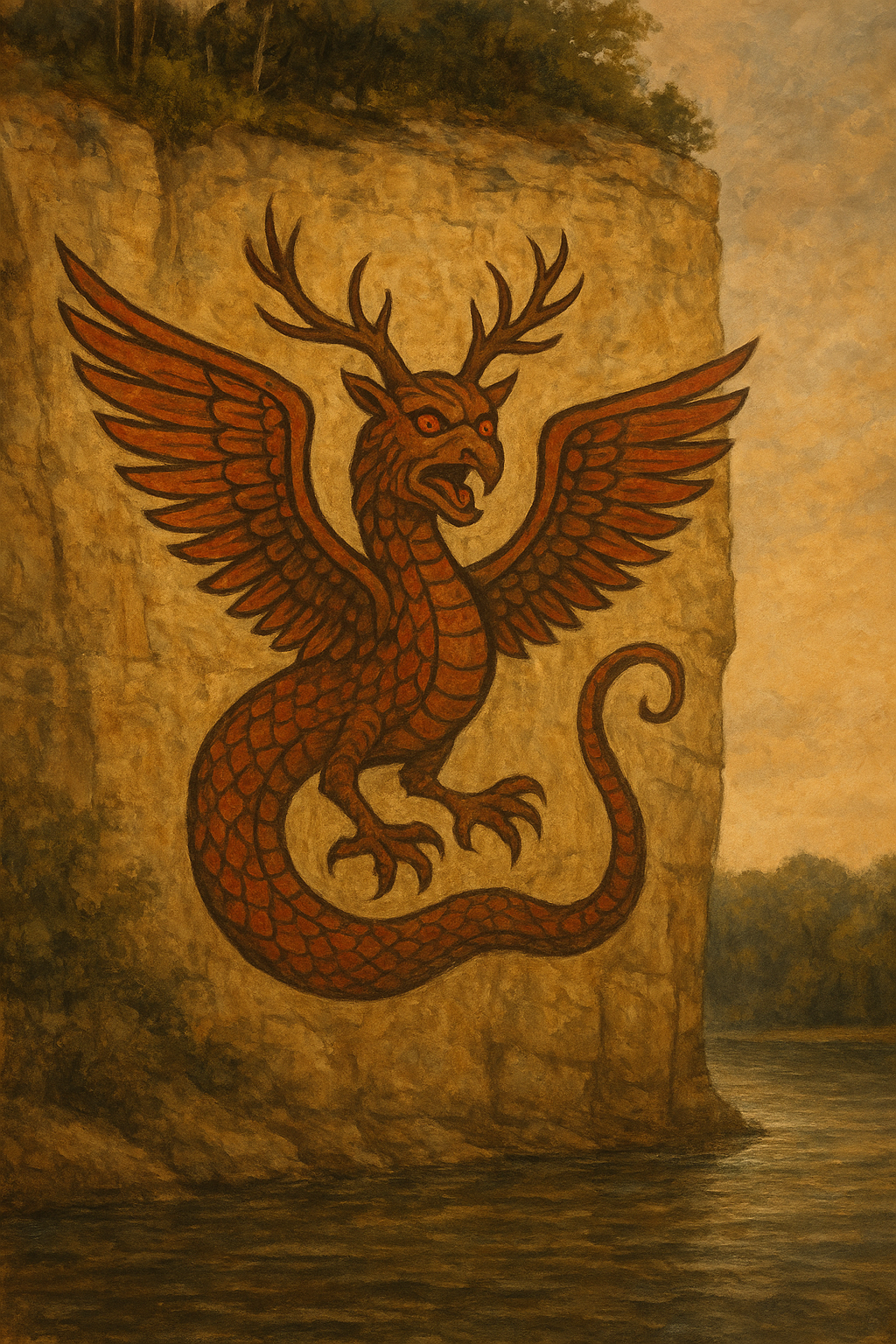
The Piasa Bird was no ordinary predator. Those who glimpsed it and lived to tell the tale described a creature that seemed assembled from the fevered dreams of many animals. Its body stretched longer than three men lying head to foot, covered in scales that gleamed like dark copper in the sunlight. A serpentine tail coiled and uncoiled behind it as it flew, thick as a warrior’s thigh and capable of crushing bone with a single strike. Massive wings, each as wide as a canoe, beat the air with a sound like thunder rolling across the water. But most terrifying of all was its face almost human in its features, with blood-red eyes that burned with intelligence and hunger, and crowned with branching antlers like those of a great stag.
Click to read all American Cryptids & Monsters — creatures of mystery and fear said to inhabit America’s wild landscapes.
The Illinois tribes had learned to fear the pattern of the Piasa Bird’s appearances. It did not hunt like other predators, swooping down on deer or fish. No, the Piasa Bird had developed a taste far more sinister. It waited and watched from its perch high on the cliffs, a patient shadow against the stone. Only after battles, when warriors from rival tribes clashed in the valleys below, would the creature descend. It circled above the aftermath of conflict, waiting for the survivors to depart, then glided down on silent wings to feast upon the fallen.
Villages along the Mississippi lived in constant dread. Mothers pulled their children inside when clouds passed over the sun, fearing the Piasa Bird’s shadow. Warriors began to question whether their battles were worth the risk, knowing that defeat meant not just death, but becoming prey for the monster that haunted the cliffs. The creature had grown bold over the years, sometimes appearing even when no battle had been fought, as if testing whether the people below had grown too frightened to resist.
Among the Illinois people lived a chief named Ouatoga, a man whose wisdom matched his courage. He had seen too many of his warriors fall, too many bodies carried away by the Piasa Bird’s talons. The grief of his people weighed upon him like stones, and he spent long nights beneath the stars, praying to the Great Spirit for guidance. How could mortal men defeat a creature that seemed born of darkness itself?
One night, as the moon hung full and bright over the river, Ouatoga fell into a deep sleep. In his dreams, the world transformed. The Great Spirit appeared before him, not in physical form but as a presence that filled him with warmth and certainty. Through visions that unfolded like smoke, the Great Spirit revealed a plan dangerous and requiring absolute courage, but offering the only hope of freeing the Illinois people from their terror.
When dawn broke, Ouatoga awakened with purpose burning in his chest. He gathered his bravest warriors, men who had proven themselves in countless battles, whose loyalty to their people outweighed their fear of death. In hushed voices, speaking only to those he trusted most, Ouatoga shared the vision the Great Spirit had granted him. The warriors listened with wide eyes, understanding that they were being asked to risk everything, but knowing that their children and their children’s children would suffer if they did nothing.
The plan was set. As the sun climbed toward its zenith, Ouatoga positioned his warriors in crevices and behind rocks along the cliff face, each man armed with the strongest bow and the sharpest arrows the tribe possessed. They made themselves invisible against the stone, barely breathing, every sense alert. Ouatoga himself stood exposed on a high outcropping, a solitary figure silhouetted against the sky deliberate bait for the monster that ruled these cliffs.
The wait seemed endless. The sun beat down mercilessly, sweat trickled down painted faces, and muscles cramped from holding perfectly still. Then, just as some began to wonder if the Piasa Bird would appear at all, a shadow passed over the sun. The temperature dropped. A sound like wind rushing through a canyon filled the air.
The Piasa Bird descended from the heights, its massive wings spread wide, its red eyes fixed on the lone figure standing exposed on the cliff. Ouatoga stood his ground, every instinct screaming at him to run, to hide, to do anything but remain still as the monster approached. The creature’s talons extended, each claw as long as a knife blade. Its serpentine tail lashed behind it. The almost-human face twisted into what might have been hunger or triumph.
At the moment the Piasa Bird committed to its dive, when escape was impossible, Ouatoga gave a piercing cry. The hidden warriors burst from their concealment as one, arrows flying like a deadly rain. The Great Spirit guided their aim, and shaft after shaft found its mark in the creature’s scaled hide. The Piasa Bird shrieked, a sound that echoed off the cliffs and made the river below seem to tremble. It writhed in the air, trying to climb back to the safety of the heights, but more arrows struck home.
The battle raged for what felt like hours but was only moments. The warriors attacked with the fury of people fighting for their very existence, and slowly, inexorably, the mighty Piasa Bird weakened. Its wing beats became labored. Its movements sluggish. Finally, with one last terrible cry that seemed to contain all the rage and hunger of its long reign over the Mississippi, the creature fell. It tumbled through the air like a broken thing and crashed upon the rocks below, where the river would eventually claim it.
Silence descended over the cliffs. The warriors emerged fully from their hiding places, hardly believing what they had accomplished. Ouatoga stood among them, his heart still racing, knowing that the Great Spirit had been with them every moment. The shadow that had darkened their lands for so long had been lifted.
To ensure that future generations would remember both the terror and the triumph, the Illinois people carved the Piasa Bird’s image into the cliff face where the battle had taken place. They depicted every detail the scales, the wings, the antlers, the almost-human face with its blood-red eyes, the serpentine tail. The carving was massive, visible from the river below, a testament in stone that would endure for centuries. It served as both memorial and warning: the Piasa Bird had once haunted these skies, a predator born of war and shadow, but courage guided by the Great Spirit had overcome even such a monster.
The river rolled on, seasons passed, and generations came and went. The carved image weathered but remained, a silent guardian of memory. Even today, when travelers pass along the Mississippi near Alton, Illinois, they can see remnants of the ancient carving, restored and preserved. Some say that on quiet evenings, when mist rises from the river and the cliffs glow in the setting sun, you can feel an echo in the air not of menace, but of ancient courage. The Piasa Bird is gone, but the story of those who faced their greatest fear and prevailed remains, carved not just in stone but in the hearts of all who hear the tale.
Explore Native American beings, swamp creatures, and modern cryptid sightings across the country.
The Moral of the Story
The legend of the Piasa Bird teaches that even the most terrifying threats can be overcome through courage, unity, and faith in higher guidance. Chief Ouatoga’s willingness to seek spiritual wisdom and trust in the Great Spirit’s vision, combined with the bravery of warriors who put their people’s welfare above their own safety, demonstrates that no evil is insurmountable when a community acts together with purpose. The story emphasizes that true leadership requires both strength and humility the wisdom to seek help from the divine and the courage to act on that guidance for the greater good.
Knowledge Check
Q1: What was the Piasa Bird in Illinois Native American folklore?
A: The Piasa Bird was a monstrous creature that terrorized the Illinois tribes along the Mississippi River. It had a scaled body longer than three men, massive wings, a serpentine tail, blood-red eyes, antlers like a stag, and an almost-human face. The creature was known for feeding on fallen warriors after battles.
Q2: How did Chief Ouatoga learn how to defeat the Piasa Bird?
A: Chief Ouatoga received divine guidance through a vision from the Great Spirit. After praying for help to save his people from the monster’s terror, he had a dream in which the Great Spirit revealed a plan to defeat the creature, which required courage and careful strategy.
Q3: What strategy did the Illinois warriors use to kill the Piasa Bird?
A: Chief Ouatoga used himself as bait, standing exposed on a cliff outcropping while his bravest warriors hid in crevices and behind rocks. When the Piasa Bird descended to attack Ouatoga, the hidden warriors emerged and attacked with arrows, guided by the Great Spirit, until the creature fell.
Q4: Why did the Illinois people carve the Piasa Bird into the cliff face?
A: The Illinois people carved the Piasa Bird’s image into the cliff as both a memorial of their victory and a warning to future generations. The carving served to preserve the memory of the terror the creature had caused and the courage required to defeat it, ensuring the story would endure for centuries.
Q5: What does the Piasa Bird symbolize in Native American culture of the region?
A: The Piasa Bird symbolizes the destructive consequences of war and violence, as it fed on the casualties of tribal conflicts. It also represents the challenges that require both physical courage and spiritual guidance to overcome, embodying the belief that faith and community unity can triumph over seemingly impossible threats.
Q6: Where can evidence of the Piasa Bird legend be found today in the USA?
A: Evidence of the Piasa Bird legend can be found near Alton, Illinois, along the Mississippi River cliffs. The original ancient carving weathered over centuries, but the image has been restored and preserved, allowing modern visitors to see the depiction of the creature that once terrorized the Illinois tribes.
Cultural Origin
This folktale originates from the Illinois Confederation of Native American tribes, particularly the Illini people who inhabited the regions along the Mississippi River in what is now the state of Illinois, USA. The legend dates back centuries before European contact, with the original Piasa Bird carving on the bluff cliffs near present-day Alton, Illinois, first documented by French explorer Father Jacques Marquette in 1673. The story reflects the spiritual beliefs of the Illinois tribes, including their reverence for the Great Spirit and the importance of visions and divine guidance in overcoming adversity. The tale has been passed down through generations and remains an important part of Illinois Native American cultural heritage and Midwest American folklore.