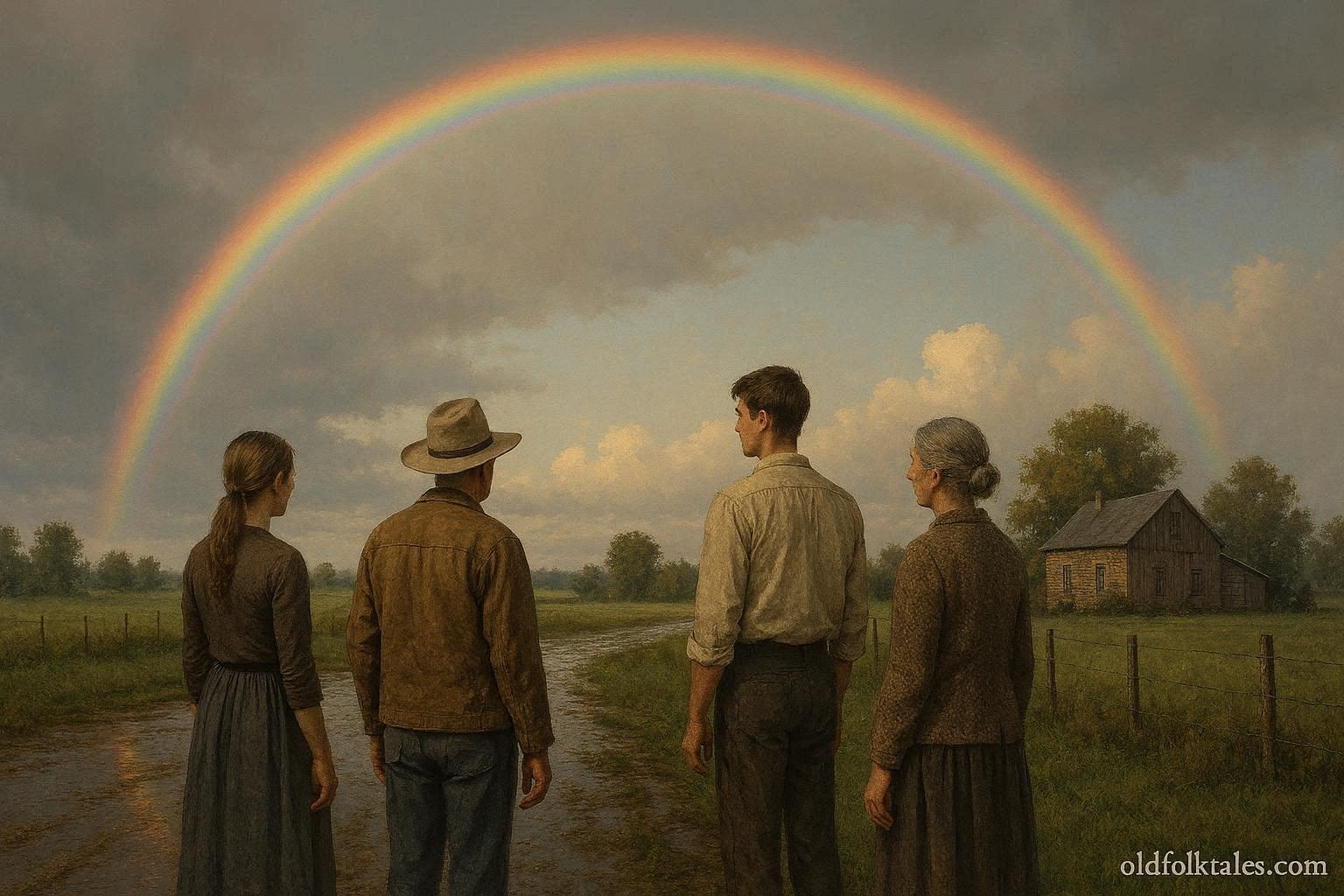
Rainbows have long held a place of wonder in American belief. Appearing briefly after storms and disappearing without warning, they have been treated not simply as weather events but as signs that something unseen had passed through the sky. Among Plains and Eastern Woodlands communities, a quiet rule followed these moments of beauty. One should never point at a rainbow.
The warning was often delivered quickly. A child would lift a finger toward the sky, and an elder would lower the hand at once. The correction was firm but calm. The act itself was believed to bring bad luck. More than that, it was said to disrupt the balance between people and the natural world.
The belief did not frame rainbows as objects meant to be claimed or called attention to. They were considered appearances rather than possessions. To point was to assert control or ownership over something that did not belong to humans. This breach of respect was believed to invite misfortune.
Discover chilling ghost tales and haunted places that echo through America’s towns and countryside.
In many Indigenous worldviews, nature was not separate from daily life. The sky, the land, and the water all carried awareness. Rainbows were understood as pathways or boundaries. Some traditions associated them with spiritual transitions, moments when worlds brushed close together.
Pointing at such a moment was thought to be disruptive. It was an intrusion into a natural process that required stillness and humility. Elders often taught that one should observe quietly and allow the rainbow to fade on its own.
The superstition served as more than a spiritual rule. It functioned as a lesson in restraint. Children learned that not everything beautiful was meant to be touched, claimed, or directed. Some things existed to be witnessed only.
Stories passed down explained the consequences. A person who pointed might experience sudden bad luck. Tools could break. Crops might fail. Illness could follow. The exact outcome varied, but the cause was always the same. Disrespect toward the natural order.
Anthropologists later recorded that similar beliefs existed across different regions, each adapted to local environments. While explanations differed, the core message remained unchanged. Nature demanded respect, especially during moments of rare appearance.
As settlers encountered Indigenous communities, the belief spread beyond its original cultural boundaries. It entered rural folklore and eventually became a superstition repeated in households with no direct knowledge of its origin.
Parents warned children without explanation. Grandparents corrected gestures instinctively. Even adults sometimes caught themselves lowering their hands mid motion, laughing nervously at their own behavior.
The superstition endured because rainbows themselves resisted explanation for centuries. They appeared suddenly and vanished just as quickly. This unpredictability made them powerful symbols. They reminded people that not everything followed human schedules or intentions.
In agricultural communities, rainbows often followed storms that could either nourish crops or destroy them. This connection strengthened the idea that rainbows marked moments of uncertainty. They were signs of balance being restored or disrupted.
To point at one was to draw attention to oneself during a moment meant for observation, not action. Silence and stillness were seen as appropriate responses.
In modern times, people may dismiss the belief as harmless folklore. Yet the behavior persists. Many still hesitate before pointing. Some choose to gesture with their whole hand instead. Others simply look and say nothing.
The superstition continues not because of fear alone, but because it reinforces a relationship with the world that values humility. It reminds people that beauty does not require commentary to be meaningful.
Rainbows still arrive without permission. They still disappear without farewell. And the old warning still echoes quietly in many homes. Look, but do not point.
Step into America’s cultural roots — from folk healing and weather lore to seasonal celebrations.
Moral Lesson
Respect for nature includes knowing when to observe quietly rather than assert control or ownership.
Knowledge Check
- What action is believed to cause bad luck in this superstition?
Pointing at a rainbow. - Which communities are most associated with this belief?
Plains and Eastern Woodlands communities. - Why were rainbows considered sensitive moments?
They were seen as natural or spiritual transitions. - What lesson does the superstition teach children?
Restraint and respect for nature. - How did the belief spread beyond its original communities?
Through cultural contact and oral tradition. - Why does the superstition still exist today?
Because it reinforces humility and careful observation.
Source
Adapted from American Philosophical Society Indigenous belief documentation
Cultural Origin
Plains and Eastern Woodlands communities