At the edge of a sunlit prairie, where tall grasses ripple and sway like ocean waves beneath an endless sky, a small falcon ruled the heavens with grace and precision. Her name was Sable, and though she was no larger than a man’s handspan, barely the size of a mourning dove, her spirit carried the boldness of eagles and hawks far bigger than herself.
The prairie stretched for miles in every direction, a golden sea broken only by scattered fence posts, gnarled cottonwood trees, and the occasional abandoned barn whose weathered boards had turned silver with age. This was Sable’s kingdom, a realm of wind and grass and infinite blue overhead. Here, she was not small. Here, she was sovereign.
Click to read all American Cryptids & Monsters — creatures of mystery and fear said to inhabit America’s wild landscapes.
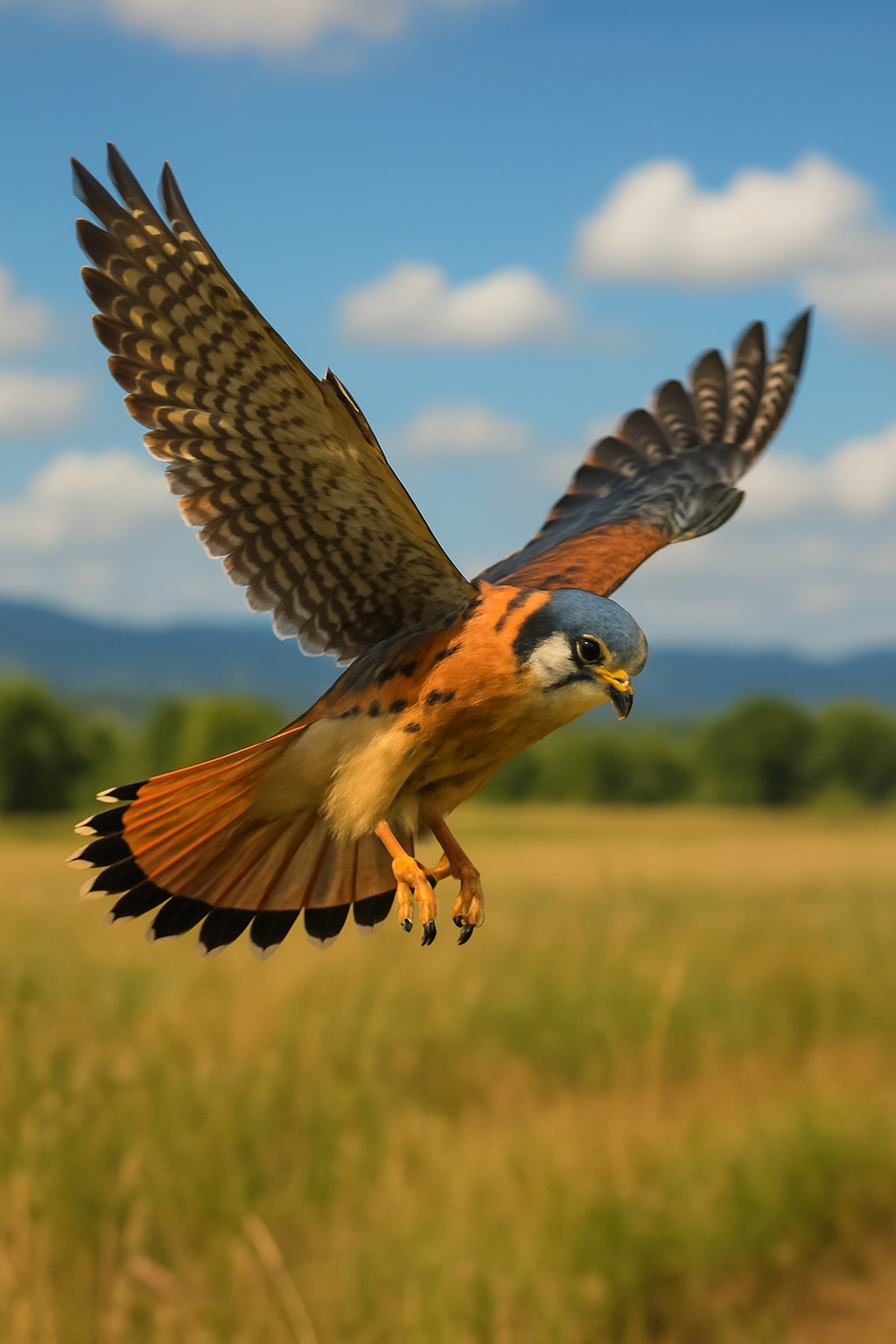
Each morning, as the horizon blushed pink and orange with dawn’s first light, Sable rose from her perch on a weathered fence post that leaned slightly toward the east. The air at this hour was still and cool, the kind that carried every sound with crystal clarity, the high-pitched chirp of crickets settling down after their night songs, the melodic flutter of meadowlarks greeting the sun, the faint rustle of a field mouse testing the morning air. With a flick of her blue-gray wings, barred with elegant black stripes, and a flash of her rusty red tail feathers bright as autumn leaves, she took to the air.
Unlike the heavier red-tailed hawks that soared in wide, lazy circles on thermal currents, or the turkey vultures that rocked on tilted wings searching for carrion, Sable possessed a gift that set her apart from all other raptors. She could stop mid-flight hovering perfectly still as if suspended by invisible strings, her wings trembling rapidly against the wind in a blur of motion, her tail fanned wide for balance. From that height, twenty or thirty feet above the swaying grass, she watched with eyes sharper than any hunter’s scope, waiting with the patience of stone.
A twitch in the grass below barely a movement, just the slightest disturbance of a blade was all she needed. Her head tilted, calculating distance and wind. In an instant, she folded her wings tight against her streamlined body and dove swift as a falling stone, silent as shadow, precise as an arrow loosed from a master archer’s bow. Her talons, though small, were needle-sharp and deadly. She struck true, and rose again with her prize clutched firmly a grasshopper, its green body still twitching, or a vole too slow to reach its burrow.
For weeks she hunted alone, mastering every current and eddy in the skies above the fields. She learned where the mice ran thickest, which fence posts offered the best view of hunting grounds, when the light was perfect for spotting prey against the golden grass. Each day she grew stronger, her timing more precise, her confidence unshakeable.
But she was not without danger in this wide-open world. Crows, those clever and vengeful birds that traveled in raucous gangs, often chased her when they spotted her with a kill. They mobbed her with harsh caws and diving attacks, jealous of her hunting prowess and eager to steal what she had earned. Though they were larger and more numerous, Sable’s speed and agility allowed her to twist and turn through the air, evading their clumsy attempts until they finally gave up and returned to their communal squabbling.
Sometimes, storms came fast and fierce from the western horizon dark walls of cloud that turned the sky green and sent the wind howling across the prairie like a living thing. Lightning split the heavens, and rain fell in sheets so thick it was impossible to see more than a few yards. During these tempests, Sable was forced to cling to a branch in one of the cottonwood trees, her feathers plastered against her body, her talons gripping the bark with all her strength as the tree swayed and groaned. Still, she endured her keen eyes never dulling, her feathers always bright and carefully preened when the sun returned.
One spring morning, when the prairie had erupted in wildflowers purple coneflowers, yellow black-eyed Susans, and delicate white prairie roses, Sable found a hollow in the top of a weathered wooden fence post. The opening was just large enough, the cavity inside dry and protected from the elements. It was perfect. She claimed it immediately, lining it with soft grasses and a few downy feathers plucked from her own breast.
There, in that simple nest, she laid her eggs four of them, each no bigger than a walnut, speckled and mottled like the earth itself, colored in browns and creams that would help them blend with the prairie should any predator peer inside. For weeks she sat, keeping them warm through cool nights and hot afternoons, leaving only briefly to hunt and eat before returning to her maternal duty.
When they hatched, her young looked nothing like the sleek hunter she was. They were all fluff and downy white feathers, their heads oversized, their eyes enormous and dark. They were noisy too, their hunger cries piercing and constant, demanding food from dawn until dusk. But in their eyes even in those first helpless days shone the same fierce glint that burned in their mother’s gaze. It was the look of the prairie’s smallest falcon, the sky dancer born to hunt on trembling wings.
Sable worked tirelessly, bringing grasshoppers, dragonflies, mice, and small birds to the nest. She taught her young by example, showing them how to tear food, how to watch the sky for danger, how to recognize the alarm calls of other birds. As the weeks passed, their fuzzy down was replaced by sleek feathers blue-gray and rusty red, marked with the distinctive face pattern of their kind: bold vertical stripes like warrior’s paint.
When summer reached its peak and the young were strong enough, they took their first flights clumsy at first, wings uncoordinated, landings awkward but each day they improved. Sable watched from her post, her work complete, knowing they would carry on the dance.
And so, as the seasons turned and the prairie grass faded from green to gold to brown and back to green again, Sable’s kind continued to dance above the meadows small, swift, and utterly fearless. To those who paused to watch her hover in the open sky, wings beating like hummingbird’s, head perfectly still as she hunted, she was not just a bird but a living reminder that greatness is not measured in size or wingspan, but in the courage to rise, the skill to hunt, and the strength to endure whatever the prairie wind might bring.
Explore Native American beings, swamp creatures, and modern cryptid sightings across the country.
The Moral of the Story
This tale teaches us that true strength and capability are not determined by physical size but by courage, skill, and perseverance. Sable, though the smallest of falcons, proves herself equal to any challenge through her determination, precision, and fearless spirit. Her story reminds us not to underestimate ourselves or others based on appearance alone, and that mastery comes from dedication and practice. In a world that often values size and power, the kestrel shows us that grace, intelligence, and persistence can be just as mighty.
Knowledge Check
Q1: Who is Sable in this American prairie folktale?
A: Sable is an American kestrel, a small falcon who lives on the prairie. Despite being no larger than a handspan, she rules the skies with skill and courage, representing the idea that greatness comes from spirit rather than size.
Q2: What special hunting ability does Sable possess that sets her apart?
A: Sable can hover perfectly still in mid-air, with rapidly beating wings, allowing her to watch for prey below with incredible precision. This distinctive hunting technique, called “wind-kestrel” behavior, makes her unique among raptors and demonstrates her mastery of the sky.
Q3: What dangers does Sable face in her prairie home?
A: Sable faces multiple threats including aggressive crows that mob her and try to steal her kills, fierce prairie storms with violent winds and rain, and the constant challenge of finding enough food to survive and feed her young.
Q4: What does Sable’s nest represent in the story?
A: The nest in the hollow fence post represents home, safety, and the continuation of her legacy. It’s where she raises the next generation, passing on her skills and fierce spirit to her young, ensuring that the sky dancers will continue.
Q5: What lesson do Sable’s young learn from their mother?
A: The young kestrels learn hunting skills, vigilance, and survival techniques through their mother’s example. More importantly, they inherit the fierce glint in their eyes the courage and determination that defines their kind and proves that even the smallest can be mighty.
Q6: What does the American kestrel symbolize in North American prairie culture?
A: The American kestrel symbolizes adaptability, precision, and the beauty of small things. In prairie ecology and folklore, these small falcons represent the balance of nature and remind us that every creature, regardless of size, plays a vital role in the ecosystem.
Cultural Origin
This nature tale originates from the American prairie regions of the United States, celebrating the American kestrel (Falco sparverius), North America’s smallest and most colorful falcon. The story reflects the prairie’s ecological heritage and the relationship between settlers, farmers, and the wildlife that shares the grasslands particularly the small raptors that help control rodent and insect populations while inspiring wonder with their aerial prowess.