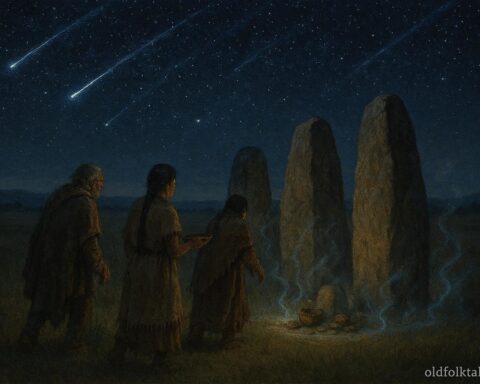
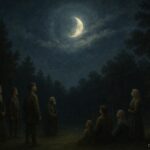
Before the land was divided by borders and paths, the people of the plains and plateau regions lived with wide skies above them. At night, the darkness was never empty. Countless stars stretched from horizon to horizon, steady and bright. Elders taught that these lights were not distant objects without meaning. They were campfires, burning high above, tended by ancestors who had crossed from the world of breath into the world of memory.
In those early times, the dead were not believed to vanish. When a person’s body returned to the earth, their spirit began a journey upward. It traveled along paths unseen during the day, rising into the night sky. There, among the stars, the ancestors gathered, lighting fires just as they once had on the ground. These fires provided warmth, guidance, and watchfulness for the living below.
The people believed that each star was a fire lit by a family line. Larger stars marked great elders, leaders, or protectors. Smaller stars belonged to those who lived quietly but faithfully. Together, they formed a great circle of remembrance. When people looked up, they were not alone. They were being watched over by generations of care.
Explore Native American beings, swamp creatures, and modern cryptid sightingsacross the country.
In one village lived a young girl named Saniyah, who often sat outside at night with her grandmother. They would wrap themselves in blankets and stare upward while the fire crackled beside them. Saniyah asked why the stars never went out. Her grandmother smiled and explained that ancestors never abandoned their fires. Even after death, they kept watch, ensuring their people were never lost.
One winter night, Saniyah’s grandmother passed away. The village mourned deeply. Fires were kept low, and voices were softened. Saniyah felt the night sky had changed, as if something familiar was missing. She sat alone after the burial, staring upward, waiting for a sign. The cold air stung her face, but she did not move.
That night, a new star appeared, brighter than the others, near the cluster her grandmother often pointed out. Saniyah felt warmth wash over her despite the cold. She knew without being told. Her grandmother had lit her campfire. From then on, Saniyah greeted that star each evening, speaking softly as if continuing their conversations.
As seasons passed, Saniyah grew older, but her belief never faded. She noticed that during times of hardship, the stars seemed brighter. When hunters were lost, elders told them to follow the ancestor fires. When travelers were uncertain, they were taught to read the sky as a map of memory. The ancestors guided through light, not words.
The people believed the stars shifted slightly as the ancestors moved about their campfires. On nights when the wind was still and the sky clear, elders said the ancestors were listening closely. These were the nights for prayer, for speaking names aloud, for asking guidance. The stars did not answer with sound, but with steadiness, reminding the living to remain grounded.
When children were born, families held them under the night sky and introduced them to the ancestors. Names were spoken, stories shared, and the fires above were acknowledged. This connection ensured that no child grew without knowing where they came from. Identity was written not only in blood but in starlight.
During times of conflict or migration, the stars became especially important. When the people were forced to move or faced uncertainty, elders pointed upward and reminded them that the ancestors had endured worse. Their fires still burned. As long as the stars remained, the people had not been erased.
Saniyah eventually became an elder herself. She told the story of the ancestor campfires to children gathered around the evening fire. She taught them to recognize patterns in the sky, explaining which stars belonged to which teachings. Some stars warned of danger. Others promised renewal. Each fire carried memory.
As she aged, Saniyah felt her own connection to the sky deepen. She no longer feared death. She knew she would not disappear. One evening, she told her family where her fire would be, pointing to a quiet space near her grandmother’s star. They nodded, understanding.
When Saniyah passed, the people gathered again beneath the night sky. They waited in silence. That night, a new star shimmered into view, steady and warm. Children whispered in awe. Elders smiled. Another fire had been lit.
Even now, the people teach that stars are not cold or distant. They are alive with memory. They burn so the living do not forget who they are or where they come from. The sky is not empty. It is full of ancestors watching, guiding, and remembering.
When people sit by their own campfires and look upward, they understand they are mirroring the ancestors. Fire below answers fire above. Life continues, held together by light, memory, and connection across worlds.
Discover celestial myths of the sun, moon, and stars — and the heroes who bridged earth and sky.
Moral Lesson
The story teaches that remembrance keeps communities strong and that honoring ancestors provides guidance, comfort, and continuity across generations.
Knowledge Check
- What are stars believed to represent in the story?
They are the campfires of ancestors watching over the living. - Why do the stars never go out?
Because ancestors continue their watch even after death. - Who was Saniyah and why was she important?
She was a girl who learned the meaning of the stars and later became an elder. - What happened when Saniyah’s grandmother passed away?
A new star appeared, believed to be her grandmother’s campfire. - How did the stars guide the living?
Through steadiness, brightness, and patterns used for direction and reflection. - What does fire symbolize both on earth and in the sky?
Connection, memory, protection, and continuity.
Source
Adapted from Library of Congress Indigenous star lore collections
Cultural Origin
Plains and Plateau Indigenous nations