Long ago, before the night sky was as we know it today, stars were not fixed in their places. They moved across the heavens like wandering spirits, bright and alive. People watched them with wonder, believing that each carried a spirit’s intention or a message from the forces above. Some stars fell closer to the earth, piercing the darkness with sudden brilliance. When these stars landed, they did not vanish. Instead, they transformed, becoming sacred stones that contained celestial power.
The people of the plains recognized that these stones were not ordinary rocks. They felt different to the touch, warmer than ordinary stone, or faintly vibrating as though alive. Elders spoke of times when the stones whispered in dreams, offering guidance or warnings. Young people were told never to take a stone lightly, for its power came not only from the sky, but from the spirits it carried. To misuse it was to invite misfortune.
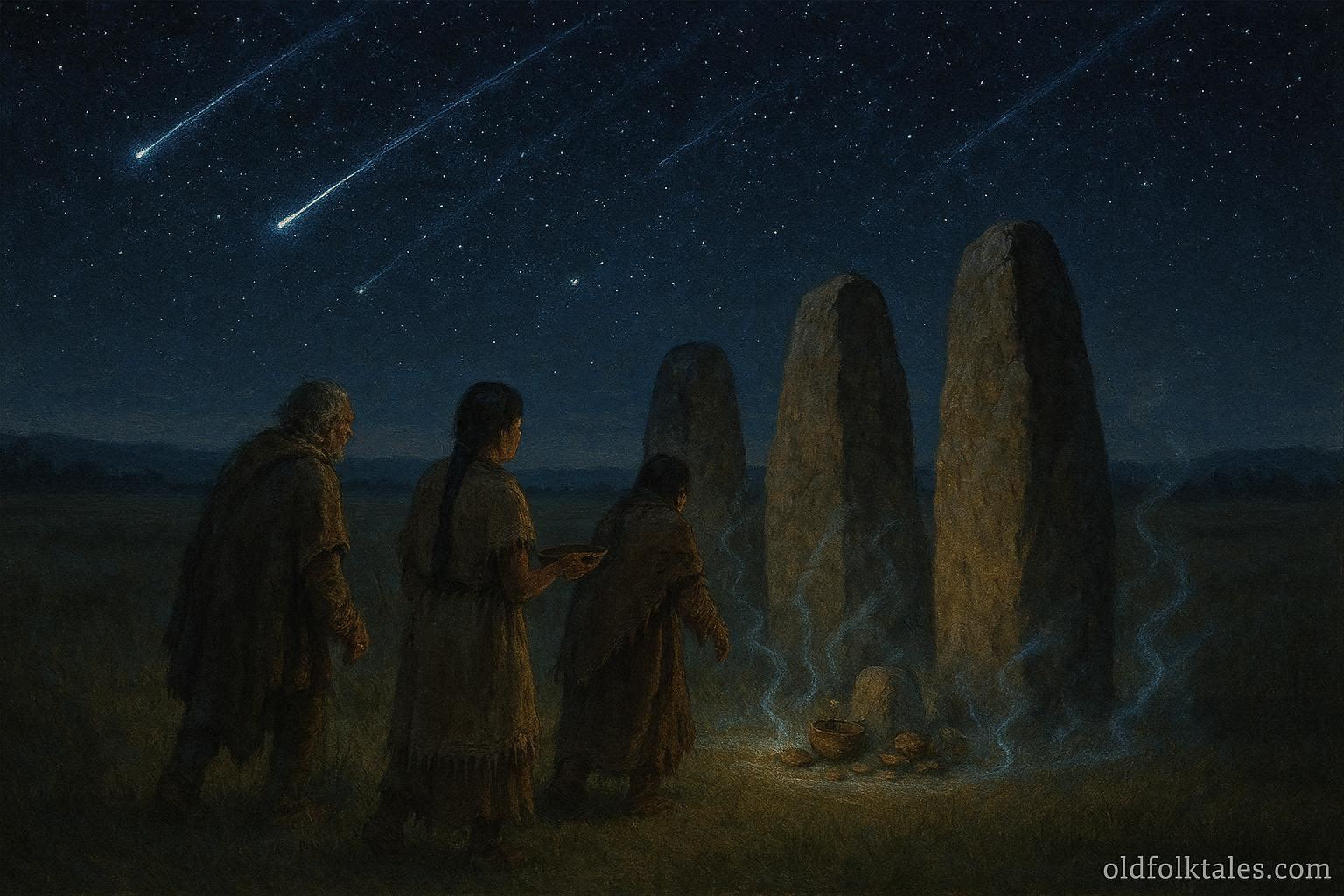
One spring, a great meteor fell near the river valley. The sky burned with fire as it crossed the horizon, drawing the gaze of every villager. People ran to the site at dawn, unsure what they would find. When they arrived, the stone lay at the riverbank, still glowing faintly with a light that was not from the sun. It seemed to hum with energy, and the wind around it shifted as if acknowledging its presence. The elders approached carefully, whispering prayers of respect.
Explore how American legends shaped the nation — from frontier heroes to Revolutionary War tales.
Among those present was a boy named Takoda, whose curiosity often surpassed his caution. He reached out to touch the stone, feeling a warmth spread through his fingers. Instantly, visions filled his mind. He saw the movements of the stars above, the rivers and mountains of the plains, and the cycles of seasons yet to come. Takoda understood that the stone was a bridge between the earth and sky, carrying knowledge that could guide the people if treated with care.
The elders decided that the stone must be protected and honored. It was placed upon a high mound and surrounded with offerings of food, feathers, and carved tokens. Songs were sung, recounting the journey of the star from the sky to earth. The people believed that each song helped the stone settle, allowing the celestial spirit within to remain calm and benevolent. Children were taught to approach it with respect, never to climb upon it, and always to bow slightly when near it.
Over time, more stones fell. Each landing was different: some sparkled with red or blue hues, others were darker and heavier than they seemed. Each stone had its own spirit, and the elders carefully recorded the circumstances of its arrival. Stories spread among neighboring villages, and rituals developed around the stones. Some were believed to bring health, others protection, and some were thought to warn of danger. Their power was not uniform, but each carried a connection to the cosmos.
The people also learned that these stones required proper care. If they were neglected or disrespected, the sky would remember. Storms might follow, rivers rise unexpectedly, or illness could spread. Conversely, when the stones were honored through song, ceremony, and offerings, the land itself seemed to flourish. Crops grew steadily, animals remained nearby, and the community felt balanced. The stones were seen as a living contract between the people and the heavens.
Takoda grew to become a respected elder, teaching the younger generations about the stones’ origin and proper handling. He shared the story of the first stone he touched, emphasizing the importance of respect, patience, and attention to the signs of the sky. He reminded children that the falling stars were gifts, not toys, and that celestial power could be shared wisely only with those who understood its significance.
One year, a meteor storm lit the plains, with multiple stones falling over several nights. Villagers gathered, setting fires and chanting songs to greet each stone respectfully. Each stone was handled according to the teachings: examined for its energy, surrounded with offerings, and allowed to rest before being moved to its place of honor. It was said that the collective respect of the people ensured that the stones retained their sacred power.
As generations passed, these sacred stones became central to the cultural identity of the plains people. They were used in ceremonies to bless new settlements, to guide hunters, and to mark significant events. They were also employed as teaching tools, helping children learn about the cycles of the sky, the seasons, and the consequences of action and inaction. Stories of stars falling continued to inspire songs, dances, and visual art.
Even today, descendants of the people tell stories of stones that fell from the sky, emphasizing that their power depends on respect and care. Visitors are reminded that while stones may appear ordinary, they are not to be disturbed casually. The sky watches, and the stars remember where they have landed. Each stone is a reminder that the universe is alive, that human action affects cosmic balance, and that some gifts are too powerful to be taken lightly.
Through these stories, the people maintain a connection to the stars. They watch the night sky with reverence, understanding that each point of light may one day choose to descend to the earth. The stones on the plains remain, not just as physical objects, but as symbols of the living cosmos, guardians of knowledge, and reminders of the delicate balance between heaven and earth.
Discover celestial myths of the sun, moon, and stars — and the heroes who bridged earth and sky.
Moral Lesson
The story teaches that gifts from the cosmos carry responsibility and must be treated with care, reverence, and wisdom to maintain harmony between humans and the universe.
Knowledge Check
- What happens to stars that fall according to the story?
They transform into sacred stones with celestial power. - Why must the stones be treated with respect?
Because neglect or misuse can bring misfortune and imbalance. - What kind of guidance can the stones provide?
Health, protection, and warnings about danger. - Who was Takoda and what did he learn from the first stone?
He was a boy who experienced visions and learned the importance of respect and patience. - How did rituals help maintain the power of the stones?
Through offerings, songs, and proper care that honored the celestial spirits. - What do the stones symbolize for the people?
The living cosmos, guardians of knowledge, and a connection between heaven and earth.
Source
Adapted from Field Museum Indigenous cosmology and material culture archives
Cultural Origin
Plains Indigenous nations