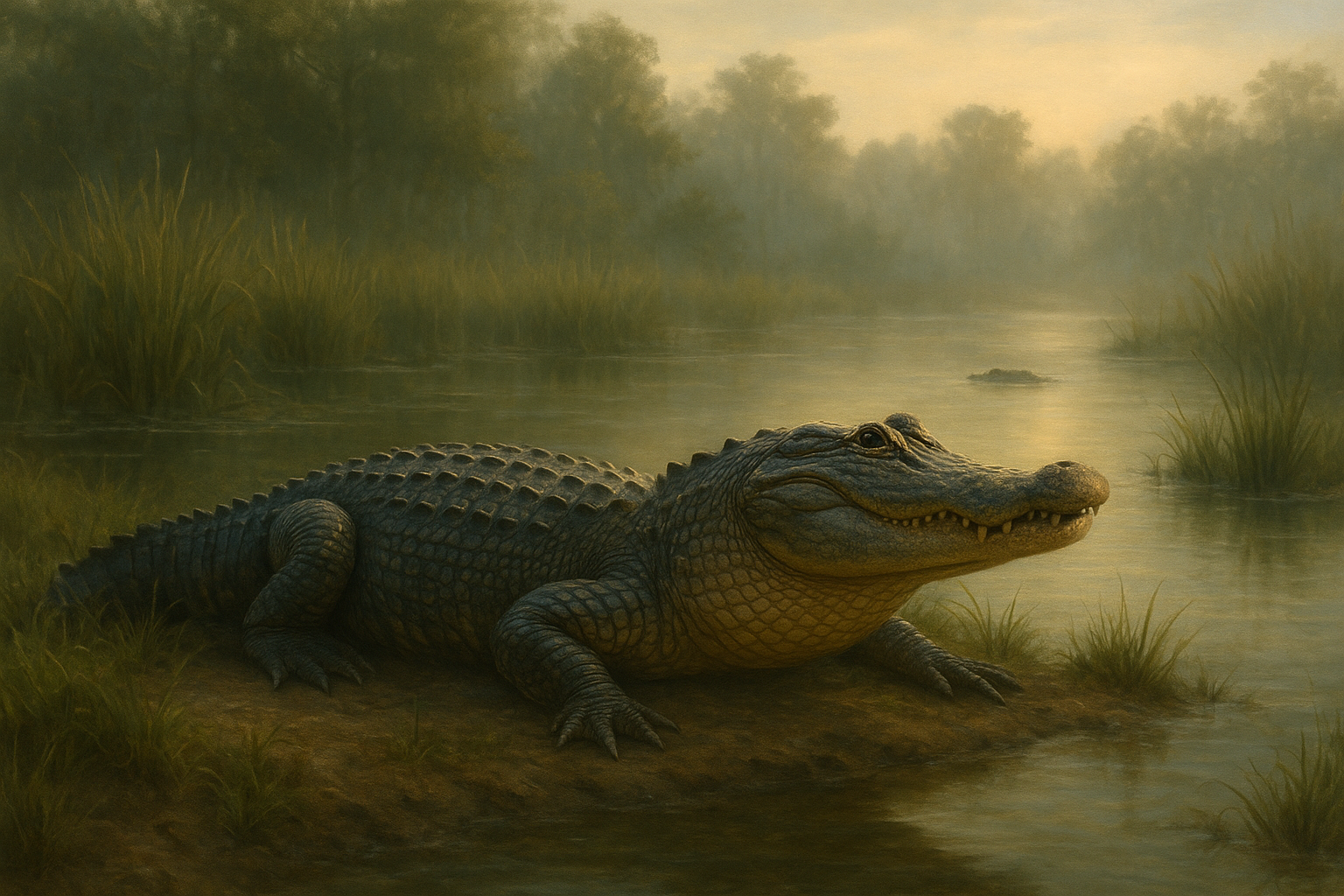
In the vast marshes and slow-moving rivers of the southern United States, where the air hangs heavy with mist and the reeds whisper secrets in the wind, lives the great alligator, the keeper of the wetlands. Spanish moss drapes from ancient cypress trees like the beards of old men, and the water moves so slowly it seems to breathe rather than flow. This is a world of shadow and light, of hidden depths and sudden movements, where life and death dance together in the muddy shallows.
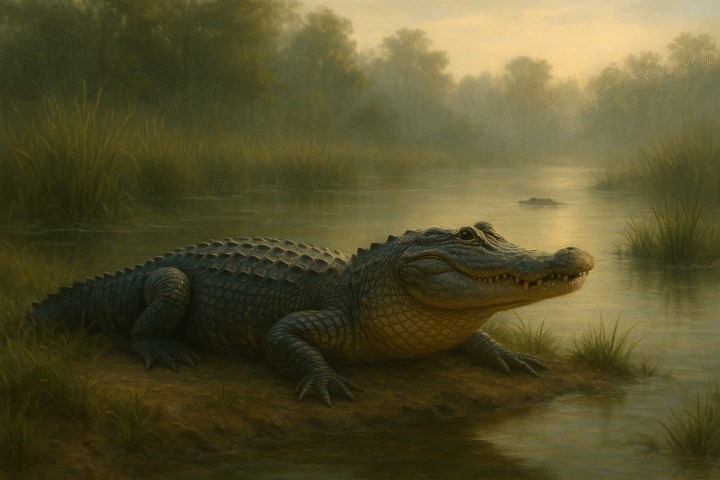
The people who have lived near these waters for generations know the alligator’s ways well. They have watched him since childhood, learning to read his moods and movements like the pages of an ancient book. They have seen him bask in the morning sun on muddy banks, his dark scales glistening like wet stone, ridged and armored like the bark of the oldest trees. They have heard his deep, thunderous bellow roll across the still water before the rain comes, a sound so primal it seems to rumble up from the earth itself, shaking the very air.
Explore Native American beings, swamp creatures, and modern cryptid sightings across the country.
The elders say that the alligator teaches the rhythm of patience, a lesson carved into the land over countless centuries. He waits motionless as a fallen log, silent as stone while fish ripple past in silver flashes and birds skim the surface on delicate feet. His eyes, barely visible above the waterline, watch everything with an ancient knowing. He understands that the river always provides for those who move with its flow, who do not rush or force, but become part of the water’s own timeless dance. And when he strikes, it is with the precision of a creature that wastes nothing, takes only what is needed, and honors the balance that keeps the wetlands alive.
Long ago, when hunters came from distant places, drawn by stories of leather and profit, they took more than they needed. They took without asking, without watching, without understanding. Nets swept through the waters. Guns echoed across the marshes. The alligators began to disappear, pulled from their ancient pools and muddy dens. And as they vanished, the marshlands began to change in ways no one had expected.
Fish grew fewer, their populations swelling and crashing without the alligator’s steady presence. The herons stopped nesting by the banks, their fishing grounds disturbed and barren. Turtles struggled to find shelter. The reeds grew thick and tangled in places, while in others the water grew stagnant and lifeless. It was then, when the wetlands began to sicken, that the people realized how much the alligator’s presence meant how deeply his life was woven into the fabric of their own.
Where he dug his resting holes deep, muddy pools excavated with powerful claws and ancient instinct these became oases when the dry season came and the water levels fell. Fish, turtles, frogs, and countless other creatures found shelter in these gator holes, surviving the harsh months because the alligator had prepared the way. His power, though feared and respected, kept the wetlands alive through drought and flood alike. He was not separate from the swamp; he was part of its very heartbeat.
So the people began to respect him not as a monster lurking in nightmares and cautionary tales, but as a guardian who had always been there, watching over the waters that sustained them all. They watched him from afar with new eyes and learned from his stillness, his patient strength, his perfect balance with the world around him. They saw how he took his place in the web of life without breaking it, how he shaped the land without destroying it.
When his low roar echoed at dawn, rolling across the mist-shrouded water like distant thunder, they said it was the voice of the swamp itself ancient, powerful, and enduring. It was a reminder that true strength is quiet, that power does not always announce itself with noise and fury. It was a song that said survival depends on harmony, on understanding one’s place in the great circle of life, on taking only what is needed and giving back in return.
Even today, those who rise early enough, who move quietly through the morning fog with reverence in their hearts, may still see him the ancient one of the water lying beneath the morning sun on a weathered bank. His eyes are half-closed, his body utterly still, as the mist drifts away like departing spirits and the day awakens around him. In his unblinking gaze, the wetlands remember what it means to endure, to persist, to belong so completely to a place that you become indistinguishable from it.
The alligator remains, as he has always remained, a living reminder carved in scales and silence.
Click to read all American Cryptids & Monsters — creatures of mystery and fear said to inhabit America’s wild landscapes.
Moral Lesson
The American alligator teaches us that true strength lies not in domination but in patience and balance. By respecting the natural rhythms of life and taking only what we need, we maintain the delicate harmony that sustains all creatures. The alligator shows us that every being has a role in the greater ecosystem, and when we remove even one thread, the entire tapestry begins to unravel. Wisdom comes from watching, listening, and understanding our place within nature rather than above it.
Knowledge Check
1. What role does the American alligator play in the wetlands ecosystem?
The alligator serves as a guardian and ecosystem engineer, creating gator holes that provide vital shelter for fish, turtles, and other creatures during dry seasons. His presence maintains balance in the wetlands food chain.
2. What does the alligator’s patience symbolize in this American folktale?
The alligator’s patience symbolizes wisdom, timing, and living in harmony with nature’s rhythms. He teaches that true strength comes from waiting, watching, and moving with the natural flow rather than against it.
3. What happened when hunters took too many alligators from the marshes?
The wetlands ecosystem began to fail fish populations declined, herons stopped nesting, and the delicate balance was disrupted. This taught people how essential the alligator was to the health of the entire marsh.
4. What is the moral lesson of the Keeper of the Wetlands folktale?
The moral teaches that every creature has a vital role in nature’s balance, and true strength comes from patience and harmony rather than domination. We must respect and protect natural guardians who sustain the ecosystems we depend on.
5. What does the alligator’s bellow represent in southern wetland folklore?
The alligator’s deep bellow represents the voice of the swamp itself , a primal reminder of ancient power, the changing seasons, and the enduring presence of nature’s guardians in the southern marshlands.
6. Where does this American alligator folktale originate?
This folktale originates from the southern United States, particularly regions with extensive wetlands, marshes, and slow-moving rivers where alligators have lived for millions of years and hold deep cultural significance.
Cultural Origin: Southern United States folklore and Native American oral traditions of the Gulf Coast and southeastern wetland regions