In the far northern reaches of New Hampshire lies Coos County, a land of dense forests, cold rivers, and long winters that seem to stretch endlessly across the mountains. Even today, the region feels remote. In the nineteenth century, it felt almost unreachable.
The trees stood thick and towering, their branches weaving together to block much of the sunlight. Snow blanketed the ground for months at a time. Small logging camps and scattered settlements clung to the edges of civilization. Beyond those fragile borders was wilderness.
And in that wilderness, settlers claimed something else lived.
They called it the Wood Devil.
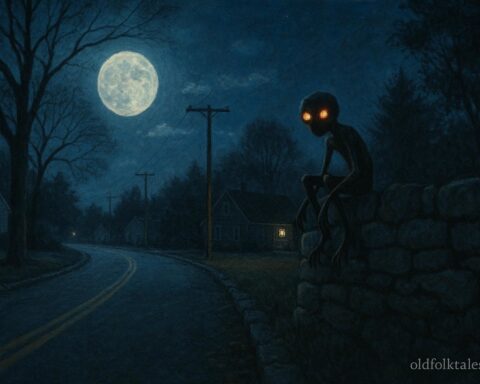
The first detailed reports appeared in the late 1800s. Lumbermen working deep in the forests of Coos County began telling stories of a strange figure seen between the trees. It was described as tall and lean, covered in dark hair, moving swiftly and silently through the undergrowth. Unlike a bear, it walked upright. Unlike a man, it never spoke.
Discover chilling ghost tales and haunted places that echo through America’s towns and countryside.
One winter evening, a group of loggers gathered inside their rough wooden cabin after a long day of cutting timber. The wind howled outside, rattling the loose boards. Snow drifted against the door. As they warmed themselves by the fire, one of the men, Samuel Dyer, swore he had seen something unusual while checking traps near the tree line.
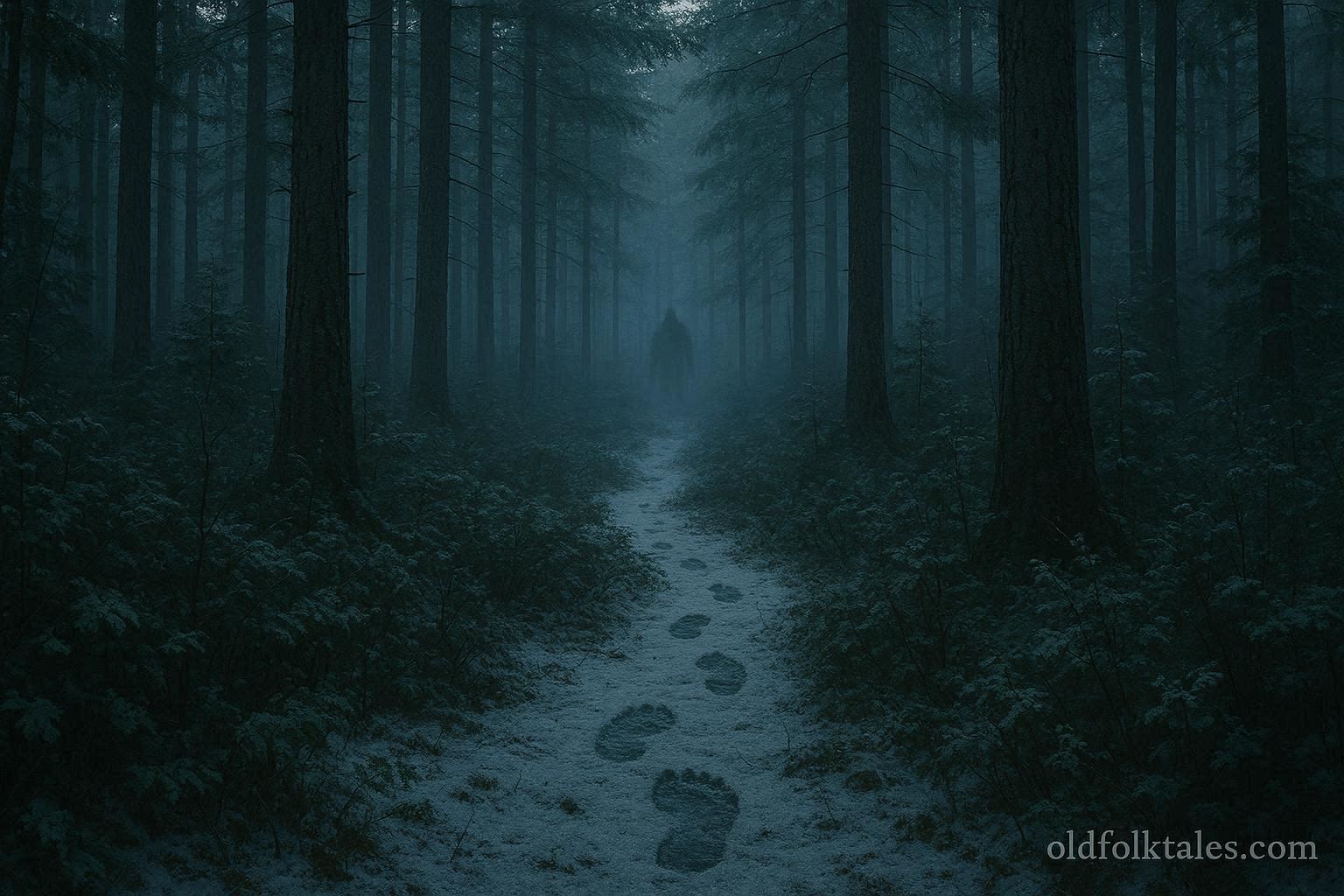
He said he noticed large footprints in the snow that did not match any animal he knew. The prints were long and narrow, spaced as though made by a tall figure walking upright. Curious and uneasy, he followed them for a short distance. That was when he saw movement ahead.
Between two pine trees stood a shape.
It was taller than any man in camp. Its shoulders were narrow but strong. Dark hair covered its body, and its arms hung longer than seemed natural. The creature did not charge or threaten. It simply watched.
Samuel described its eyes as reflective, catching the fading daylight. Then, without a sound, it turned and moved deeper into the forest, vanishing as though swallowed by shadow.
The other men listened carefully. Some laughed nervously. Others crossed themselves or muttered that the wilderness played tricks on tired minds. But within weeks, two more loggers reported similar sightings.
The Wood Devil was never described as violent. It did not attack camps or steal supplies. Instead, it kept its distance. Witnesses often spoke of feeling watched before ever seeing it. Branches would snap lightly in the distance. Footsteps would echo where no person stood.
As the legend spread through Coos County, townspeople began speculating about what the creature might be. Some believed it was a remnant of ancient folklore, a wild man spirit tied to the forest itself. Others suggested it could be an unknown animal species, adapted perfectly to the harsh climate of northern New England.
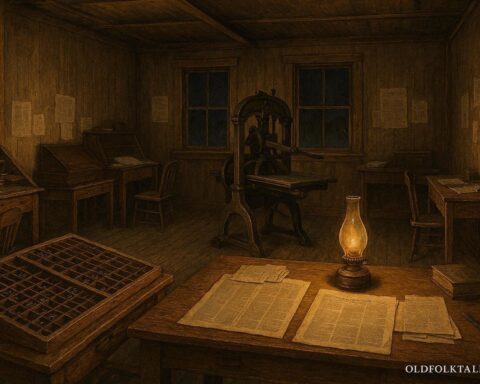
At the time, newspapers occasionally printed brief reports of the sightings. The descriptions remained consistent. Tall. Hair covered. Silent. Elusive.
One notable account came from a hunter traveling alone along the Androscoggin River. He reported seeing the Wood Devil crouched beside the water at dawn. The figure appeared to be drinking. When the hunter shifted his rifle, the creature lifted its head sharply and stared directly at him.
He said there was intelligence in its gaze.
Not animal panic. Not human fear. Something in between.
The creature then stood fully upright and stepped into the tree line with surprising grace. The hunter lowered his rifle, shaken but unharmed.
As decades passed, sightings became less frequent, though never completely absent. Some blamed the expansion of railroads and logging operations. Others believed the Wood Devil simply retreated farther north into deeper wilderness.
The legend took on new meaning as Coos County developed. For early settlers, the forest represented uncertainty and danger. Isolation was real. Harsh winters tested survival. The Wood Devil embodied that fear of the unknown.
But it also symbolized something else.
Freedom.
The creature was said to move without boundaries, untouched by property lines or human rules. It belonged fully to the forest. In a region where life was shaped by hard labor and strict seasons, the idea of a being untamed by society carried a strange fascination.
Modern explanations suggest the sightings may have been misidentified bears standing upright, wandering hermits, or exaggerated storytelling fueled by long winters and isolation. Yet even skeptics admit that the consistency of early descriptions is intriguing.
Today, Coos County remains one of the most forested regions in New Hampshire. Hikers occasionally report odd experiences deep within the woods. A sudden feeling of being observed. Footsteps that stop when they stop. Large tracks that vanish without explanation.
No confirmed evidence of the Wood Devil has ever been produced. No photographs from the nineteenth century exist. No remains have been found.
Still, the story persists.
Local historians note that nearly every heavily forested region of the United States has some version of a wild man legend. The Coos County Wood Devil stands as New England’s interpretation of that ancient archetype. A reminder that vast wilderness can inspire both fear and wonder.
On quiet mornings, when fog settles low among the trees and sunlight filters weakly through pine branches, it is easy to imagine a tall shadow moving between trunks. The forest holds its own sounds and secrets. Wind brushing through leaves can mimic footsteps. Animal calls can echo strangely across valleys.
Yet those who claim to have seen the Wood Devil insist on one detail above all others.
The silence.
They say it moves without breaking branches. Without heavy breathing. Without the clumsy noise of a bear or moose. It passes like a shadow that chooses not to be caught.
Whether the Wood Devil was a misunderstood animal, a product of frontier imagination, or a symbol born from isolation, it remains part of Coos County’s cultural memory.
The forests of northern New Hampshire are vast. Even now, there are stretches where human footprints are rare. In such places, legends survive easily.
And somewhere beyond the reach of highways and towns, beneath tall pines that have stood for centuries, some believe the Wood Devil still walks quietly, watching from the trees.
Click now to read all American Legends — heroic tales where truth and imagination meet, defining the American spirit.
Moral Lesson
The unknown often reflects our deepest fears and fascinations. Legends remind us to respect wilderness and acknowledge that not everything must be fully explained.
Knowledge Check
- Where was the Wood Devil reportedly seen?
In the forests of Coos County, New Hampshire. - How was the Wood Devil described?
As a tall, hairy figure walking upright. - Was the creature known to attack people?
No. It was generally described as elusive and nonviolent. - What did the Wood Devil symbolize for early settlers?
Fear of wilderness and fascination with freedom. - Why do some believe sightings occurred?
Because isolation and harsh conditions may have influenced perception. - Why does the legend continue today?
Because it remains part of regional folklore and identity.
Source
Adapted from New Hampshire State Library Archives
Cultural Origin
Coos County, New Hampshire