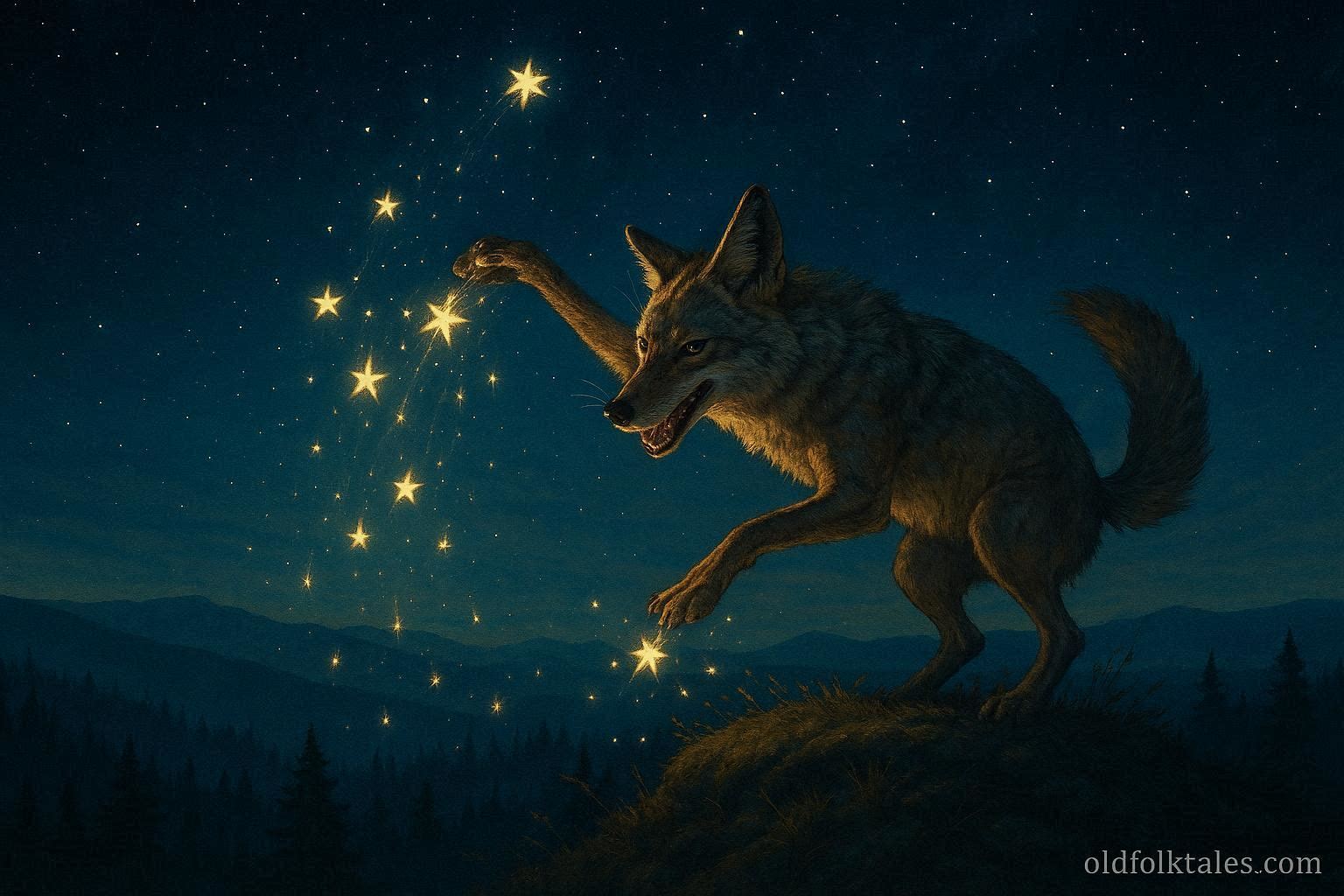
In the rolling hills and forests of Northern California, the Karuk people watched the night sky with wonder, understanding it as a living tapestry shaped by spirits and stories. Among the most memorable figures in their tales was the coyote, a clever and mischievous trickster whose actions often brought both chaos and lessons to the world. One tale recounts how the coyote once took it upon himself to organize the stars.
According to the story, long ago, the stars in the sky were scattered in a disorderly fashion, blinking sporadically and forming no recognizable patterns. The coyote, noticing the chaotic sky, decided that the stars needed his guidance. He climbed to the top of the highest hill, carrying a large pouch filled with star sparks he had gathered from the riverbeds and mountain streams. His goal was to arrange the stars in neat lines and familiar shapes, thinking this would bring order and beauty to the night sky.
The coyote began his work at dusk, moving stars with nimble paws and clever paws-like hands, but his mischievous nature quickly interfered. He would place a star carefully in one spot, only to be distracted by the flicker of another, and before he knew it, some stars had tumbled out of their intended places. The more he tried to organize them, the more the stars seemed to resist his efforts, dancing away or flipping unpredictably. His laughter echoed through the hills as the night grew darker, and the sky became a patchwork of bright points in whimsical patterns.
Explore how American superstitions and rituals still influence modern life and local traditions.
The animals and spirits watched from below, some amused and others concerned. The owl hooted softly, warning the coyote that the stars belonged to the universe and could not be fully commanded by any one being. The river spirits whispered that even the smallest ripple of water could reflect a star, showing that the celestial bodies were connected to the entire world. Yet the coyote, eager to finish his task, ignored these warnings, thinking that his cleverness alone could bring order to the heavens.
Hours passed, and the coyote grew tired but continued his work. He arranged a cluster of stars into what he thought resembled a hunting scene, then a river flowing across the sky. Every time he stepped back to admire his work, the stars would shimmer and shift, reshaping themselves into new patterns beyond his control. Frustrated, he attempted to push one particularly stubborn star into place, only for it to bounce high into the sky, scattering sparks that landed in the forests and rivers below. Those sparks, according to Karuk belief, became fireflies, the shimmering lights that dance at night and remind humans of the playful mischief of the coyote.
By dawn, the coyote stepped back, exhausted. He realized that the sky could not be controlled or ordered completely. The stars had a life and rhythm of their own, and his interference had only introduced a sense of playful chaos. Still, the night sky had become more beautiful and vibrant than ever before. The coyote laughed at his own folly, understanding that creation often involves both order and mischief, and that even tricksters contribute to the balance of the world in their own way.
From that night onward, the stars maintained patterns, constellations, and points of light that humans could recognize, but they also twinkled unpredictably, reminding the Karuk people of the coyote’s playful influence. The tale teaches that the universe has its own wisdom, that attempts to control nature may fail, and that humor, cleverness, and creativity are part of the cosmic order. Storytellers shared this tale around fires, using it to explain why the stars are arranged the way they are and why they sometimes seem to dance or shimmer without reason.
The story also reinforced respect for the natural world and the spirits inhabiting it. While the coyote’s actions were mischievous, they were not harmful; instead, they highlighted the importance of observing, learning, and adapting to the environment rather than attempting to dominate it. Children were taught to appreciate the unpredictable beauty of the night sky and to see lessons in both the successes and the playful mistakes of the coyote.
Through generations, the Karuk preserved this tale as a reminder that creation is not always orderly, that cleverness can coexist with humility, and that the world contains humor and surprises even in the most sacred and grand aspects of life. The coyote remains a symbol of learning through mischief, showing that wisdom often comes wrapped in playful challenges and unexpected outcomes.
Discover African American wisdom, Native American spirit stories, and the humor of early pioneers in American Folktales.
Moral Lesson
The story teaches that attempts to control nature can be futile, and that creativity, playfulness, and humility are essential in understanding the world. Lessons often come through challenges and mischief rather than strict order.
Knowledge Check
- Why did the coyote try to rearrange the stars?
To bring order and recognizable patterns to the night sky. - How did the stars respond to the coyote’s efforts?
They shimmered, moved unpredictably, and resisted full control. - What creation element arose from the coyote’s mistakes?
The scattered sparks became fireflies that glow in forests and rivers. - What lesson does the coyote’s failure teach about nature?
Nature has its own rhythm and wisdom that humans cannot fully control. - How did the Karuk people use this story?
To explain the arrangement and twinkling of stars and to teach children about observation, respect, and humor. - What broader value does the tale convey about trickster figures?
Mischief and playfulness can teach wisdom and reveal lessons about balance, humility, and creativity.
Source
Adapted from University of California Berkeley Folklore Archives
Cultural Origin
Karuk traditions