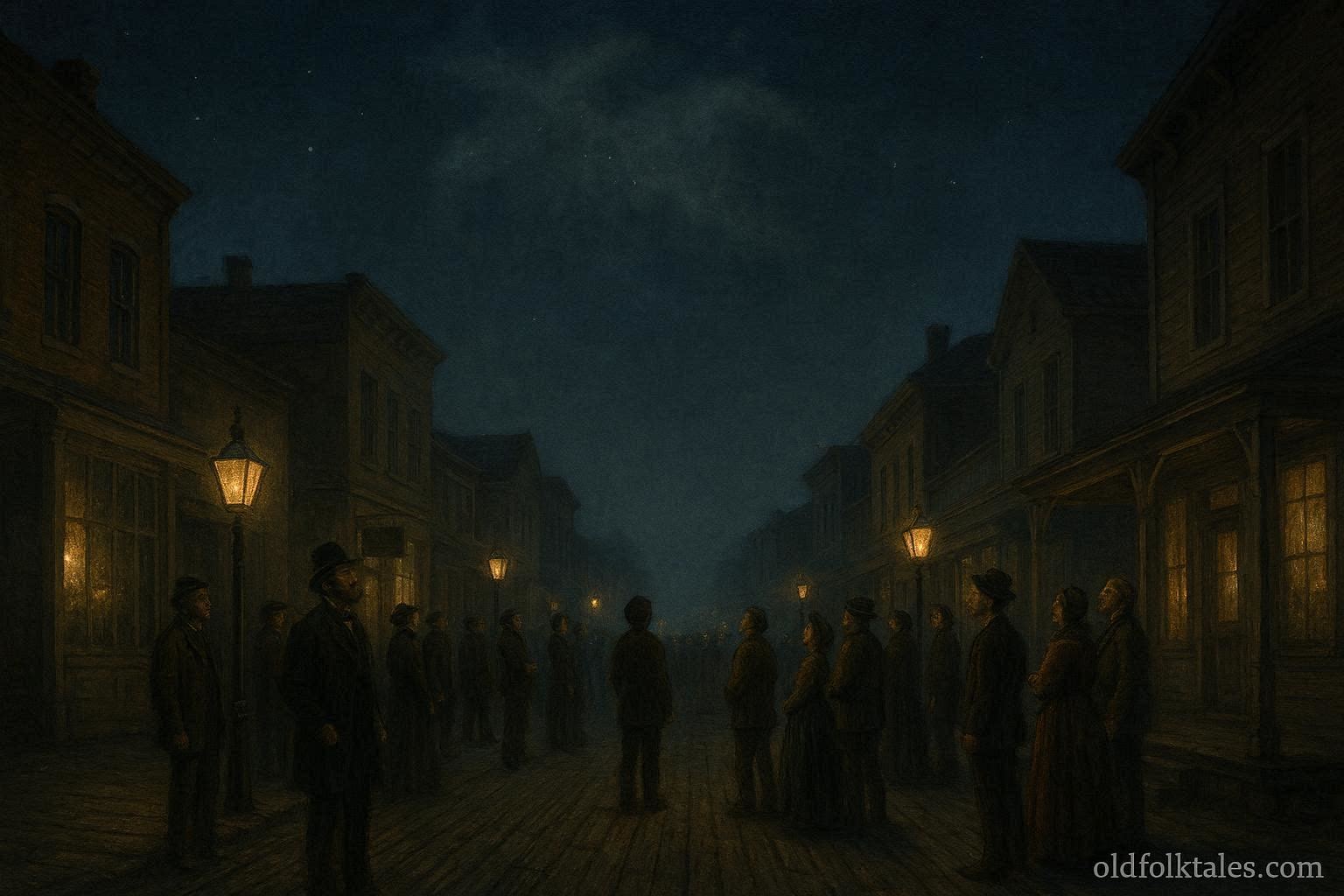
Autumn settled over Crawfordsville, Indiana in 1891 with the steady rhythm of harvest season. Cornfields stood trimmed and golden at the edge of town, and wooden storefronts lined the main street beneath the glow of gas lamps. Evenings brought neighbors onto their porches, where conversations drifted lazily through the cooling air. Life followed a predictable pattern, shaped by church bells, market days, and the dependable cycle of sunrise and dusk.
Nothing in that ordinary Midwestern routine prepared the town for what it would soon witness in the night sky.
The first sighting occurred on a calm September evening. Several men were walking near the courthouse square when something unusual caught their attention above the rooftops. At first glance, it appeared to be smoke. Yet no chimney nearby produced such a cloud, and there was no scent of fire. The shape moved with intention, gliding slowly against the darkening sky.
As it drifted closer, confusion replaced curiosity.
The object was not smoke. It was not a bird. It was not a balloon. It seemed to be a floating mass without definite form. Witnesses later described it as shapeless and shifting, almost like a giant jellyfish suspended in the air. Its outline appeared uneven, expanding and contracting as though it possessed a rhythm of its own.
Explore the heart of America’s storytelling — from tall tales and tricksters to fireside family legends.
Most unsettling were two faint glowing points embedded within the mass. They resembled eyes, dim but steady, fixed in silent observation of the town below.
The men stood motionless. One called out to others nearby. Within minutes, more townspeople gathered, staring upward. The object hovered soundlessly above them. No wings flapped. No mechanical noise hummed. It drifted with eerie calm before slowly rising and moving southward, disappearing into the night.
By morning, Crawfordsville was buzzing with discussion. Shopkeepers repeated the story to customers. Farmers spoke of it in fields. Children whispered about glowing eyes in the sky. Skeptics dismissed it as imagination or poor lighting. Believers insisted the witnesses were practical men unlikely to invent such a tale.
Then it returned.
On another evening, the floating mass reappeared. This time, a larger crowd saw it. Gas lamps illuminated anxious faces as the shape drifted once more across the rooftops. Some swore it changed form while moving, narrowing and widening as if breathing. Others thought they saw faint extensions trailing beneath it.
Fear spread more quickly than before.
Local newspapers documented the accounts carefully. Reporters interviewed witnesses separately and noted remarkable consistency in their descriptions. This was not a single excited observer telling a fanciful story. Multiple residents, standing in different areas, reported seeing the same silent drifting mass with glowing eyes.
Speculation multiplied.
Some suggested it was an undiscovered species. The late nineteenth century was an age of scientific expansion. Strange creatures were still being discovered in remote regions of the world. Could something unknown have wandered into Indiana’s skies?
Others proposed technological explanations. Hot air balloons had become more common by that time. Yet no known balloon matched the reported description. There was no basket, no flame, no pilot visible beneath it.
Religious interpretations also surfaced. A few residents wondered whether it signaled an omen. The glowing eyes disturbed many, lending the phenomenon an almost conscious presence.
One determined farmer attempted to follow it beyond town limits. Riding his horse toward open fields, he hoped to see it more clearly. According to his account, the mass seemed always to rise just beyond his reach, maintaining distance before vanishing entirely.
For several weeks, intermittent sightings continued. Groups gathered outdoors at night, scanning the sky in expectation. Some felt excitement at the possibility of witnessing it again. Others dreaded its return.
Despite widespread fear, the object never caused harm. It did not descend to the ground. It did not emit sound beyond its silent drifting presence. It simply appeared, hovered, and vanished.
Eventually, the sightings stopped.
The skies above Crawfordsville returned to their quiet normalcy. Yet the memory endured. Newspaper archives preserved detailed reports. Generations later, historians examining those clippings noted the careful documentation and multiple witness testimonies. The Crawfordsville Monster stood out among nineteenth century legends because it involved collective observation rather than isolated rumor.
Modern researchers have proposed natural explanations. Atmospheric conditions at dusk can distort perception. Dense flocks of birds moving in tight formation might create unusual silhouettes. Light refraction can produce glowing effects in clouds or mist. Still, none of these theories fully account for the consistent descriptions recorded at the time.
The legend remains significant not merely because of what was seen, but because of how the town responded. Crawfordsville in 1891 was experiencing the uncertainties of rapid modernization. Electricity was expanding into cities. Scientific knowledge was advancing quickly. Yet here was something that defied easy explanation.
The floating mass became a symbol of the limits of certainty.
It revealed how communities process mystery. Fear mingled with curiosity. Skepticism balanced belief. Neighbors gathered not only to witness the sky but to share interpretation. The event transformed from strange occurrence into shared narrative.
Today, the Crawfordsville Monster occupies a unique place in Midwestern folklore. It represents one of the earliest well documented mass sightings of an unexplained aerial anomaly in American history. The glowing eyes and drifting form remain vivid in local storytelling.
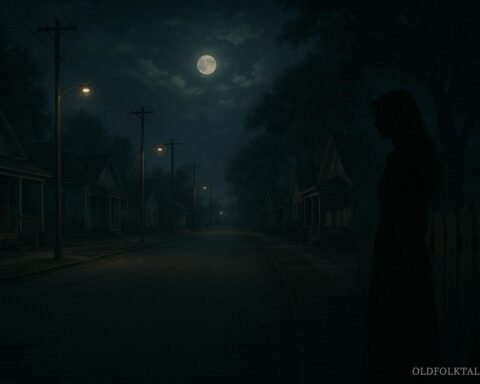
The image lingers. A quiet Indiana town beneath a starlit sky. Gas lamps flickering. Faces turned upward. Something unknown moving slowly overhead, silent and unclaimed by explanation.
Whether atmospheric illusion, unknown creature, or phenomenon lost to history, the Crawfordsville Monster continues to remind listeners that even the most ordinary communities can encounter the extraordinary.
Explore how American legends shaped the nation — from frontier heroes to Revolutionary War tales.
Moral Lesson
Mystery challenges certainty, but collective reflection transforms fear into shared history. Communities grow stronger when they confront the unknown with curiosity, documentation, and thoughtful interpretation.
Knowledge Check
- In what year did the Crawfordsville Monster sightings occur?
The sightings occurred in 1891. - How did witnesses consistently describe the aerial phenomenon?
As a floating shapeless mass drifting silently with two faint glowing points resembling eyes. - What made this event unusual compared to typical folklore sightings?
It involved multiple witnesses over repeated evenings, with consistent descriptions recorded in newspapers. - Did the phenomenon cause physical harm to the town?
No, it never caused harm and eventually disappeared without incident. - What are two possible explanations suggested by modern researchers?
Atmospheric optical illusions and tightly clustered migrating birds. - Why has the Crawfordsville Monster remained important in Indiana folklore?
Because it represents one of the earliest documented mass sightings of an unexplained aerial anomaly and reflects how communities respond to mystery.
Source
Adapted from Indiana State Library Digital Archives
Cultural Origin
Crawfordsville, Indiana