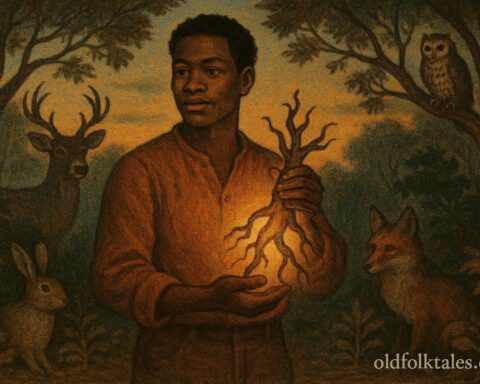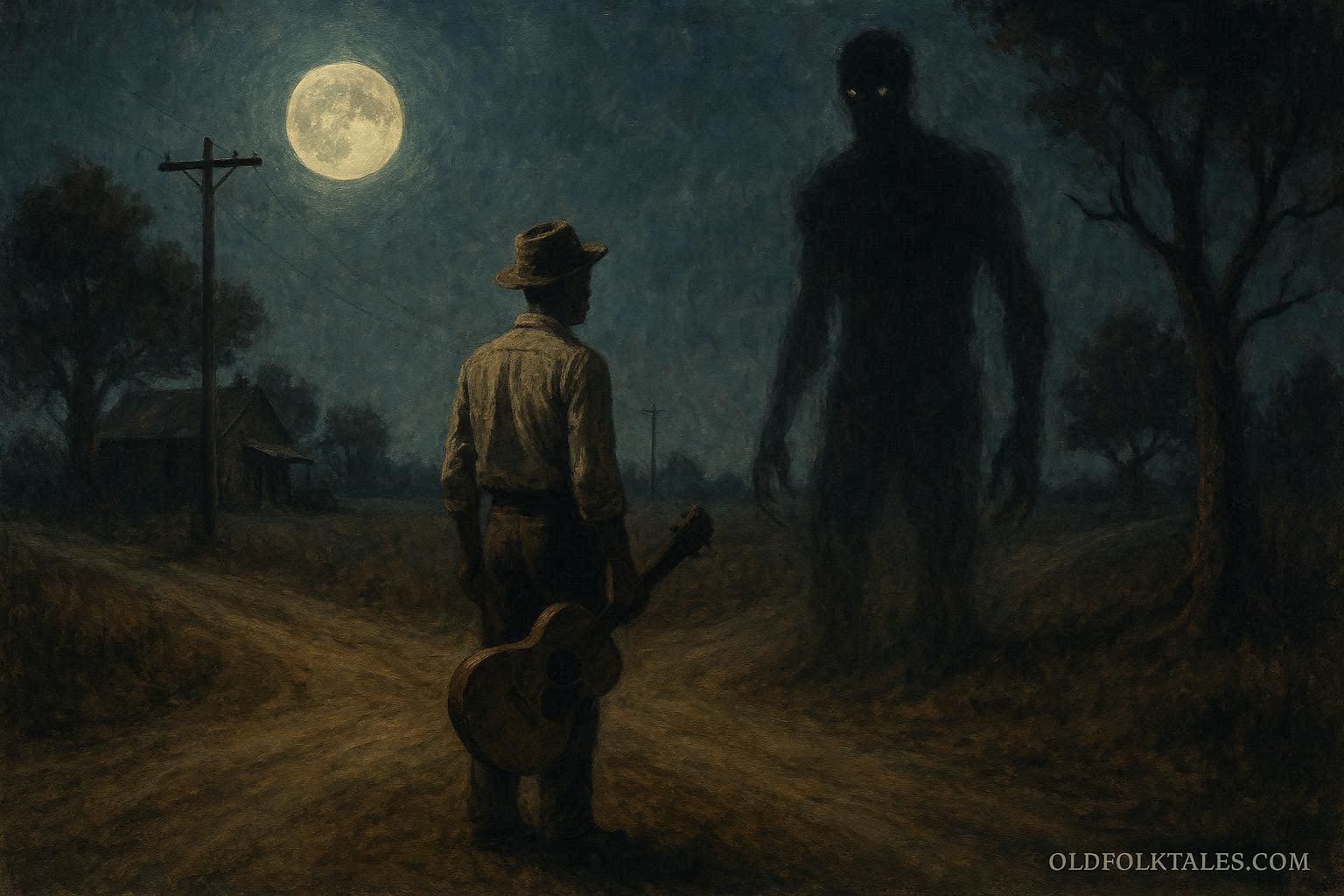
In the low country of the Mississippi Delta, where the earth lay flat and dark and the cicadas sang like restless spirits, there lived a young man named Eli Carter. Eli was known around the plantations and juke joints as a quiet soul with restless hands. He worked the fields by day, chopping cotton until his palms split, and at night he carried an old guitar whose wood was scarred like a body that had lived too long.
Music came to Eli easily, but greatness did not. He could play well enough to earn a meal or a drink, but whenever the crowds gathered around another musician, someone whose fingers seemed to dance with fire, Eli felt something twist inside his chest. He practiced until his fingers bled, sitting beneath oak trees and on sagging porch steps, repeating the same melodies until the moon climbed high. Still, his playing never crossed the invisible line between skill and wonder.
The elders noticed his hunger. They warned him quietly, not with anger but with care. They told him that music was a gift that answered only to patience and respect. They spoke of roads that should not be walked and bargains that never ended as promised. Eli nodded, but his eyes never stopped searching the dark.
Explore how American legends shaped the nation — from frontier heroes to Revolutionary War tales.
One night, after a humiliating performance where laughter followed his final chord, Eli wandered away from the juke joint and kept walking. The road stretched ahead, pale in the moonlight, until it split into four directions. The crossroads lay silent, a place where even the wind seemed to hesitate. Eli had heard stories about such places. Everyone had. Crossroads were where choices waited and where words carried weight.
Eli stood there with his guitar hanging low, heart pounding louder than the insects. He did not pray. He did not sing. He simply waited.
The air grew colder. The moon slipped behind a cloud, and the darkness thickened until it felt heavy on his shoulders. Then footsteps sounded, slow and deliberate, approaching from the shadow between the roads. A tall man appeared, dressed finer than anyone Eli had ever seen in that part of the Delta. His shoes shone without dust, and his smile showed too many teeth.
The man spoke first. His voice was smooth, like a song played backward. He asked Eli why he stood alone at a crossing meant for decisions. Eli tried to speak, but his throat tightened. When words finally came, they spilled out in a rush. He spoke of hunger and envy, of nights spent practicing and days wasted in fields, of wanting to be remembered for something other than hard labor and silence.
The man listened without interruption. When Eli finished, the stranger nodded as if hearing a familiar tune. He reached for the guitar, turning it in his hands with surprising tenderness. He tuned it slowly, adjusting the strings until the night itself seemed to lean closer. Then he handed it back.
Play, the man said.
Eli’s fingers moved before his mind could stop them. What came out was nothing he had ever played before. The sound was sharp and sweet, sorrowful and alive. Each note cut through the air like truth spoken aloud. Eli felt the music pour through him, filling every empty place. When he stopped, his hands shook.
The man smiled wider. He told Eli the gift could be his to keep, but every gift required balance. The terms were simple. Eli would play better than any man who walked the Delta, but his music would never bring peace. Every note would carry longing. Every song would pull him further from rest.
Eli hesitated. He thought of the elders and their warnings, of the quiet dignity they carried even in hardship. But the memory of laughter and hunger burned brighter. He agreed.
The man vanished as suddenly as he had arrived, leaving only silence and the crossroads behind.
From that night on, Eli’s music changed. Crowds gathered wherever he played. People swore his guitar spoke to them, naming grief they had never shared aloud. He traveled from town to town, welcomed and feared in equal measure. His songs brought tears and restless nights. Some claimed they dreamed of roads that never ended after hearing him play.
Yet Eli found no rest. Applause filled his ears, but it never filled the hollow inside him. He drank more, slept less, and avoided the elders who now watched him with sorrow rather than pride. His fingers never tired, but his spirit did.
Years passed, and the Delta changed as it always did, slowly and without mercy. Eli became a legend, whispered about in low voices. Some said he had learned his music from the Devil himself. Others said he was cursed. Eli said nothing. He kept playing, chasing something he could no longer name.
One night, older and worn thin, Eli found himself walking again, guided by habit rather than intention. The road led him back to the crossroads. He stood there, guitar heavy in his hands, and waited.
The man returned, unchanged by time. He asked Eli if the bargain had been fair. Eli tried to answer but could not find the words. The man reminded him that choices, once made, shaped the road behind and ahead alike. Then he disappeared, leaving Eli alone with the echo of his own music.
Eli never played again. He left his guitar at the crossroads and walked away before dawn. Some say he lived out his days quietly, working the land and listening instead of performing. Others say his spirit still wanders the Delta, humming unfinished songs where the roads meet.
What remains is the warning carried in every retelling. Talent gained without patience carries a weight heavier than any hunger. Desire untempered by wisdom leads to roads with no return. The crossroads listen, and they always remember.
Click to read all American Folktales — timeless oral stories passed through generations across the United States.
Moral lesson
Ambition without restraint invites consequences that talent alone cannot undo. True mastery grows through patience, humility, and respect for the unseen boundaries that protect the soul.
Knowledge check
1 What motivated Eli Carter to seek the crossroads?
His desire for greatness and frustration with his limitations drove him there
2 What did the stranger offer Eli in exchange for his gift?
Extraordinary musical skill without peace or rest
3 Why are crossroads significant in the story?
They represent choice, consequence, and spiritual transition
4 How did Eli’s music affect those who heard it?
It stirred deep emotion but brought restlessness rather than comfort
5 What warning do the elders represent?
The importance of patience and respecting moral boundaries
6 What lesson does the legend teach about shortcuts to success?
Shortcuts often carry hidden costs that outweigh their rewards
Source
Adapted from African American blues folklore archived by Smithsonian Folkways
Cultural origin
African American blues communities, Mississippi Delta