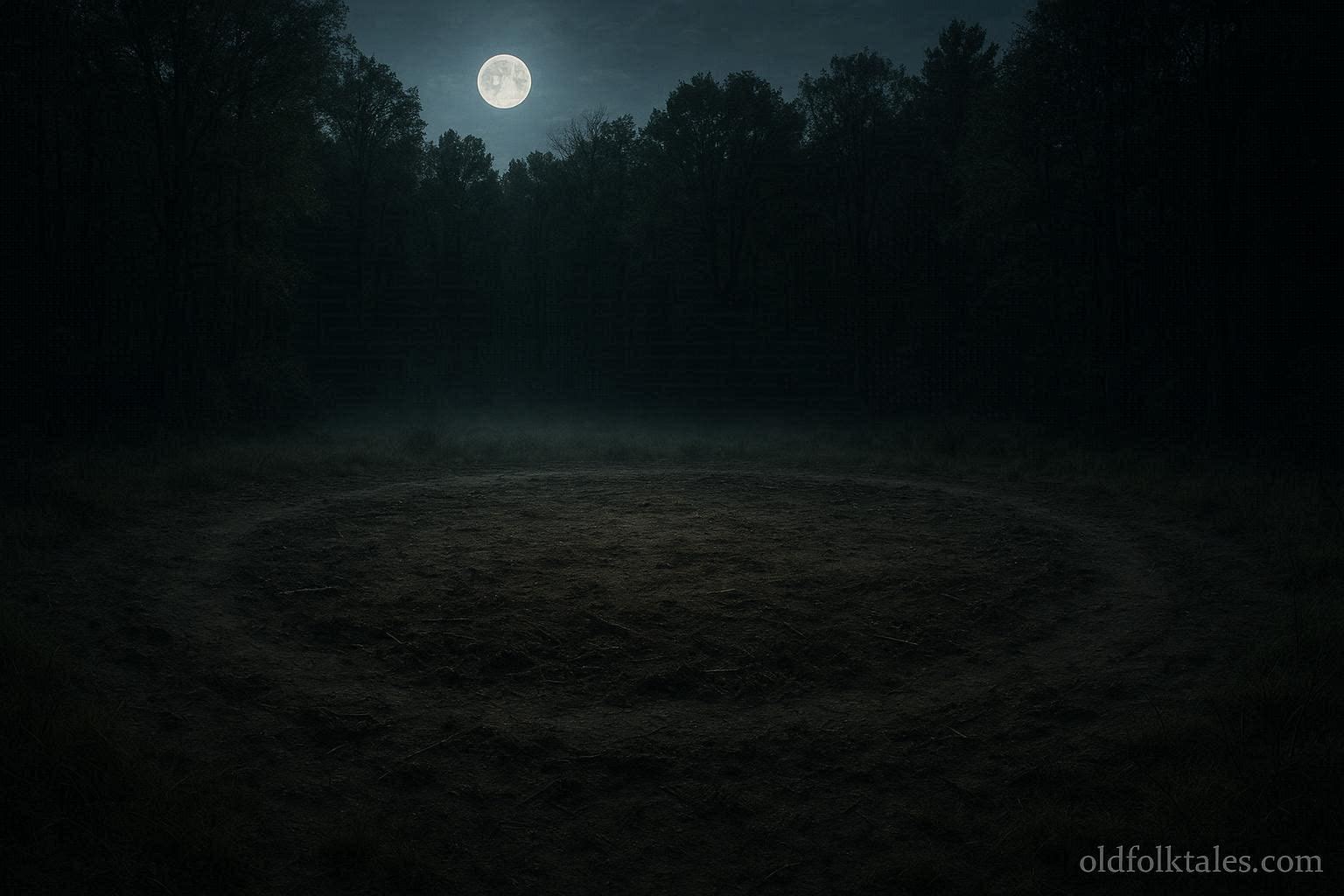
In the gently rolling countryside of central North Carolina, where pine forests meet quiet farmland, there lies a circular clearing unlike any other. Locals call it the Devil’s Tramping Ground, a name spoken carefully, often lowered to a whisper. At first glance, the place seems ordinary, no larger than a small yard. But the longer one looks, the clearer it becomes that something is deeply wrong.
The circle is perfectly bare.
No grass grows within its boundaries. No weeds push through the soil. Even after heavy rains, when surrounding fields burst with green life, the Tramping Ground remains lifeless, its dirt packed flat and pale, as though pressed down by countless invisible steps.
For generations, residents have tried to explain it.
Some say the Devil himself walks there at night, pacing the circle endlessly, plotting the ruin of souls. Others say the land is cursed by violence, injustice, or bloodshed long forgotten. A few claim it is neither Devil nor ghost, but a place where the land was wounded so deeply that it refuses to heal.
Explore the heart of America’s storytelling — from tall tales and tricksters to fireside family legends.
Whatever the cause, the effect is undeniable.
Farmers noticed long ago that crops planted too close to the circle struggled to grow. Animals refused to graze near it. Horses shied away. Dogs barked and pulled back, hackles raised. Birds flew overhead but never landed inside the ring.
More unsettling than the barren soil was what happened to objects left within it.
Curious visitors often tested the stories. A lantern placed carefully in the center at dusk would be found overturned by morning. Tools left inside the circle shifted positions overnight. Rocks arranged deliberately were discovered scattered, sometimes near the edge, sometimes clustered together as if gathered by unseen hands. Yet no footprints ever led in or out.
One story tells of a local man who, determined to disprove the legends, decided to sleep in the circle overnight. He brought a blanket, a small pack, and a confident smile. His family warned him against it, reminding him that the land had a reputation older than his pride.
By dawn, they found him outside the clearing, shaken and pale. He never spoke clearly of what happened, only muttering that the ground felt alive beneath him, as if it shifted and turned all night long. He refused to return.
Attempts to reclaim the land failed repeatedly. Fences erected around the circle leaned or collapsed within days. Plows struck resistance just below the surface, dulling blades as though striking stone. Even controlled burns failed to alter the circle’s condition. When the smoke cleared, the ground remained unchanged.
What troubled elders most was not fear, but memory.
They taught their children that the Tramping Ground was not merely haunted, but remembered. They said land holds stories the way people do. When harmed, disrespected, or burdened with wrongdoing, it does not forget. It responds.
Some elders spoke of old conflicts, boundary disputes, or violence that once occurred there. Others said the cause no longer mattered. What mattered was the lesson the place continued to teach.
Do not disturb what you do not understand.
Do not assume the land belongs to you simply because you stand upon it.
Over time, the Tramping Ground became a boundary rather than a destination. People walked around it, not through it. Children dared each other to approach the edge but rarely crossed. Even skeptics admitted that something about the circle felt wrong, as if sound itself thinned near its boundary.
Insects buzzed loudly in the surrounding grass, then fell silent near the clearing. Wind stirred leaves everywhere except inside the circle. At night, the moonlight revealed the ground smooth and unmarked, waiting.
Whether the Devil ever walked there no longer mattered. The land itself carried the warning.
The Devil’s Tramping Ground endures not as proof of a single legend, but as a reminder that places, like people, can be shaped by what happens upon them. Some scars do not fade. Some stories are written not in words, but in soil.
Step into shadowy legends of restless spirits and ghostly travelers in American Ghost Stories.
Moral Lesson
Land should be treated with respect and care, because harm done to the earth can leave lasting consequences that time alone cannot erase.
Knowledge Check
- What physical feature makes the Devil’s Tramping Ground unusual?
Answer: Vegetation refuses to grow within the circular patch of land. - What happens to objects left inside the circle overnight?
Answer: They are moved, overturned, or displaced without explanation. - How do animals typically react to the Tramping Ground?
Answer: They avoid it and show signs of fear or discomfort. - Why did elders discourage people from disturbing the land?
Answer: They believed the land remembered past wrongdoing or harm. - What lesson did the clearing teach local communities?
Answer: That land must be respected and not taken for granted. - Why does the legend persist even among skeptics?
Answer: Because the land continues to behave in unexplained ways.
Source
Adapted from University of North Carolina folklore collections
Cultural Origin
Rural Southern Appalachian communities, United States