Long ago, in the vast plains of the United States, where the grass stretches as far as the eye can see and the wind carries stories across the land, there lived a small skunk unlike any other. This skunk had always been curious, watching humans from a distance as they worked, laughed, and celebrated. The skunk observed their ways carefully, fascinated by their tools, their clothing, and the stories they shared around evening fires. Unlike the other animals, who scurried or hid from humans, this skunk felt a strange pull toward them, a desire to experience life as humans did.
One evening, as the sun dipped below the horizon and the sky filled with stars, a wise elder in the nearby village performed a ritual under the glow of a full moon. The elder was known for his knowledge of the spirits and the natural world. He could sense the balance between animals and humans and knew that some creatures had lessons to learn and gifts to share. In this particular ritual, he whispered a powerful blessing, calling for a bridge between the human and animal worlds. The skunk, drawn by the strange energy, wandered into the clearing where the ritual took place.
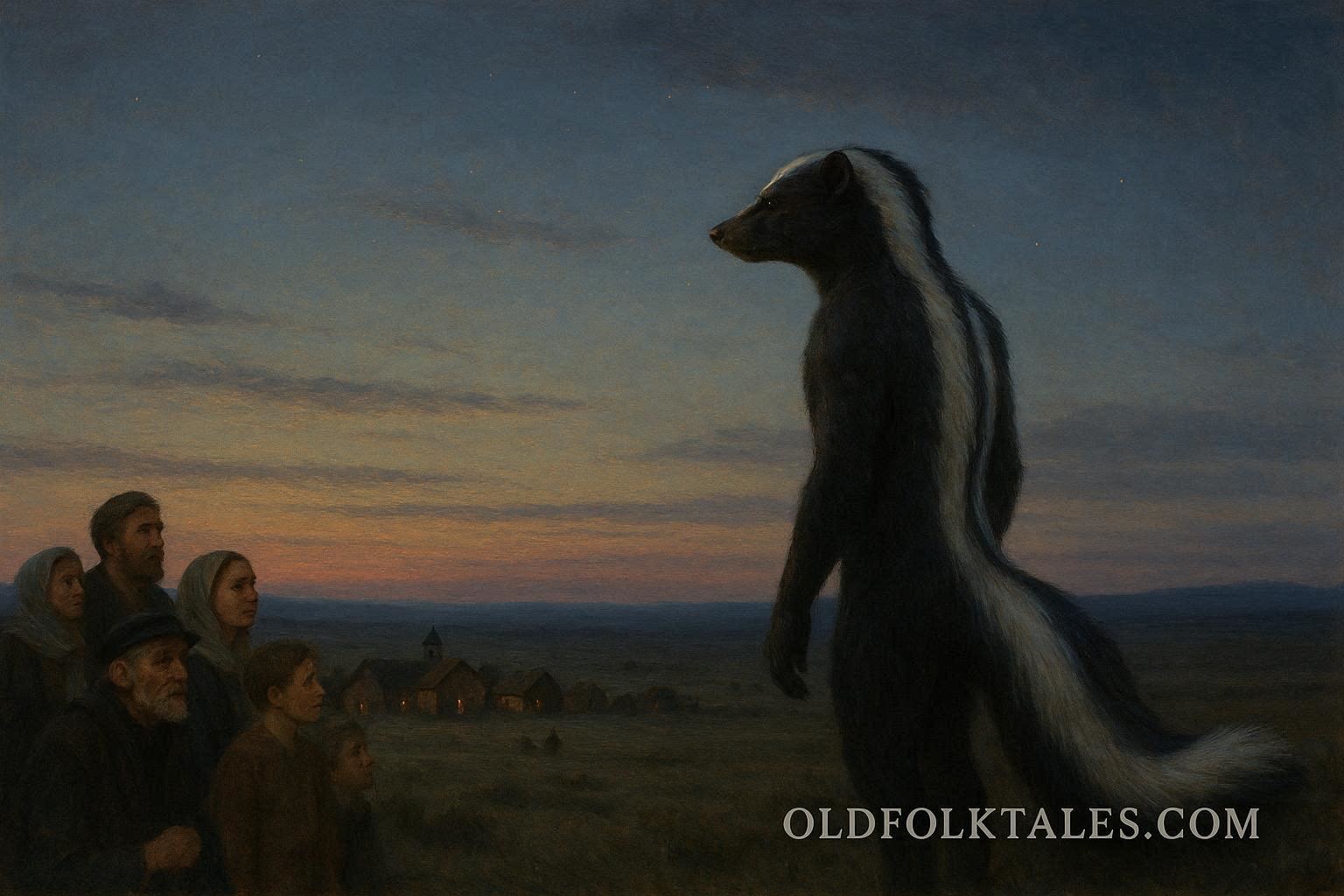
A soft light surrounded the skunk, warm and shimmering, and in the blink of an eye, it transformed. Where the skunk had once crouched, there now stood a young human, small and spry, with a hint of fur still clinging to their arms. The skunk had become a person, given the form and faculties of humans, while retaining the instincts and awareness of its animal self. Confused at first, the skunk-turned-human explored its new form, marveling at the ability to stand upright, speak, and touch objects with precision.
Discover chilling ghost tales and haunted places that echo through America’s towns and countryside.
The village soon noticed the newcomer. At first, they were cautious. Visitors who appeared without warning were often treated with suspicion. But the skunk, now in human form, showed no threat. Instead, it mimicked the behaviors it had observed for so long like greeting villagers, bowing respectfully, and participating in daily chores. The villagers, impressed by the newcomer’s eagerness to help, welcomed the transformed skunk, though some could not fully shake their sense of wonder.
Over the following days, the skunk learned quickly. It studied the villagers’ routines, understanding the tools they used to hunt, gather, and prepare food. It observed their storytelling, realizing that human life was filled with lessons and wisdom. The skunk’s transformation was more than physical; it was an immersion into a new way of understanding the world. The villagers, in turn, began to see the skunk’s unique perspective. It noticed details humans often overlooked the patterns in the wind, the subtle tracks of animals, and the shifting behaviors of the seasons.
However, the transformation was not without challenges. The skunk had instincts that sometimes conflicted with human behavior. It had to learn to control sudden bursts of curiosity, the urge to dash into the grass, and the instinct to spray when threatened. These moments caused amusement, and sometimes minor panic, among the villagers. Yet, over time, the skunk adapted, blending its natural instincts with the new human form. The villagers, patient and observant, guided it gently, teaching respect for human ways while acknowledging the skunk’s inherent nature.
As the seasons passed, the skunk-turned-human became a valued member of the village. It helped in the fields, assisted in hunts, and even participated in festivals and ceremonies. But the transformation also brought wisdom to the skunk. Experiencing human life allowed it to understand the complexity of human emotions, the bonds of family and community, and the value of cooperation. In turn, the villagers learned from the skunk’s keen senses and attentiveness to nature. Together, they achieved a harmony that neither could accomplish alone.
One day, while walking along the riverbank, the skunk felt a pull, a reminder of its original form. The elder approached and spoke of balance. “You have learned much among humans,” the elder said, “but your essence remains. You must decide if you will return to your true form or continue as one of us.” The skunk considered the question carefully. Human life had taught it valuable lessons, yet its instincts and identity as a skunk were deeply rooted. In the end, the skunk chose to retain the human form, but with a promise to always honor its animal roots, blending both worlds.
The story of the enchanted skunk spread beyond the village. Travelers and neighboring tribes heard of a unique being who had bridged the gap between animal and human worlds. Songs were sung, stories were told, and the tale became part of the cultural fabric of the plains. The skunk, now fully human but always attentive to nature, continued to guide villagers, offering wisdom, curiosity, and a reminder that transformation was not only possible but could bring understanding and harmony.
This tale, preserved in collections at the Smithsonian Institution, illustrates themes of transformation, identity, and the interconnectedness of humans and nature. It reminds listeners that wisdom can come from unexpected sources and that the ability to adapt and learn is a powerful tool. The story also reinforces the importance of balance between instinct and knowledge, nature and culture, self and community.
In the quiet evenings, when the wind whispers through the tall grasses, villagers would recount the tale of the skunk who became human. Children would imagine standing in the fur, feeling both the pull of instinct and the curiosity of human life. Elders would remind them that every creature has lessons to teach and that even the smallest or most unusual being might hold the key to wisdom. The skunk’s journey was not merely a magical event; it was a lesson in empathy, observation, and respect for the unseen threads that connect all life.
The skunk, now fully integrated into human society, carried both worlds within. It taught hunters to watch for subtle signs in the environment, reminded farmers to respect the land, and encouraged children to remain curious about the world around them. Its presence became a bridge between the known and unknown, between tradition and new understanding, and between humans and the natural world.
Ultimately, the Enchanted Skunk Transformation Story endures as a reminder that identity is fluid, learning is continuous, and that courage, curiosity, and respect for all life are qualities that enrich both individuals and communities. The tale continues to inspire, reminding listeners that sometimes the most magical transformations are those of understanding and perspective rather than form alone.
Click to read all American Folktales — timeless oral stories passed through generations across the United States.
Moral Lesson
Adaptation, respect for nature, and curiosity can bridge worlds and deepen understanding.
Knowledge Check
- Who transforms in the story?
A skunk - What form does the skunk take?
Human - What challenges does the skunk face in human form?
Controlling instincts and learning human ways - Who helps guide the skunk?
The village elder and villagers - What lesson does the village learn?
Observing and respecting nature and animals - What is the main idea of the story?
Transformation teaches wisdom and harmony
Source
Smithsonian Institution
Cultural Origin
Plains Indigenous folklore