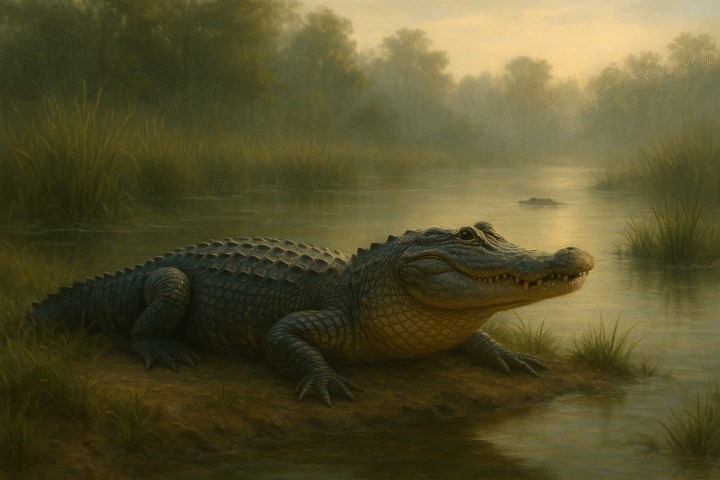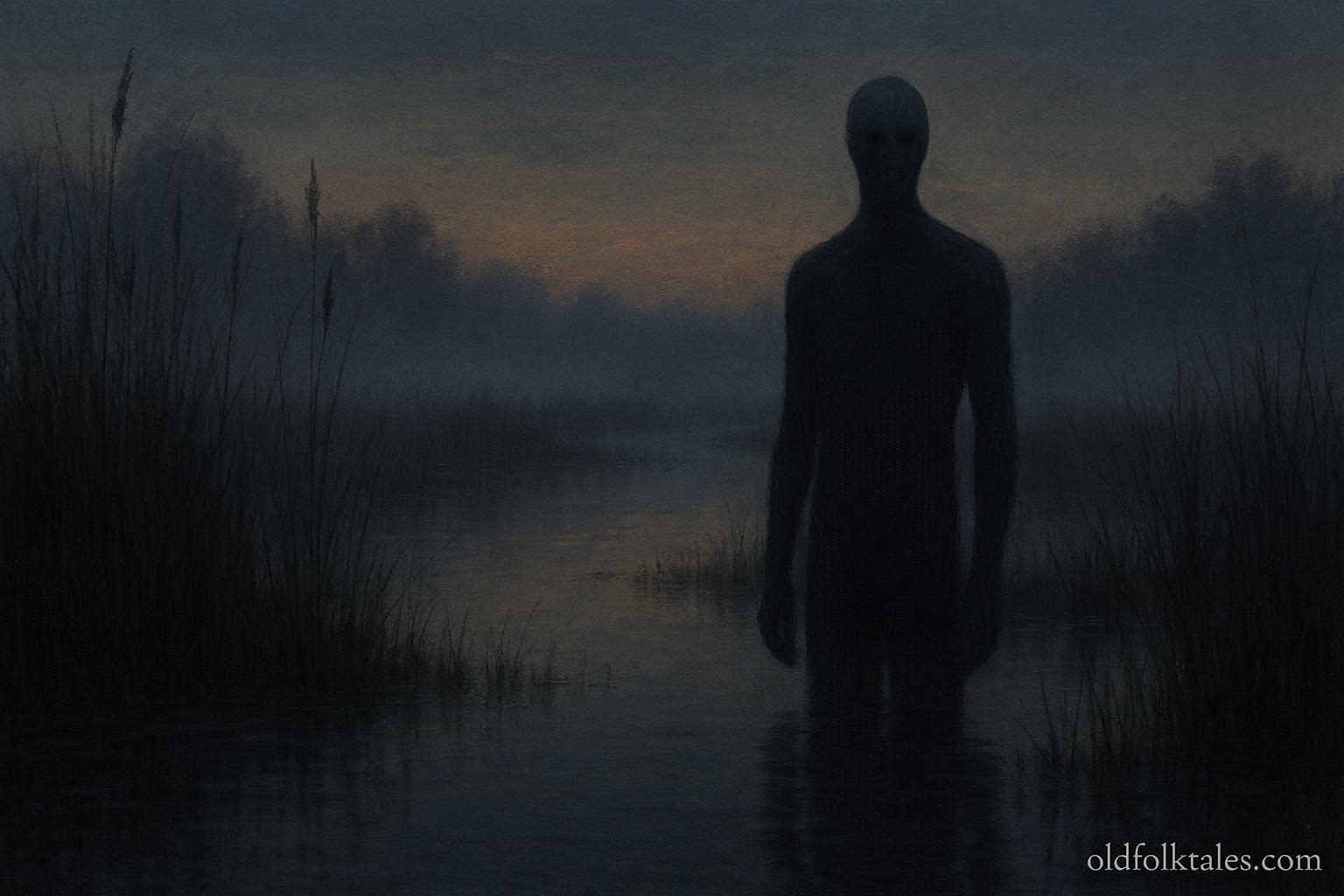
The marsh grows quiet before night arrives. Frogs pause between calls, insects hover low over dark water, and the air thickens with moisture. This brief stillness marks the hour when the land seems to watch itself. It is during this moment that people say the Faceless Marsh Walker appears.
Those who encounter the being rarely see it all at once. At first, it is mistaken for a tall figure standing among the reeds. Only when it moves does its shape become clear. The body is human in outline, upright and long limbed, moving with slow intention. When the head turns, there is no face. No eyes. No mouth. Just smooth emptiness where features should be.
Wetlands across the Southeastern regions have long been regarded as places of transition. Water and land blend together. Paths disappear beneath shallow pools. Footing shifts without warning. Elders taught that marshes demanded awareness and respect because they existed between certainty and loss. The Faceless Marsh Walker belongs to this in between space.
Explore the heart of America’s storytelling — from tall tales and tricksters to fireside family legends.
Oral traditions describe the being as silent. It never speaks, calls, or gestures. When people notice it, the figure either continues walking or stands completely still. Those who approach feel an instinctive resistance, as if the land itself discourages closeness. Witnesses often turn away without knowing why.
The Walker is most often seen at dusk. Light fades unevenly across wetlands, creating reflections that blur distance and shape. This hour is believed to thin the boundary between visible and unseen. Elders say the being does not emerge from the marsh. It is already there, becoming noticeable only when the land shifts into balance between day and night.
Children sometimes notice the Walker first. They describe a tall person standing where no one should be. When asked about its face, children pause, confused, then say there is nothing to describe. Elders believe children sense the absence rather than searching for explanation.
Adults report a different reaction. Many feel watched, though no eyes are visible. Others describe sudden disorientation, losing track of direction even in familiar areas. Hunters and travelers say they have stopped walking without understanding why, later realizing they were near unstable ground or deep water.
The being is not believed to chase or harm. Instead, it serves as a presence that enforces boundaries. Those who ignore warning signs in the marsh risk becoming lost, injured, or worse. The Walker embodies this risk. Its facelessness represents the unknown consequences of disrespecting the land.
Elders explain that the Walker does not belong to any single person or story. It is a manifestation of the marsh itself. Wetlands absorb footsteps, hide movement, and reshape paths. The being mirrors these qualities, moving quietly and leaving no trace.
Some traditions suggest the Walker appears more often near places where people vanished or were buried near the water. These sites hold memory that has not fully settled. The being stands where stories end abruptly, reminding the living that not every path leads back.
Animals react subtly to the Walker. Birds grow quiet. Fish movement stills. Dogs refuse to advance. These signs are interpreted as confirmation that the being exists within natural order rather than outside it. The land recognizes its own guardian.
Communities developed customs to avoid disturbing the Walker. People were advised not to call out at dusk, not to follow figures seen near the water, and not to mock the marsh. Silence and awareness were considered forms of respect.
The Walker is also associated with accountability. Those who enter wetlands with careless intent are more likely to encounter confusion or fear. Those who move thoughtfully often pass without incident. Elders say the being does not judge but reflects the intentions brought into its space.
Stories describe encounters where the Walker stands directly on narrow land paths, forcing travelers to stop or turn back. In these moments, the figure does not block physically. Instead, its presence creates hesitation strong enough to halt movement. Later, travelers often discover flooding or unstable ground ahead.
As development reduced wetlands, sightings became less frequent. However, in preserved marshlands, the legend persists. People still report seeing tall figures at dusk, always faceless, always silent. These stories continue because the marsh remains a place where certainty dissolves.
The Faceless Marsh Walker endures as a reminder that not all dangers announce themselves. Some exist quietly, testing awareness rather than strength. The being teaches that survival depends not on conquest but on understanding limits.
In Southeastern traditions, fear is not always meant to paralyze. Sometimes it sharpens perception. The Walker embodies this lesson. Its silence invites listening. Its facelessness invites caution. Its presence affirms that the land has its own ways of being known.
Those who respect the marsh rarely see the Walker clearly. Those who ignore its nature often do. In this way, the being does not hunt or punish. It reveals.
Click to read all American Cryptids & Monsters — creatures of mystery and fear said to inhabit America’s wild landscapes.
Moral Lesson
Respect for natural boundaries and awareness of the unknown are essential for survival and balance.
Knowledge Check
- When is the Faceless Marsh Walker most often seen?
At dusk. - What physical feature distinguishes the Walker?
It has no face. - Where does the Walker appear?
In wetlands and marshland areas. - Does the Walker communicate verbally?
No, it remains silent. - What reaction do animals show near the Walker?
They become quiet or refuse to move forward. - What lesson does the Walker represent?
Respect for boundaries and awareness of unseen danger.
Source
Adapted from University of Florida Southeastern Indigenous folklore documentation
Cultural Origin
Southeastern Indigenous nations