Before there were roads, before footprints marked the earth in repeating patterns, the land stretched wide and unbroken. Forests stood thick and endless, rivers cut their own paths through valleys, and mountains rose without clear passage around them. In those early days, moving across the land was not simple.
In the regions now known as Pacific Northwest, the people lived close to the natural world, learning its rhythms and respecting its power. They understood the direction of rivers and the position of the sun, but the land itself held no clear routes. Each journey required effort, memory, and caution.
Travel was slow.
Uncertain.
And often dangerous.
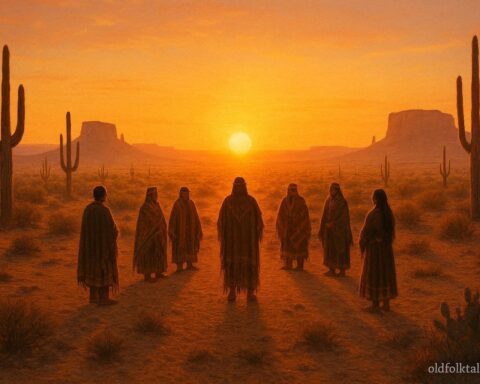
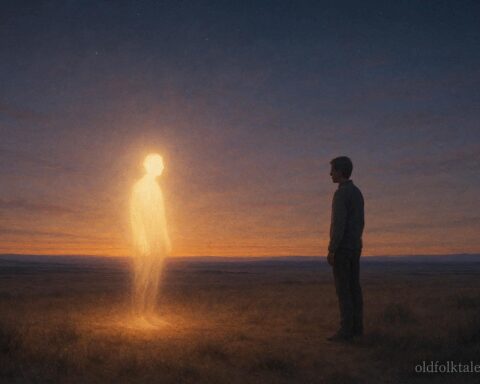
It is said that before humans began to move widely across the land, there were beings who came before them. These were not ordinary people, but figures who understood the land in a deeper way. They saw not only what was present, but what could be.
Step into America’s cultural roots — from folk healing and weather lore to seasonal celebrations.
They understood that for life to grow, for communities to connect, there needed to be a way to move.
Not just anywhere.
But with purpose.
These early beings began to walk the land.
Not wandering.
But choosing their steps carefully.
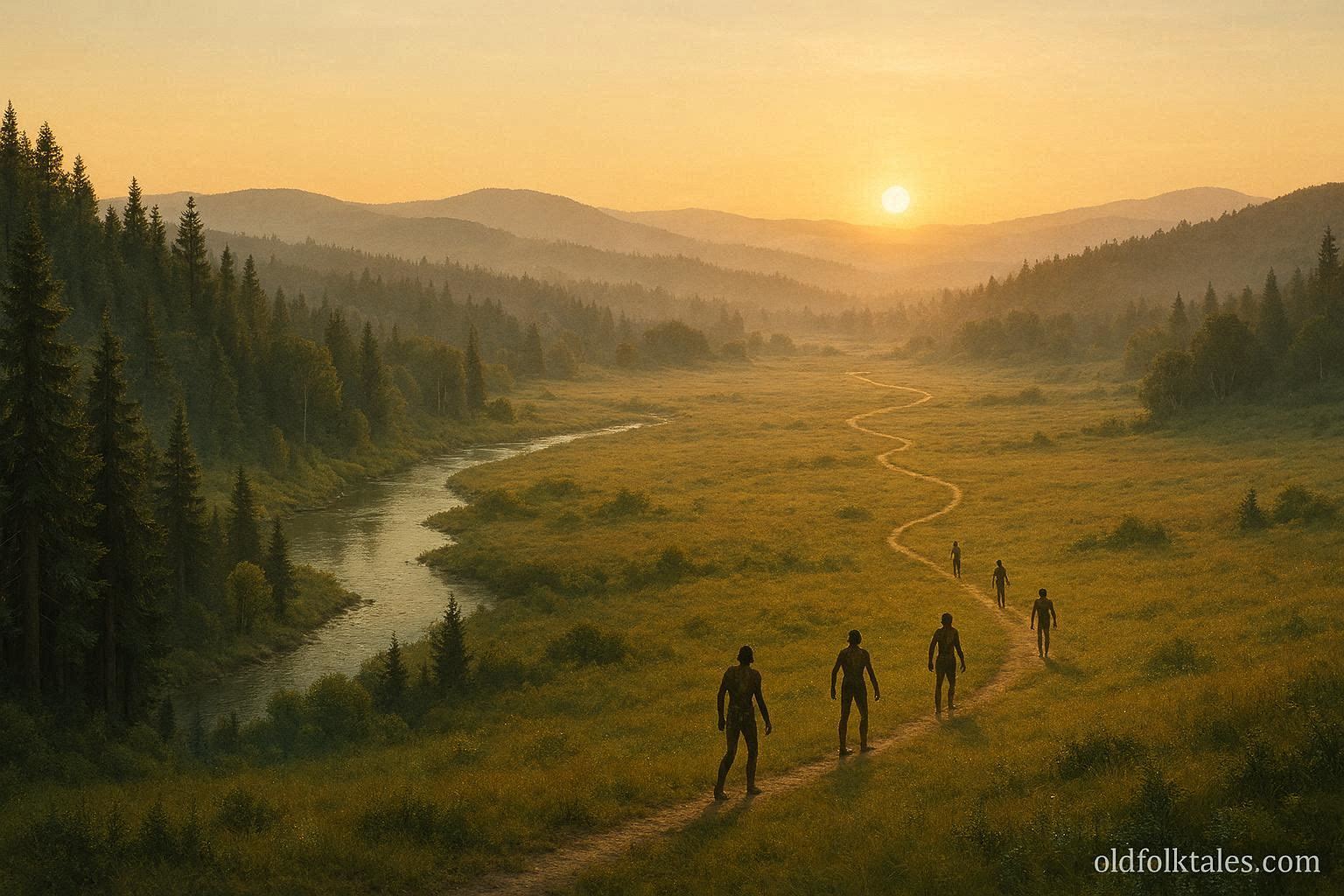
They moved through forests, across open plains, along rivers, and over hills. As they traveled, they pressed their paths into the earth. Each step shaped the ground, bending grass, shifting soil, and marking a direction that could be followed again.
At first, the marks were faint.
Barely visible.
But they continued.
Again and again.
Over time, the repeated movement formed something new.
A trail.
One of the first pathways was said to follow the course of a river. The beings walked beside the water, tracing its movement through the land. They chose this route because it connected many places, providing water, food, and direction.
As they walked, the path became clearer.
The ground smoothed.
The obstacles reduced.
The trail began to guide movement rather than resist it.
Another pathway crossed through dense forest. Instead of forcing a straight line, the beings followed the natural openings between trees. They curved around large trunks, stepped over roots, and moved in ways that respected the structure of the land.
This created a path that felt natural.
One that did not disrupt the forest, but worked within it.
Over time, more pathways formed.
Some led to water.
Some to open land.
Some to places of gathering.
Each trail had a purpose.
Each one connected one place to another.
When humans began to travel more widely, they discovered these paths. At first, they noticed the subtle changes in the land. Areas where the ground was easier to walk, where the direction seemed clearer.
They followed these signs.
Step by step.
The trails guided them.
What once required guesswork became more certain. People could move with greater confidence, knowing that the path ahead had already been shaped. These trails reduced the danger of becoming lost and allowed journeys to take place more often.
Communities began to connect.
People traveled between places, sharing knowledge, resources, and stories. The pathways made it possible to return, to revisit, to build relationships across distance.
But the trails were more than just physical routes.
They carried meaning.
Each path held the memory of those who first walked it. The direction of a trail often reflected a purpose, whether it led to water, to shelter, or to a place of importance. Travelers learned to recognize these meanings, understanding not only where a path went, but why it existed.
In the traditions of the Nez Perce, pathways are not seen as random lines across the land. They are part of a larger relationship between people and the environment. To follow a path is to trust in the knowledge that shaped it.
The land itself becomes a guide.
The curves of a trail, the rise and fall of the ground, the direction it takes all reflect an understanding of the world that goes beyond simple movement.
Stories tell that the early beings did not create these paths for themselves alone. They knew that others would come after them. They walked not only for the present, but for the future.
Each step was a form of preparation.
A way of making the world easier to navigate.
Safer to travel.
More connected.
Over time, humans continued to use these trails, strengthening them with each journey. The paths became more defined, more reliable. Some grew into major routes, used by many over long distances. Others remained smaller, known only to those who lived nearby.
Even as new ways of travel developed, the idea of the path remained.
The understanding that movement follows meaning.
That direction is shaped by those who come before.
The first pathways were not marked by signs or built with tools.
They were created through intention.
Through repeated steps.
Through an understanding of the land.
And even now, long after those first beings walked the earth, the idea remains present.
Every road.
Every trail.
Every route taken.
All follow the same principle.
That someone, at some time, chose a direction.
And others followed.
Discover celestial myths of the sun, moon, and stars — and the heroes who bridged earth and sky.
Moral Lesson
The paths we follow are often shaped by those who came before us, so we should respect and learn from their guidance.
Knowledge Check
- What was travel like before pathways existed?
It was difficult, slow, and uncertain - Who created the first paths?
Early beings who understood the land - How were the paths formed?
By repeated walking and intentional movement - Why did humans begin to follow these paths?
They made travel easier and safer - What do the paths represent beyond travel?
Connection, meaning, and shared knowledge - What is the main idea of the story?
That guidance from the past helps shape the future
Source
Adapted from materials preserved by University of Oregon
Cultural Origin
Nez Perce