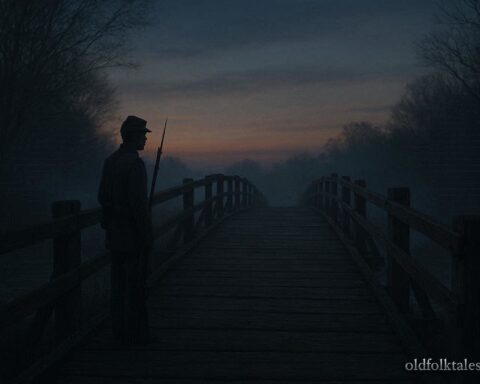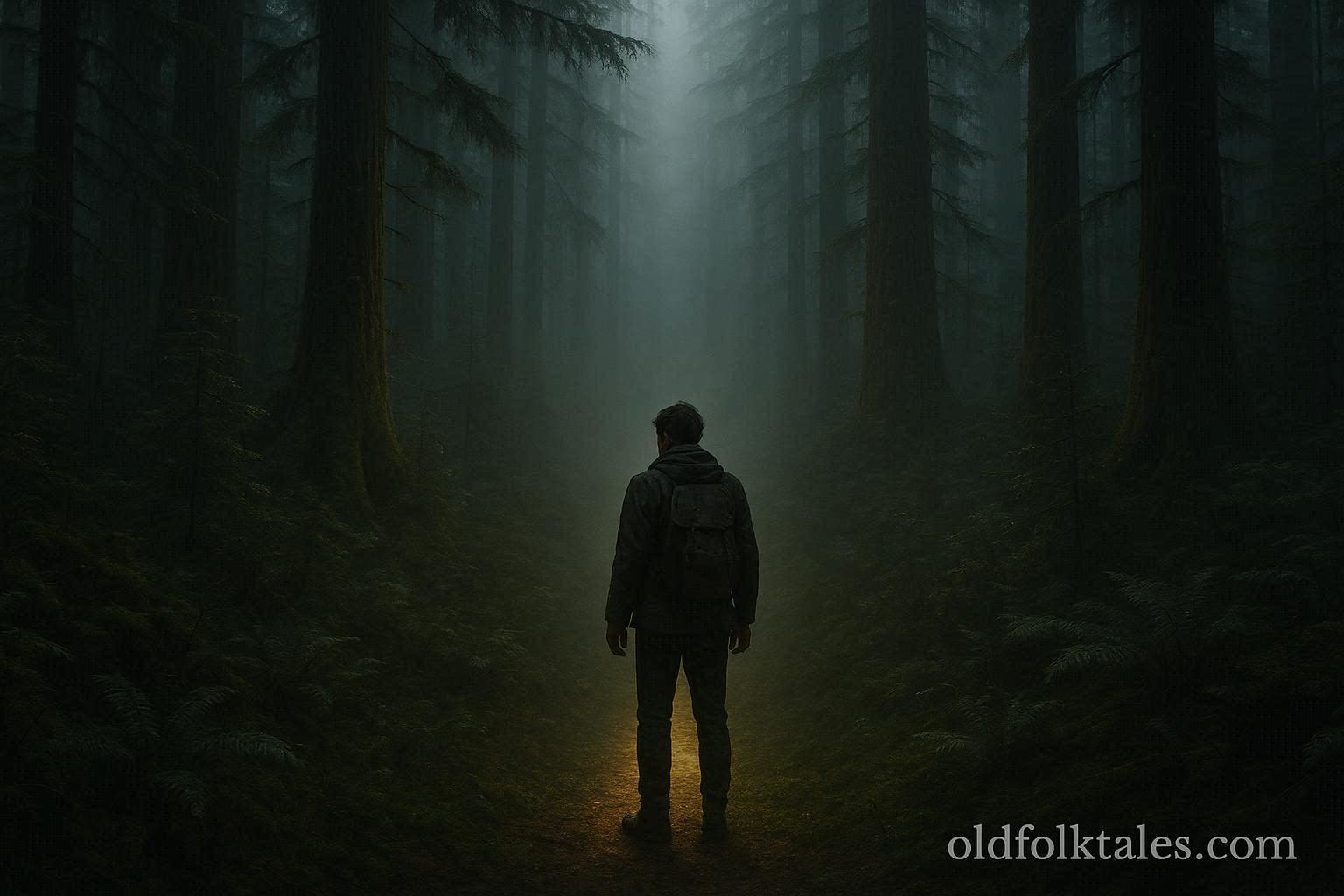
In the deep green wilderness of the Pacific Northwest in the United States, where tall trees stand like silent watchers and the air carries the scent of earth and rain, there are stories told about paths that are not meant to be found. These forests are known for their beauty, but also for their mystery. Among the many trails that wind through the land, there is said to be one that does not lead forward at all. Instead, it leads backward.
The elders in nearby communities speak of it carefully, never with certainty but always with caution. They call it the path that leads to yesterday. It is not marked on any map, nor does it appear to everyone. Some say it reveals itself only to those who are lost, while others believe it appears to those who carry something unresolved within them.
For many years, these stories were dismissed by travelers who believed only in what they could see and measure. But there were always a few who listened closely, who paid attention to the quiet warnings and the subtle changes in the forest.
Explore ancient Native American creation myths and the symbolic tales that shaped America’s belief systems.
One such person was a man who had spent much of his life moving from place to place. He was not searching for anything specific, but he carried with him a sense of unfinished time. There were moments in his past that stayed with him, memories that returned again and again, each time with a different feeling.
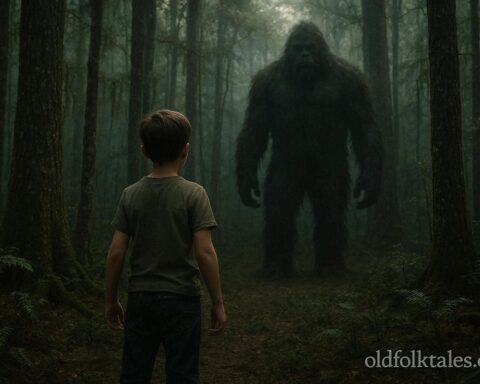
One afternoon, as the sky shifted from bright to overcast, he entered the forest along a familiar trail. The air was cool, and the ground was soft beneath his steps. He walked without urgency, letting his thoughts move freely. The deeper he went, the quieter the world became.
At first, nothing seemed unusual. The trees stood tall, the path was clear, and the sounds of distant birds echoed through the branches. But then, something changed. The path began to narrow, and the forest around him seemed to grow denser. The light filtered differently through the leaves, creating patterns that felt unfamiliar.
He paused, noticing that the trail ahead was not one he remembered. It curved gently, disappearing behind a cluster of trees. There were no signs, no markers, only the faint outline of a path that seemed to invite him forward.
He hesitated for a moment, then continued.
As he stepped onto the new trail, the air shifted. It felt heavier, as if time itself had slowed. The sounds of the forest grew distant, replaced by a quiet that was almost complete. Each step felt deliberate, as though the path required attention.
After walking for some time, he began to notice something unusual. The surroundings were changing, but not in the way he expected. The trees seemed younger, the ground less worn. There was a sense of familiarity, but also of distance, as if he were seeing something he had once known.
Then he saw it.
Ahead of him, through the trees, was a place he recognized. It was not part of the forest as it existed now, but part of a memory. A clearing where he had once stood many years before. The details were exact, from the arrangement of stones to the way the light fell across the ground.
He stepped closer, uncertain of what he was seeing. As he entered the clearing, the feeling became undeniable. He was no longer just remembering the past. He was inside it.
The air carried the same warmth it had on that day. The sounds were the same, the movement of leaves, the distant voices. And then, he saw himself.
Not as he was now, but as he had been. Younger, unaware, moving through the moment without knowing what would come later. The man stood still, watching, unable to speak or interfere. It was as though he were both present and separate at the same time.
The experience was overwhelming. Memories that had once been distant were now vivid and immediate. He could see every detail, feel every emotion, but he could not change anything. The moment unfolded exactly as it had before.
He realized then that the path did not exist to alter the past. It existed to reveal it.
As he continued along the trail, more moments appeared. Each step brought him to another point in his life. Some were filled with joy, others with regret. Each one offered a chance to see clearly, without the confusion of the present.
But with each step, there was also a growing understanding. The path could not be walked forever.
There was a point, though not clearly marked, where the past began to feel distant again. The clarity faded, and the surroundings shifted back toward the present. The forest returned to its original form, the sounds of the world slowly reappearing.
When he finally stepped off the path, he found himself back where he had begun. The trail behind him looked ordinary, no different from any other. There was no sign that anything unusual had happened.
But he knew.
The journey had not changed the past, but it had changed him. He understood now that memory was not something to escape or rewrite. It was something to learn from, to carry forward with greater awareness.
Stories like this have been preserved in collections such as those at University of Oregon, where regional folklore of the Pacific Northwest is studied. These tales often reflect the relationship between people, land, and time, showing how the environment itself can become a part of human experience.
In the years that followed, the man spoke rarely of what he had seen. When he did, it was not to convince others, but to share a lesson. He spoke of paths that are not always visible, of moments that shape who we become, and of the importance of facing the past with clarity rather than fear.
Some who heard his story went into the forest hoping to find the same path. Most returned with nothing but the usual sights and sounds. But a few, those who carried something unresolved, claimed to have seen a trail that did not belong to the present.
The forest remains as it has always been, quiet, watchful, and full of stories. And somewhere within it, hidden among countless paths, there may still be one that leads not forward, but back.
Discover African American wisdom, Native American spirit stories, and the humor of early pioneers in American Folktales.
Moral Lesson
Understanding the past can bring clarity, but it cannot be changed.
Knowledge Check
- What is special about the forest path?
It leads into the past - Who discovers the path?
A traveler - What does he see?
Moments from his own life - Can he change the past?
No - What does he gain from the experience?
Understanding - What is the main idea?
The past teaches but cannot be altered
Source
University of Oregon
Cultural Origin
Northwestern folklore