Dry winds swept across the wide desert mesas, lifting dust into the air and carrying it across fields that had once been green with corn and beans. The land had not seen rain for many months. Springs that once flowed gently from the rocks had slowed to thin trickles, and the soil had grown cracked and pale beneath the relentless sun.
The Hopi village stood quietly atop the high desert plateau. Families had lived there for generations, farming the land and depending on the balance between the sky and the earth. Rain had always been precious in that place, but now it seemed as though the clouds had forgotten the people entirely.
Each morning the villagers searched the horizon for signs of dark clouds, but the sky remained empty and bright. Crops withered in the fields. Corn stalks curled and bent toward the ground. Even the hardy desert plants struggled to survive.
Step into shadowy legends of restless spirits and ghostly travelers in American Ghost Stories.
The elders of the village gathered to discuss what could be done. They prayed to the spirits of the sky and performed sacred dances that had long been used to call the rain. Drums echoed across the mesas as dancers moved carefully in traditional steps meant to honor the spirits who governed the clouds.
Yet the skies remained silent.
Among the villagers lived a young woman known for her compassion and quiet strength. She had grown up listening to the teachings of her elders about the living spirit of the desert and the sacred relationship between the people and the natural world. She understood that the rain was not merely water falling from the sky. It was a living force that carried life to the land.
The young woman spent many evenings walking alone along the edges of the village. She watched the fading colors of sunset spread across the desert and listened to the whispering wind moving across the rocks. She often wondered whether the spirits of the sky could hear the prayers of her people.
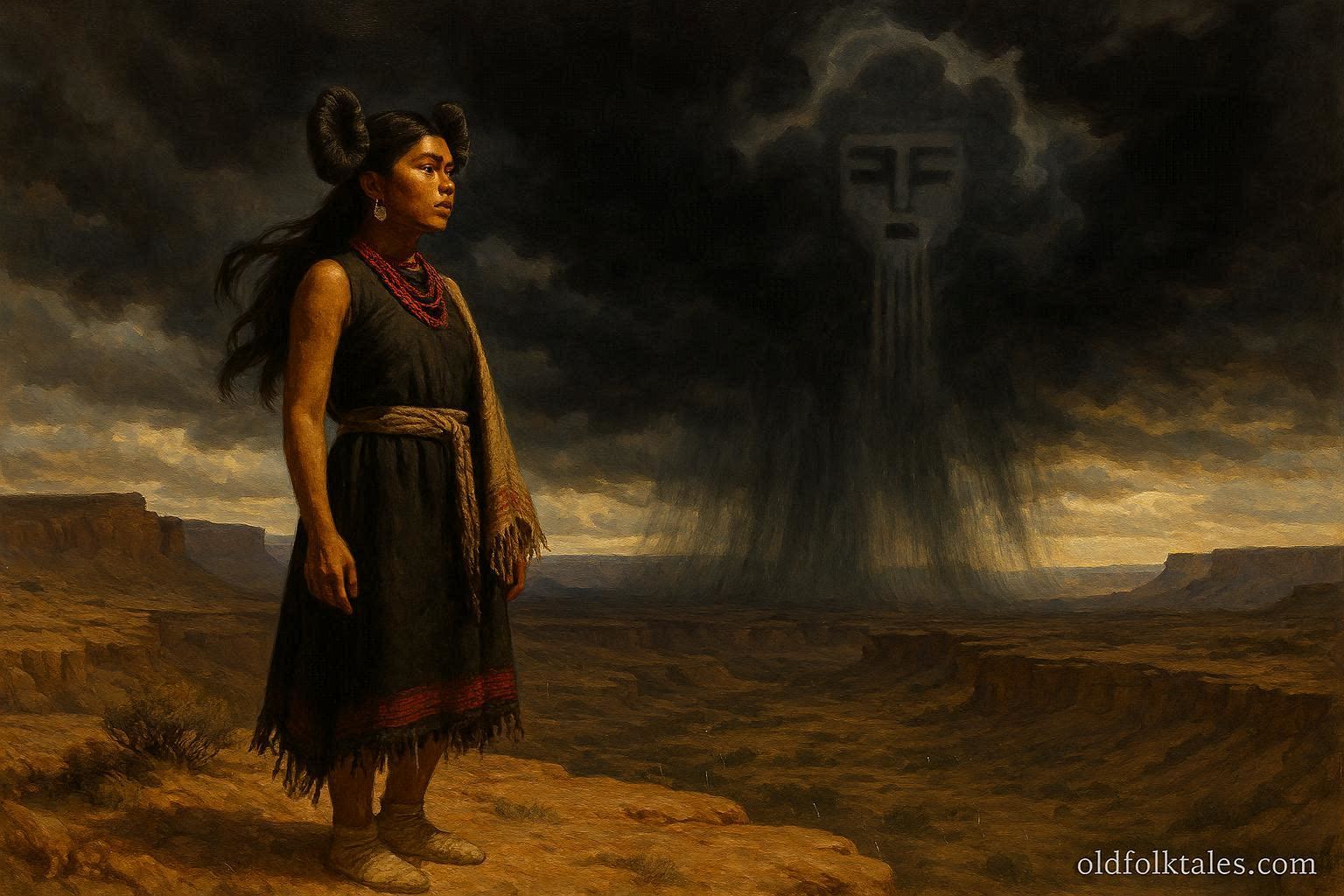
One evening as the sun lowered behind the distant mesas, she climbed to a high ridge where she could see far across the valley below. The land stretched endlessly in shades of red and gold, yet there was no sign of clouds anywhere in the sky.
As she stood there quietly, a strange feeling filled the air around her. The wind slowed, and the desert seemed to grow still.
A soft voice spoke from the empty sky.
The voice was gentle but powerful, like distant thunder echoing beyond the mountains. It told her that the spirit of the rain had heard the suffering of the people but could not return freely to the land.
The young woman listened carefully as the voice explained that the rain spirit needed a sacred bond with the people of the desert. Without that bond, the rains would remain distant and the clouds would continue to pass over the land without stopping.
The spirit offered a difficult choice.
If someone from the village was willing to join their life with the rain spirit in a sacred union, the rains would return and nourish the land again. Such a bond would connect the spirit world and the human world, allowing the clouds to gather over the mesas once more.
The young woman understood what the voice meant. The one who accepted this bond would no longer live an ordinary life in the village. Their destiny would become tied to the spirit of the rain itself.
She remained silent for a long time, thinking about the suffering of her people. She thought of the children who watched their families struggle to grow food, the elders who feared the loss of traditions, and the animals that wandered the desert searching for water.
Finally she spoke to the unseen spirit.
She said that if her sacrifice could save the village and restore life to the land, she was willing to accept the sacred bond.
The voice of the rain spirit answered with deep gratitude.
The next day the young woman shared her experience with the elders of the village. At first they were shocked by her story and worried about the meaning of such a decision. But as they listened, they realized that the message reflected ancient teachings about harmony between humans and the natural world.
After many discussions and prayers, the elders agreed that the young woman had been chosen for an important purpose.
A ceremonial gathering was prepared to honor the sacred union between the young woman and the rain spirit. The villagers decorated the central plaza with symbols of clouds, water, and growing plants. Sacred songs were sung to call the attention of the sky.
As the ceremony began, the young woman stood calmly among her people. She felt both fear and determination, yet she believed deeply in the choice she had made.
The elders raised their voices in prayer, asking the spirits of the sky to accept the bond and restore balance to the desert.
Slowly the wind began to change.
Clouds gathered on the distant horizon where the sky had been empty for so long. The air grew cooler as shadows spread across the land.
The villagers watched in amazement as dark clouds rolled toward the mesas.
Thunder echoed across the desert, and the first drops of rain began to fall onto the dry earth.
At first the rain came softly, tapping gently against the ground. Soon it grew stronger, soaking the thirsty soil and filling the air with the scent of wet earth.
The people lifted their hands toward the sky in gratitude. Children laughed as they felt rain on their faces for the first time in many months. Farmers hurried to their fields knowing that new life would soon grow from the soil.
The young woman looked toward the clouds and felt the presence of the rain spirit beside her. She understood that her life had become part of something greater than herself.
From that day forward the village remembered her sacrifice and the sacred bond she formed with the rain. The story was passed down through generations as a reminder that the survival of the people depended on respect for the natural world.
The Hopi believed that harmony between humans and nature required responsibility, humility, and a willingness to care for the balance of the earth.
Whenever rain clouds gathered above the mesas, elders sometimes told children the story of the girl who formed a sacred bond with the rain spirit. They explained that the rains were not simply weather but part of a living relationship between the land and the people.
The story reminded everyone that the desert could only flourish when humans honored the forces that sustained life.
Even today the tale continues to echo through Hopi traditions as a symbol of sacrifice, courage, and the deep connection between humanity and the natural world.
Explore the heart of America’s storytelling — from tall tales and tricksters to fireside family legends.
Moral Lesson
True leadership sometimes requires sacrifice for the good of the community. Harmony between humans and nature ensures the survival of both.
Knowledge Check
- Why was the Hopi village struggling at the beginning of the story?
The land was suffering from a long drought and the crops were dying. - What did the rain spirit say was needed for the rain to return?
A sacred bond between the rain spirit and a member of the village. - Who decided to accept the rain spirit’s offer?
A compassionate young woman from the village. - Why did she agree to form the sacred bond?
She wanted to save her people and restore life to the land. - What happened after the ceremony honoring the union?
Dark clouds gathered and rain finally returned to the desert. - What lesson does the folktale teach about nature?
Humans must respect and maintain harmony with the natural world.
Source
Adapted from materials preserved in the Arizona State Museum
Cultural Origin
Hopi traditions