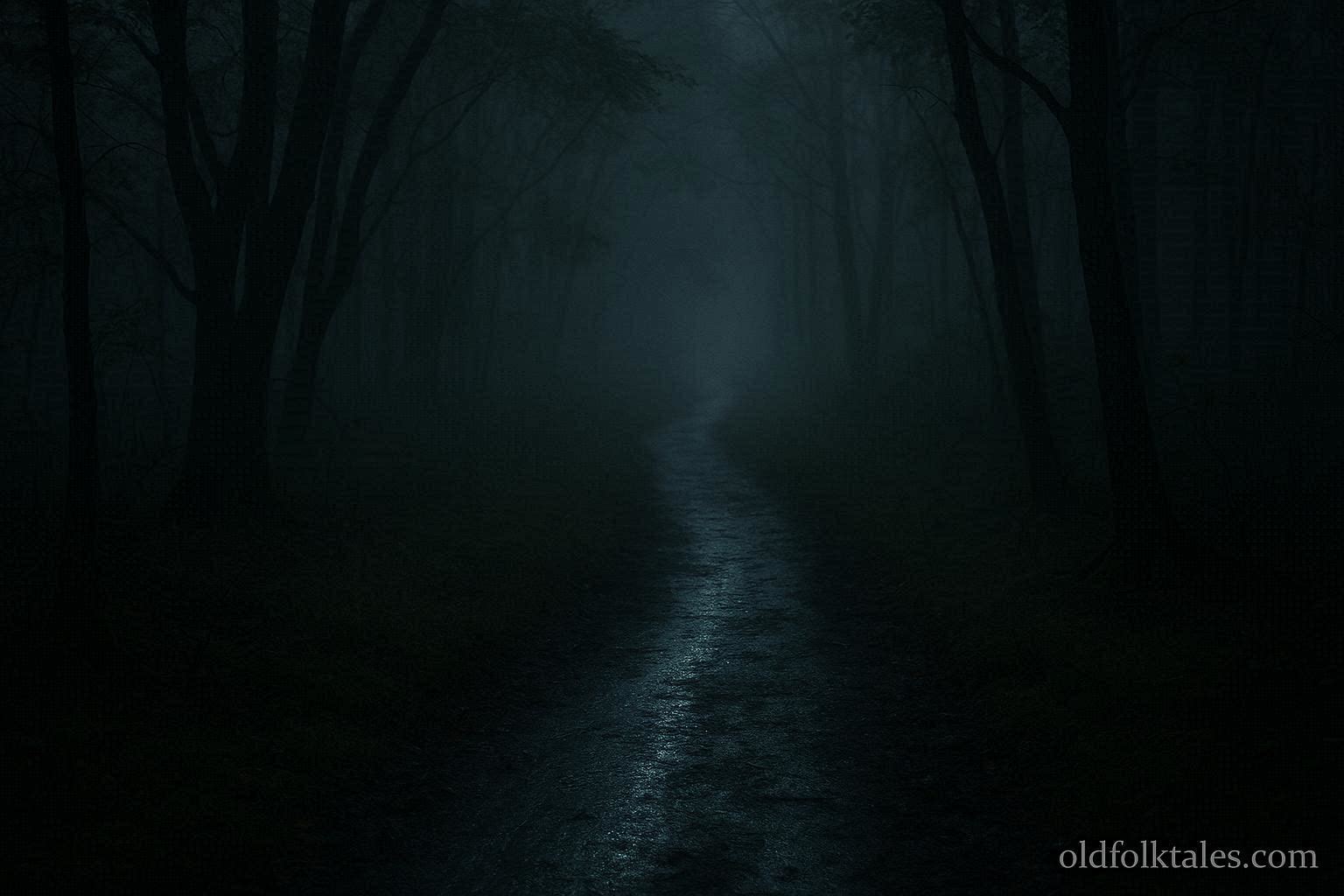
Deep within the quiet edges of the Southern countryside, beyond the reach of busy roads and crowded towns, there lay a narrow path that few people used after sunset. It wound its way through old trees and soft earth, leading toward a small and nearly forgotten burial ground.
The path itself seemed ordinary during the day.
It was no more than a strip of worn ground between grass and roots, marked by years of footsteps that had slowly shaped its direction. Those who passed by it in daylight rarely gave it much thought. It was simply a path, one of many that crossed the land.
But everything changed after the rain.
When the clouds gathered and released their weight upon the earth, the ground would darken, the air would grow still, and the scent of wet soil would rise into the night. It was during these moments, when the rain had just passed and the sky remained heavy with silence, that the path revealed something unusual.
A faint glow would begin to appear.
At first, it was subtle.
A soft light, barely noticeable, tracing the length of the path like a quiet reflection. But as the darkness deepened, the glow became clearer. It did not flicker like fire or shine like a lantern. Instead, it held a steady presence, gentle yet impossible to ignore.
Step into America’s cultural roots — from folk healing and weather lore to seasonal celebrations.
Those who had seen it spoke carefully about what it might mean.
Some believed it was a sign.
Others believed it was a warning.
The elders of the community carried the oldest understanding. They spoke of the path not as a simple walkway, but as a place connected to those who had come before. The burial ground it led to was not just a resting place. It was sacred, holding the memory and presence of generations.
They explained that the glow was not meant to frighten.
It was meant to communicate.
In earlier times, when respect for the land and its spirits was deeply observed, people believed that certain places could reveal signs when the balance between the living and the departed shifted. Rain, they said, awakened these signs. It softened the earth and opened a quiet connection between worlds.
The glowing path was one of those connections.
One story told of a traveler who had taken the path late one evening, unaware of its reputation. The rain had ended only moments before, and the ground was still damp beneath his feet. As he walked, he noticed the faint light forming along the ground.
At first, he thought it was a trick of the eye.
But as he continued, the glow became stronger, guiding his steps forward. The path ahead seemed clearer than it had before, as though something was helping him see where to go.
He followed it without fear.
Each step felt certain, each turn easier to understand. The path led him safely through the darkness, guiding him away from areas where the ground was uneven or difficult. By the time he reached open land again, the glow had faded, leaving the path as it had always been.
He later spoke of the experience not with fear, but with gratitude.
Others, however, told different stories.
There were those who ignored the signs.
Some who walked the path without respect, speaking carelessly or disturbing the quiet of the place, found that the glow did not guide them. Instead, it seemed to shift, becoming uneven and unclear. The path would appear longer, more confusing, and difficult to follow.
In these cases, the glow was not a guide.
It was a warning.
Elders reminded people that not all signs were meant to comfort. Some existed to remind the living of boundaries that should not be crossed without understanding. The burial ground was a place of rest, and the path that led to it carried that same meaning.
Respect was expected.
Over time, the story of the glowing path became a lesson shared across generations. Parents told their children to be mindful when walking near such places, especially after rain. They explained that the world held more than what could be seen in daylight, and that certain signs should never be ignored.
The path remained.
Rain continued to fall, and with it, the glow returned again and again. It did not change, and it did not disappear. It simply waited for the right conditions to reveal itself.
Even those who had never seen it believed in its presence.
They spoke of it with a quiet understanding, acknowledging that the land held memories and meanings beyond what was immediately visible. The glow became a symbol of that connection, a reminder that the past was never truly separate from the present.
On certain nights, when the rain had just passed and the world felt still, those who stood at a distance could see it.
A faint line of light.
Stretching through the darkness.
Not calling out, not demanding attention, but simply existing as a sign for those who understood how to see it.
And in that quiet glow, the path continued to serve its purpose.
Guiding.
Warning.
And reminding all who encountered it that respect for the unseen was just as important as understanding the visible world.
Click to explore all American Ghost Stories — haunting legends of spirits, lost souls, and mysterious places across the U.S.
Moral Lesson
Not all signs are meant to guide us forward, some are meant to remind us to walk with respect and awareness.
Knowledge Check
- When does the grave path begin to glow?
After rainfall when the ground is still wet. - What does the glow look like?
A faint, steady light along the path. - How did the traveler benefit from the glowing path?
It guided him safely through the darkness. - What happened to those who ignored the meaning of the path?
They became confused and lost their way. - What did the elders believe the glow represented?
A spiritual sign connected to the burial ground. - What lesson does the story teach about such signs?
They should be respected and not ignored.
Source
Adapted from materials preserved by Howard University
Cultural Origin
African American Southern folklore