The men who worked the deep forests of the Pacific Northwest learned early that laughter was as important as muscle. Long days among towering firs and rain soaked ground demanded stories that could lighten the load and sharpen the senses at the same time. It was in those camps, far from towns and even farther from comfort, that the legend of the Gumbaroo took shape.
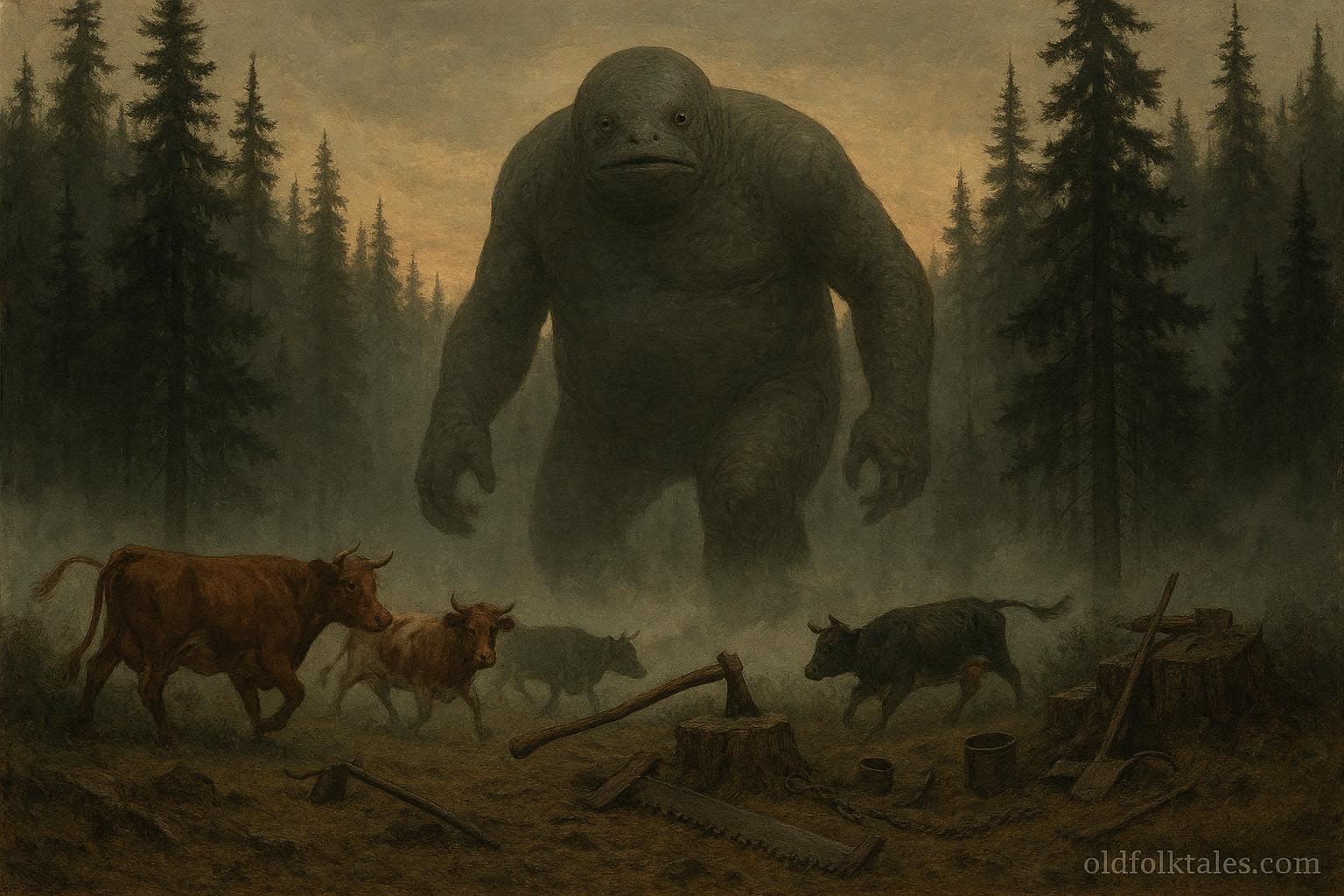
No two lumber camps told the story in exactly the same way. Some swore the creature stood as tall as a small cabin. Others claimed it was shorter but broader, moving with a strange rolling gait that bent saplings without breaking them. All agreed on one thing. The Gumbaroo could not be harmed by bullets. Lead flattened against its hide as if fired into a wagon tire, snapping back toward the shooter with dangerous force.
The earliest accounts came from camps tucked into the rain heavy valleys of Washington and Oregon. These were places where cattle were sometimes kept to supply fresh meat for workers. When livestock began disappearing without clear tracks or signs of predators, men blamed bears at first. But bears left blood, torn fences, and claw marks. The Gumbaroo left none of these. Cattle simply vanished, as if swallowed whole by the forest itself.
Discover chilling ghost tales and haunted places that echo through America’s towns and countryside.
Old loggers said the creature hunted silently. Its skin, thick and elastic like hardened rubber, absorbed sound as well as impact. When it moved through brush, branches bent and slid across its surface without snapping. This silence unnerved men more than any roar could have. You could stand twenty steps away and never hear it coming.
One camp cook, known as Red Willis, claimed to have seen the Gumbaroo at dusk while checking on a stray cow. He described its eyes as small and dark, set deep into a face that looked unfinished, as if shaped by pressure rather than intention. When Red fired his rifle, the bullet bounced back and struck a tree behind him. He dropped the gun and ran. The cow did not.
Stories like Red’s spread quickly along logging routes. They were exaggerated with every retelling, but they served a purpose. Men stopped wandering alone at night. They secured livestock earlier. They learned to listen more carefully to the forest rather than assuming they controlled it.
Some versions of the legend said the Gumbaroo was not born but made. A few claimed it formed from resin and sap, hardened over decades by rain and pressure until it became something alive. Others said it was a punishment creature, created by the forest itself to remind humans that greed had consequences. Trees fell faster each year, camps grew larger, and noise replaced reverence. The Gumbaroo arrived when balance tipped too far.
Despite the fear, humor remained central to the tale. Camp storytellers loved the absurdity of a monster immune to bullets yet vulnerable to fire. According to tradition, the only way to kill a Gumbaroo was to burn it. Fire melted its skin like wax, collapsing its body into a sticky heap. The idea that such a fearsome creature could be undone by its own material nature fit the tall tale tradition perfectly.
One popular account told of a crew that set a trap using hot coals and burning pitch. When the Gumbaroo approached, drawn by cattle, it rolled straight into the fire and burst like an overfilled bladder. The men celebrated not just survival, but cleverness. Strength alone failed. Understanding succeeded.
Not every story ended with victory. Some camps reported abandoning sites after repeated sightings. Tools were found bent. Food stores disappeared. Trees marked for cutting showed strange impressions, as if pressed inward by something heavy and elastic. These details reinforced the idea that the Gumbaroo was not merely an animal but a symbol of resistance.
Over time, the legend crossed from lumber camps into wider frontier culture. Travelers repeated it in saloons. Writers collected it as an example of uniquely American exaggeration. Children heard sanitized versions meant more to entertain than warn. But among loggers, the meaning stayed clear. The forest could not be conquered without respect.
The Gumbaroo also reflected the humor of men who lived with danger daily. Logging accidents were common. Storms could isolate camps for weeks. Stories that mixed fear with laughter helped men cope. By turning danger into something strange and ridiculous, they gained a measure of control over it.
As logging declined and machines replaced hand tools, the Gumbaroo faded from daily conversation. Yet it never disappeared entirely. Hikers still hear the name. Folklorists still record variations. And in the deep woods, where trees grow close and sound disappears, some swear the forest still remembers the creature shaped from exaggeration, caution, and survival.
The Gumbaroo endures because it was never only a monster. It was a lesson wrapped in humor. It warned against arrogance. It reminded listeners that nature responds when pushed too far. And it proved that sometimes the most lasting stories come not from truth alone, but from the space where fear and laughter meet.
Click to read all American Folktales — timeless oral stories passed through generations across the United States.
Moral Lesson
The legend of the Gumbaroo teaches that strength without understanding invites danger, and that survival depends as much on respect, cooperation, and wisdom as it does on force.
Knowledge Check
1 What material made the Gumbaroo resistant to bullets?
Answer Rubber like elastic skin
2 Where did most Gumbaroo stories originate?
Answer Pacific Northwest logging camps
3 Why did bullets fail against the Gumbaroo?
Answer They bounced off its elastic hide
4 What was said to be the only effective way to defeat it?
Answer Fire
5 What human behavior did the Gumbaroo legend warn against?
Answer Greed and disrespect toward the forest
6 Why did lumber camps tell exaggerated stories like this?
Answer To teach caution and cope with dangerous working conditions
Source
Adapted from Washington State University lumber folklore archives
Cultural Origin
Pacific Northwest logging camps, United States