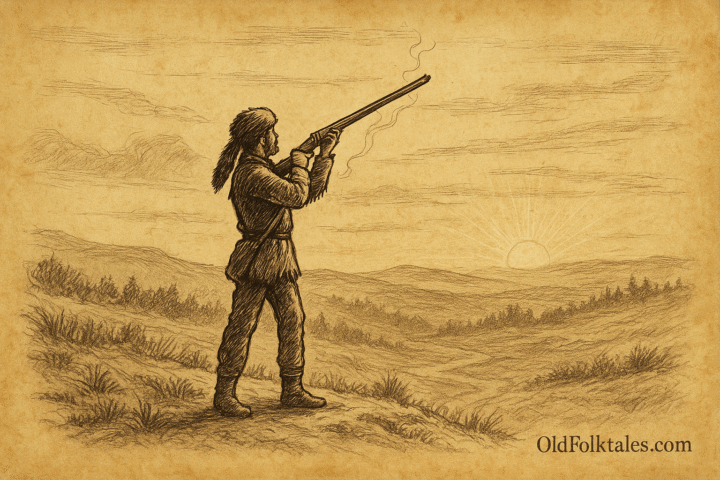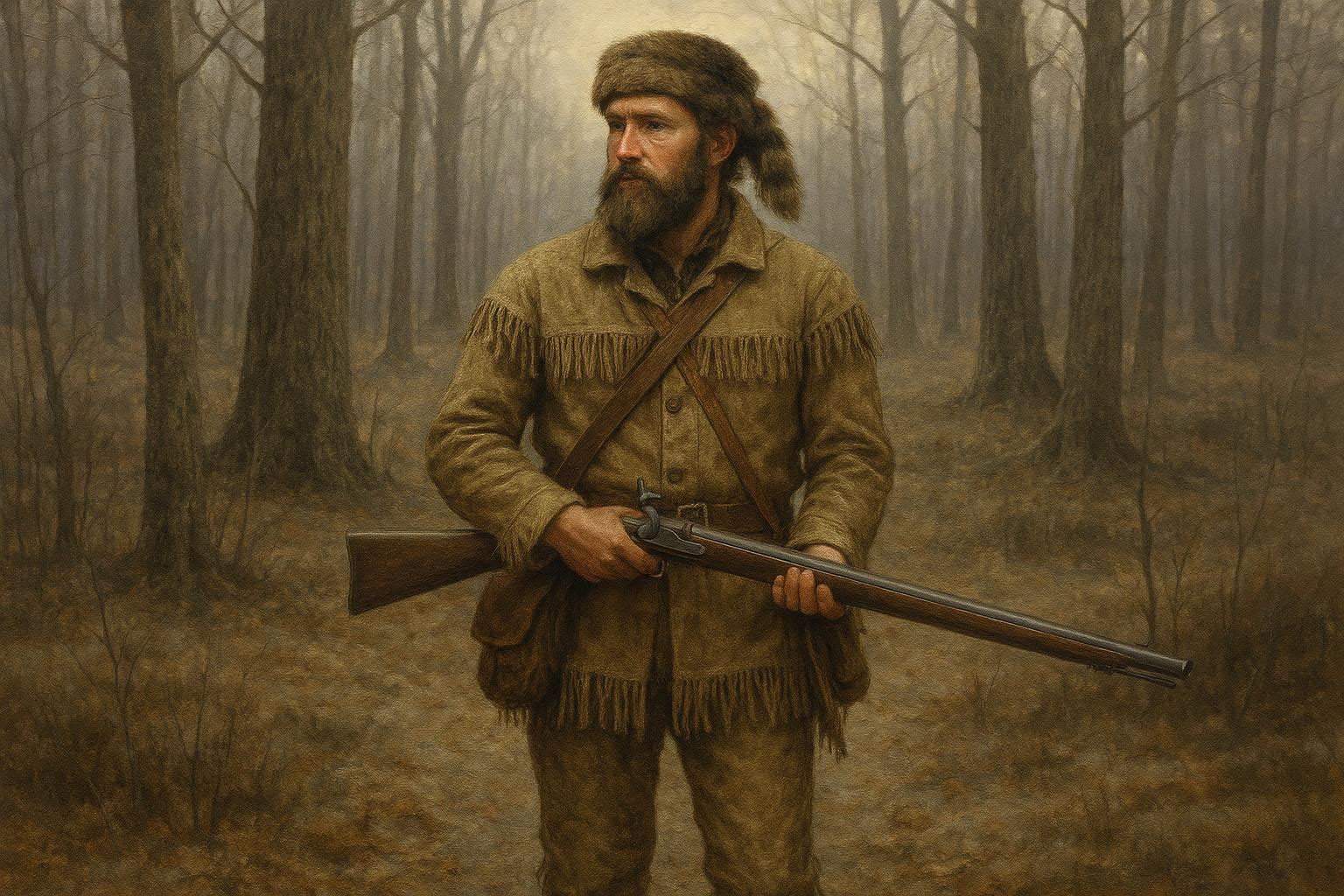
In the early days of the American frontier, when forests stretched farther than any road and silence carried more meaning than speech, there lived a hunter known simply as Elias Boone. No one remembered where he came from. Some said he walked out of the mountains one autumn morning with a rifle older than himself. Others claimed he had been taught by a man who learned to hunt before words were needed. What everyone agreed on was this. Elias Boone never missed. At least, not until the day the forest decided he must.
Elias lived on the edge of a settlement carved from wilderness by stubborn hands and shared need. He did not speak much, but when he did, his words were plain and careful. He hunted not for sport or praise but because the land demanded skill and respect. His rifle fed families through winter and ended suffering quickly when an animal fell. The settlers trusted him in ways they did not trust each other. If Elias said game would be found by morning, it was so. If he said no shot should be taken, no one argued.
Stories grew quietly around him. Children whispered that he could see the future through his sights. Others said the forest itself bent to his aim. Elias never corrected them. He also never boasted. His pride rested in restraint. He fired only when he was sure. That certainty became his legend.
Discover chilling ghost tales and haunted places that echo through America’s towns and countryside.
One winter, the snow came early and hard. Game grew scarce. Hunger pressed on the settlement like a slow tide. Each day, eyes followed Elias as he disappeared into the trees and returned with just enough to keep hope alive. Gratitude turned into reliance. Reliance began to turn into expectation.
One morning, a young hunter named Caleb followed Elias into the woods. Caleb admired him deeply but misunderstood the nature of that admiration. He wanted to learn the trick, the secret that made a man infallible. When Elias stopped near a ridge and rested his rifle against a tree, Caleb asked the question no one else had dared to speak.
“How do you know you won’t miss?”
Elias looked at the snow, then at the trees, then at the space between them. “I don’t,” he said. “I know when not to shoot.”
Caleb frowned. He did not understand. To him, mastery meant certainty. Silence followed them until a deer stepped into view, standing broad and calm. It was an easy shot. Elias raised his rifle and then lowered it.
“Not today,” he said.
Caleb could not contain himself. “You never miss,” he insisted. “Why wait?”
Elias’s voice was steady. “Because the forest has already given enough today.”
They returned empty-handed. That night, whispers spread. Some wondered if Elias was losing his edge. Hunger sharpened doubt.
The next morning, Elias went out alone. The air was brittle with cold. His breath rose in pale clouds. Hours passed before he saw movement near a frozen stream. A large buck stood there, strong and unafraid. Elias raised his rifle. The shot was clean, true, and fast. But the buck did not fall. Instead, it vanished into the trees.
Elias lowered his rifle slowly. For the first time in his life, he had missed.
The forest grew quiet in a way that felt deliberate. Elias did not chase the animal. He sat down on a fallen log and waited. His heart was calm, but his thoughts were not. He understood at once that the miss was not an accident. It was an answer.
From that day on, Elias noticed a change. His shots were still accurate, but the forest no longer felt predictable. Wind shifted without warning. Game moved in unexpected patterns. When he took a shot driven by urgency instead of patience, something interfered. A branch moved. A sound distracted. Fate itself seemed to step between his aim and its mark.
The settlement grew uneasy. Food returned, but not with the same ease. Some blamed Elias. Others defended him. Caleb, now restless and proud, decided to prove himself. He went into the woods alone and fired recklessly. His shots echoed without result. He returned empty-handed and ashamed.
One evening, Elias called the settlement together. He spoke longer than he ever had before.
“I missed once,” he said. “That miss was not punishment. It was a lesson. Skill without humility becomes noise. The forest listens, and it remembers.”
He explained what he had learned. The first miss was a reminder that mastery was never ownership. The second miss would come only if he forgot that truth. From then on, Elias shot less often. When he did fire, his aim was guided by patience rather than certainty. He never missed twice.
As seasons passed, the legend changed. People stopped saying Elias could not miss. Instead, they said this. The forest allowed him to hit his mark because he never forgot he could fail.
Caleb learned as well. He practiced waiting more than shooting. Others followed. The settlement survived, not because of perfect aim, but because of shared restraint.
When Elias eventually disappeared into the woods one spring morning and did not return, no one searched for him. Some believed he had become part of the forest he respected so deeply. Others said he simply walked on, carrying his lesson to places that needed it.
What remained was the story. Not of a man who never missed, but of one who learned the cost of believing he never could.
Click to read all American Folktales — timeless oral stories passed through generations across the United States.
Moral Lesson
True mastery is not proven by flawless performance, but by humility, restraint, and respect for forces greater than oneself. Skill without humility invites correction, while wisdom preserves balance.
Knowledge Check
1 What caused the hunter’s first miss?
Answer: His certainty replaced humility, and the forest corrected him.
2 Why did Elias sometimes choose not to shoot?
Answer: He believed restraint was part of respecting the land.
3 What mistake did the younger hunter make?
Answer: He pursued skill without patience or understanding.
4 How did the forest respond to arrogance?
Answer: By disrupting certainty and forcing reflection.
5 What changed after Elias missed once?
Answer: He relied more on patience and humility than reputation.
6 What does “never missed twice” symbolize?
Answer: Learning from failure instead of denying it.
Source
Adapted from American hunting folklore archives documented in regional frontier oral traditions.
Cultural Origin
Early American frontier folklore.