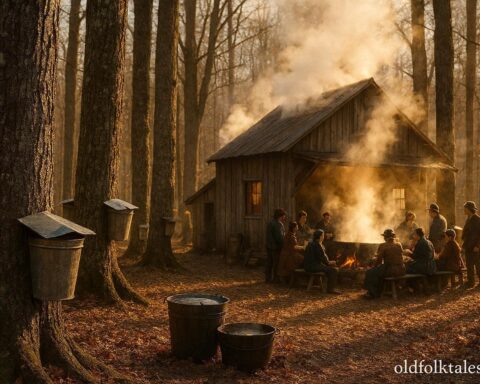
If you’ve never walked the Pine Barrens at night, you don’t know how big quiet can be. The pitch pines lean together like whispering men, the sandy roads vanish into black, and the cedar swamps hold a stillness that can stop your breath. When the wind falls away, you hear other things—the drip of tannin-dark water, the click of cranberries in their bogs, the creak of a raven on a dead limb—and sometimes, they say, a scream that isn’t any bird at all.
Old maps call it Leeds Point, and old mouths tell it this way: In the winter of 1735, a woman named Mother Leeds labored through her thirteenth birth. “Let it be a devil,” she muttered, whether in jest or bitterness depends on who’s telling it. The child came red and wailing, and before the midwife could swaddle him, he stretched, split, and changed—hooves where feet had been, a long tail like a whip, leathered wings that beat the candle out. The creature leapt to the rafters, screamed like a wet hinge, and flew into the pines.
For two centuries and change, the Jersey Devil has been the Barrens’ traveling rumor. He’s taken blame for slaughtered chickens and frightened drivers, for hoofprints on a snowy roof and a shadow that keeps pace with a wagon at midnight. People who don’t live there laugh. People who do keep their lamps trimmed.
Which is where Ephraim Gaskill comes in. He was a lighthouse keeper once, posted where the marsh met the breakers. When the sea clawed the shoreline and the island shifted, his light was moved inland, then retired to a museum that children visit on field trips. Ephraim took the pension and a rented shack among the pines, saying he’d rather hear frogs than foghorns. He carried with him an old habit: every evening, just before dark, he trimmed a lantern, cleaned the soot from its chimney, and set it glowing in the front window.
“Keeper’s hands remember,” he’d say, flexing fingers that smelled of oil and salt. “Light’s a duty, even when there’s no tower to keep.”
Local boys would come with their bikes and stories. “Mister Gaskill,” one would ask, “you ever see the Devil?”
“Once,” he’d answer, “and again if I’m foolish.” Then he’d smile and say no more.
The Barrens have blue holes—cold, bottomless ponds that hold their color even under clouds. Ephraim avoided them, like most folks. One spring, he heard that a boy from Batsto went missing after daring his friends to swim in one by moonlight. The rangers searched. The church prayed. Ephraim set his lantern in the window and kept it burning all day.
On the third night, the wind died. Even the peepers fell quiet. Ephraim sat by the window with his tools—wick, snuffer, rag—and listened to the hush like a man listens for a footfall that decides a life. When the scream came—high, tearing, too big for any throat—he did not bolt or fumble. He trimmed the wick.
What came out of the trees was taller than a man and thin as hunger. Hooves clicked on the sandy path. Wings furled and unfurled with the sound of canvas snapping on a storm-schooner. Its head—goatish, bat-like, something in between—tilted to the light as if smelling it.
Ephraim stood. “Evening,” he said, like a keeper greeting weather. “Mind the sill.”
The Devil’s tail switched. It pressed a hoof against the porch rail, curious as a stray dog. Up close, Ephraim saw bristles where fur should be, saw the old scars on the wing leather. The lantern flame fluttered; he steadied it with a hand cupped just so—a trick learned in gales.
“Looking for something?” he asked. His voice didn’t shake because keepers learn early the sea won’t listen to a tremble.
The creature’s ears twitched toward the cedar swamp, where the water keeps secrets and returns them slow. Ephraim pictured a boy’s shoe dark with tannin, a bicycle rusting in tea-colored shallows. He thought of Mother Leeds’ curse, of a midwife’s candle blown out, of all the years between when men told the story and set their lamps just a little closer to the glass.
“You can fetch what you fetch,” he said softly to the shape, “but not from my threshold.”
The Devil leaned in, curious, then flinched when Ephraim raised the snuffer. It hissed like a coal in rain.
“Ah,” Ephraim murmured, understanding. “You don’t like a kept light, do you? You prefer the ones folks let gutter.”
He set the lantern on the porch rail and polished its chimney until the little flame shone like a coin rubbed clean. The creature watched. Its tail stilled. The scream that lived in its chest settled to a low grating hum, as if some old anger had slipped its grip for a breath.
“Here’s our bargain,” Ephraim said, because keepers broker with storms and might as well try with devils. “So long as this lamp is kept—wick trimmed, glass clean—you’ll pass my door without mischief. If it gutters, well, that’s on me, and I’ll take what walks in.”
The Devil’s eyes, red as tail lamps on a fog road, blinked once. Then it turned, unfolded those tired wings, and leapt into the black above the pines. The scream that followed was smaller, as if distance and mercy could be weighed by the same scale.
At dawn, the rangers found the missing boy at the road’s bend—hypothermic, shivering, alive. He told a strangest thing: a shadow with wings had walked beside him in the night, not close enough to touch, just near enough to keep the coyotes honest. He’d followed a small light bobbing in the trees until he smelled kerosene and saw a lantern in a window. He collapsed on the step of an old man’s porch.
Ephraim fed him broth and didn’t ask about shadows. He kept the lantern burning all that day, then all the next, until his hands stopped shaking. When the boy’s mother came with tears and thanks, Ephraim only nodded. “Light’s a duty,” he said. “I was paid for it once. I’ll pay it back now.”
Word went around, as words do in places with more trees than people. Some laughed about the “old keeper who made peace with a goat-bat.” Others started keeping porch lamps lit longer, cleaning chimneys, minding wicks. A few left offerings at Leeds Point—bread, milk, a candle in a jar. Not worship, exactly. Boundary.
There were still chickens taken, still hoofprints in snow where no animal should go, still screams that raked the night. But when the lamps were kept, when the light was tended, fewer things went wrong close to home.
Years later, a storm took Ephraim—the sort of storm that eats shorelines and remakes maps. Neighbors found his shack empty and his lamp on the table, chimney polished, wick trimmed to a needle’s patience. Some swear they still see a little, well-kept light bobbing the sandy roads on foul nights, and a taller shadow pacing the tree line, never crossing the beam.
As for the Devil, the Barrens hold him like a rumor you can hear breathe. Now and then, some new reporter comes to laugh and gets quiet in the cedar gloom. The pines hush, the blue holes wait, and a far-off scream sounds bigger than the night. If you’re wise, you’ll make sure the porch lamp back home is clean and bright. Whatever walks the Barrens seems to respect a kept light.
And if you ever pass Leeds Point at dusk and feel watched, tip your hat and say, “We’re keeping it trimmed.” Sometimes the trees answer with a wind you’re grateful to hear.
Moral of the Story
Keep your own light in order. Boundaries held by steady care can turn fear into truce—even with the monsters you can’t outrun.
Knowledge Check
1. What place is the heartland of this legend?
The Pine Barrens of New Jersey, especially around Leeds Point.
2. How does the origin tale describe the Jersey Devil’s birth?
As Mother Leeds’ thirteenth child, transforming into a winged, hoofed creature and fleeing into the pines.
3. Who is Ephraim Gaskill, and what habit defines him?
A retired lighthouse keeper who faithfully trims and tends a lantern every night.
4. What bargain does Ephraim propose to the Devil?
So long as his lantern is kept—wick trimmed, glass clean—the creature will pass without mischief.
5. How is the missing boy ultimately saved?
He follows a bobbing light through the woods to Ephraim’s porch lantern and survives the night.
6. What is the story’s central lesson about fear and safety?
Maintained boundaries—symbolized by a well-kept light—invite respect and protection, even from what we fear.
Origin: New Jersey Pine Barrens legend (Leeds Point tradition), contemporary retelling