The summer sun burned fiercely over the fields of Monmouth, New Jersey, on June 28, 1778. The air was thick with heat, smoke, and gunfire. The battle between the Continental Army and the British raged across the countryside, one of the fiercest clashes of the American Revolution. Amid the thunder of cannons and the cries of soldiers, a young woman moved swiftly among the ranks, a water pitcher in hand. Her name was Mary Ludwig Hays, but to the men who fought that day, she would forever be known as Molly Pitcher.
Mary was the wife of William Hays, an artilleryman in George Washington’s army. Like many soldiers’ wives, she followed the troops, cooking, washing, and caring for the wounded. But that hot June morning, her task was to bring water from a nearby spring to cool the soldiers and their cannons. The name “Molly Pitcher” came naturally, “Molly” being a common nickname for Mary, and “pitcher” for the jug she carried tirelessly through smoke and musket fire.
Click to explore all American Ghost Stories — haunting legends of spirits, lost souls, and mysterious places across the U.S.
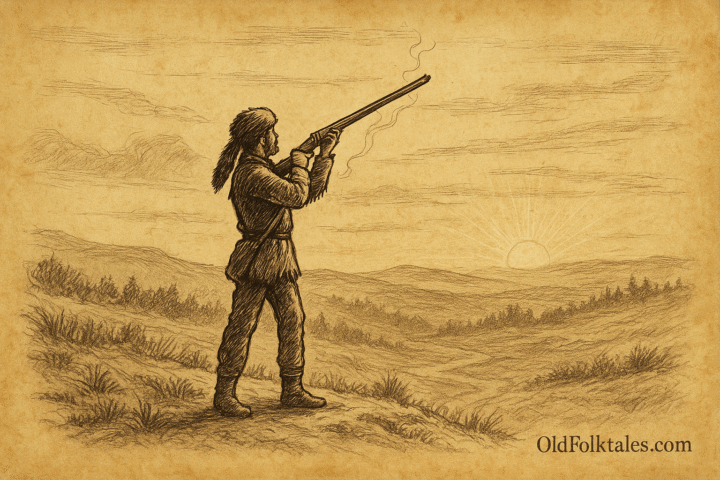
The battle was brutal. The British, led by General Clinton, clashed with the American troops under General Washington’s command. Men fell where they stood, overcome by heat or struck by bullets. Yet through the chaos, Molly kept going. Again and again, she ran across the field, dodging cannonballs and musket shots, pouring water into the mouths of exhausted men and dousing the red-hot barrels of the cannons.
Suddenly, as she returned to her husband’s gun, she saw him collapse beside it. William Hays had been struck down, some say by a musket ball, others by the heat. For a brief moment, Molly froze. Around her, the world seemed to roar in fire and fury. Then, with the kind of courage that comes from instinct and love, she stepped forward and seized the rammer staff.
Without hesitation, she began to load and fire the cannon in her husband’s place. The other artillerymen watched in astonishment as the young woman, her face streaked with sweat and powder, worked the heavy weapon like a seasoned gunner. Smoke billowed around her, and each shot she fired echoed across the battlefield like a heartbeat of defiance.
General Washington himself is said to have witnessed her bravery. The soldiers cheered her on, shouting “Molly Pitcher!” as she stood firm at her post. Despite the blazing sun, she refused to step back. Her hands blistered, her dress torn, but her spirit held strong. Every cannon blast seemed to declare her message, that courage and patriotism knew no boundaries of gender or station.
By the day’s end, the Americans held the field. The British, exhausted and harried, withdrew under cover of night. The victory at Monmouth was not decisive, but it proved that Washington’s army had become disciplined and resilient. Among the tales carried from the field that day, none shone brighter than the story of the woman who fought beside the men, the woman with the water pitcher and the cannon.
In the days following the battle, word spread quickly about Molly Pitcher’s heroism. Some said that after the battle, General Washington personally commended her, issuing a warrant that made her a noncommissioned officer. Whether the document existed or not, the legend endured, and the name “Sergeant Molly” lived on among the troops.
After the war, Mary Hays returned to civilian life in Pennsylvania. She lived modestly but with pride in what she had done. To her neighbors, she was a living reminder of the Revolution’s spirit, an ordinary woman who had risen to extraordinary heights when duty called. In later years, Congress granted her a small pension in recognition of her wartime service.
Today, the figure of Molly Pitcher stands as both legend and history, a bridge between the real and the symbolic. Though other women may have performed similar acts of bravery, Mary Ludwig Hays became the emblem of them all. Her story has been told in classrooms, monuments, and songs — a celebration of courage that transcends time.
Journey through the lives of folk heroes, war legends, and hometown champions in our American Legends collection.
Moral Lesson
The legend of Molly Pitcher teaches that true heroism lies in action, not recognition. Courage, compassion, and equality are born when ordinary people step forward in extraordinary moments. Molly’s story reminds us that bravery is not confined to rank, uniform, or gender, it lives in the human heart.
Knowledge Check
1. Who was Molly Pitcher in American folklore?
Molly Pitcher was Mary Ludwig Hays, a woman who fought in the Battle of Monmouth during the Revolutionary War after her husband fell at his cannon.
2. Why was she called “Molly Pitcher”?
She earned the nickname because she carried a pitcher of water to soldiers on the battlefield to cool them and their cannons.
3. What symbolizes Molly Pitcher’s bravery?
Her act of taking her husband’s place at the cannon represents courage, patriotism, and equality in action.
4. What is the historical significance of the Battle of Monmouth?
The battle demonstrated the growing strength and discipline of Washington’s army and became the setting of Molly Pitcher’s legendary deed.
5. What lesson does the story of Molly Pitcher teach?
The folktale teaches lessons on bravery, equality, and the power of ordinary people to perform extraordinary acts in times of crisis.
6. What cultural values does Molly Pitcher’s story reflect?
It reflects American ideals of freedom, heroism, and gender equality, showing that valor belongs to all who serve their country.
Source:
Adapted from Hero Tales from American History (1895) by Henry Cabot Lodge and Theodore Roosevelt, Project Gutenberg #3474.
Cultural Origin: United States (Revolutionary War, New Jersey)