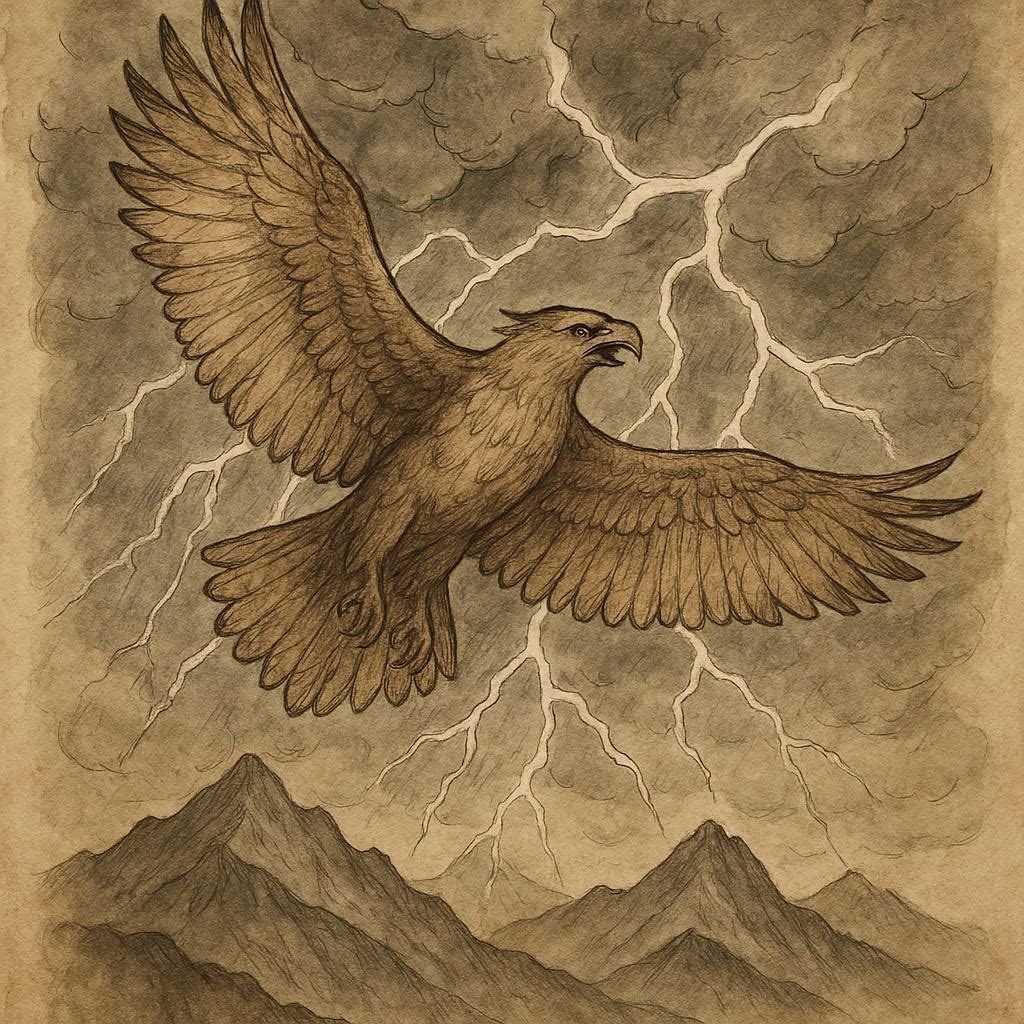
Across the endless plains and along the rugged peaks of the Pacific Northwest, stories are still told of the Thunderbird, a being of vast power, a guardian spirit of the skies, and the keeper of thunder, lightning, and rain. Long before towns and highways, before the sound of machines drowned the voice of the wind, the people looked to the heavens and saw more than clouds. They saw the wings of the Thunderbird moving through the storms, shaping the weather, and protecting the balance of the earth.
It is said that when the sky darkens and thunder rolls like the beating of a giant drum, the Thunderbird is stretching its mighty wings. Each flap stirs the winds into great tempests, and each flash of lightning is the gleam from its eyes. Rain follows its flight, falling to nourish the parched land below. The Thunderbird does not bring storms to destroy but to remind the world of the forces that hold creation together the dance of the sky and the earth, of light and darkness, of power and peace.
In ancient times, the people lived close to nature. They hunted only what they needed, spoke to the spirits of the rivers and trees, and honored the world around them. But as generations passed, pride crept into their hearts. They grew careless in their hunting, wasteful with the bounty of the land. The sacred fires were left cold, and the songs of gratitude fell silent.
Encounter the strange and the unseen — from Bigfoot to regional monsters hiding in America’s forests.
Then one season, the skies withheld their rain. The grass turned yellow, the buffalo wandered far, and the rivers shrank to mere trickles among cracked stones. The elders warned that the people had broken the harmony that tied them to the spirit world. They said the Thunderbird had seen this imbalance and would come again, not as a gentle guardian but as a storm of reckoning.
The day came when the air grew still and heavy, thick with the scent of rain that would not fall. The horizon darkened until the sun disappeared, swallowed by roiling clouds. The people gathered in their lodges, and even the animals went silent. Then a sound like a thousand drums shook the sky. Lightning split the heavens, and for an instant, they saw it Thunderbird, vast and terrible, descending from the clouds with wings that covered the valley and eyes burning like fire.
The storm raged through the night. Thunder shook the mountains, and lightning danced across the plains. The people fell to their knees in fear. They called to the spirits and promised to remember their duty to the earth. At last, the storm subsided. The rain came softly then, steady and cleansing, filling the rivers and washing away the dust of neglect.
When morning came, the sky was clear, and the earth smelled of new life. The Thunderbird had gone, but its message remained a warning written in the soil, in the water, and in the hearts of those who witnessed its power. From that day, the people never forgot to give thanks. They offered prayers before each hunt, songs before each harvest, and smoke to the sky in gratitude.
Yet the Thunderbird did not vanish into legend. Its presence lingered. Hunters would sometimes hear the flap of distant wings when a storm gathered, and fishermen would see shadows moving through the clouds before a downpour. To some, the Thunderbird was a sign of good fortune, a protector guiding them through danger. To others, it was a reminder that disrespecting the earth would bring swift punishment.
In the Pacific Northwest, great cedar totem poles rose in its honor. The Thunderbird was carved at the highest point, wings outstretched, lightning snakes clutched in its talons. Below it were the creatures of the earth and water, each representing the bond between worlds. The Thunderbird was both creator and judge, bridging the realms of spirit and man.
Many tribes tell stories of the Thunderbird’s battles against the great water serpents spirits of chaos that dwell in the depths of lakes and seas. When these serpents grew proud and tried to rise against the world above, the Thunderbird swooped down from the storm clouds, its lightning flashing across the waves. Their battle shook the mountains and churned the oceans. Finally, the Thunderbird struck the serpent with a bolt of fire so bright it turned night to day. The water boiled, and the serpent sank back into the deep, defeated.
From that time on, the people said that thunder and lightning are signs of the Thunderbird keeping watch forever guarding the balance between the sky above and the waters below.
In later generations, as settlers spread across the plains, stories of the Thunderbird took new forms. Travelers crossing the empty expanses told of enormous shadows gliding silently overhead. Ranchers found giant feathers lodged in canyon walls after storms. Some believed the Thunderbird to be only a myth, but those who heard the thunder rolling low across the prairie on a cloudless night whispered otherwise.
The elders still say that the Thunderbird appears when the world grows proud or careless when people forget that the earth beneath their feet and the sky above their heads are alive with spirit. Its storms are not only to cleanse the land but to awaken hearts. It comes to teach humility, to remind humankind that every river, every tree, every creature has its place in the great design.
Even today, as thunder echoes through distant valleys, the people tell their children to listen closely. Somewhere above, they say, the Thunderbird flies watching, waiting, guarding the balance between human and nature. And when lightning flashes across the horizon, it is not to frighten but to remind all living things that power without respect leads to ruin.
The legend endures not only because of its mystery but because of its truth. The Thunderbird lives in the storm, in the heartbeat of the earth, and in the lessons of those who came before.
Discover chilling ghost tales and haunted places that echo through America’s towns and countryside.
Moral Lesson:
The Thunderbird reminds us that strength and power must always serve balance. To live in harmony with the natural world is to walk in peace, but to forget that harmony is to summon the storm.
Knowledge Check
1. What does the Thunderbird represent in Native American tradition?
It represents power, balance, protection, and the natural world’s spiritual force.
2. What happens when people forget to respect the earth?
The Thunderbird brings storms to restore balance and teach humility.
3. Where is the Thunderbird believed to dwell?
High in the mountains or within the heart of storm clouds, guarding the world from above.
4. What creatures did the Thunderbird battle in legend?
Great water serpents that rose from the deep to challenge the sky.
5. Why is the Thunderbird honored on totem poles?
It symbolizes the highest power and protection, connecting the heavens to the earth.
6. What lesson does the Thunderbird teach humanity?
That all life is connected and that respect for nature is the foundation of balance.
Source:
Adapted from Native American myths recorded in Myths and Legends of the Great Plains by Katharine Berry Judson, 1913.
Cultural Origin:
United States (Plains and Pacific Northwest tribal mythology)