During the early years of American expansion, long before routes were fixed and landscapes fully documented, explorers depended heavily on maps. These maps were often incomplete, drawn from limited knowledge, and constantly updated as new paths were discovered. In such a time, uncertainty was expected.
But one story tells of a map that behaved in a way no ordinary map should.
It began with an explorer traveling through unfamiliar territory, carrying a hand-drawn map that had guided him reliably for several days. The markings were clear, the paths steady, and each direction led him exactly where he expected to go.
Until one morning, when everything changed.
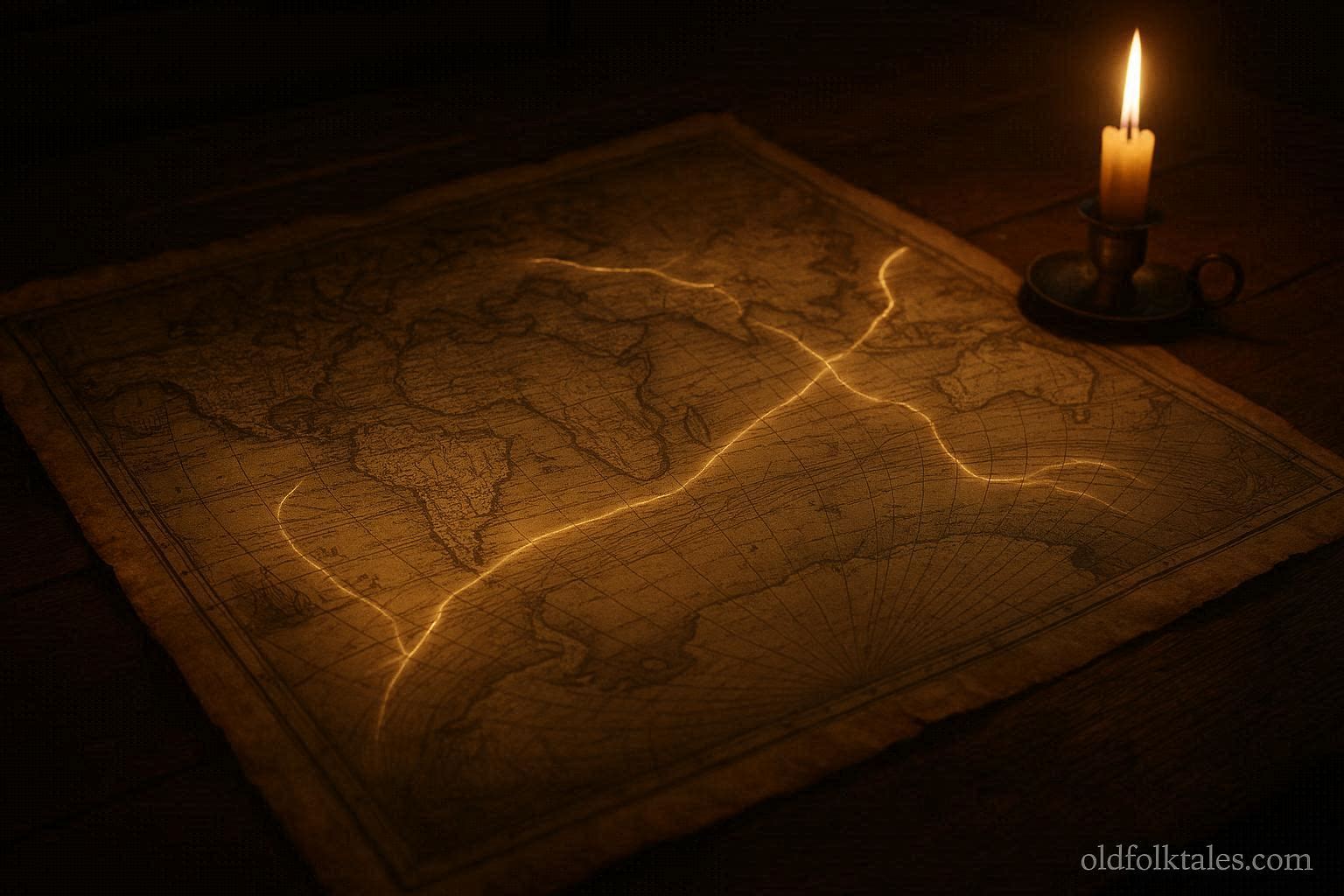
When he unfolded the map at dawn, he noticed something unusual. The lines that once showed a direct route now curved differently. Landmarks that had been clearly marked seemed to have shifted. At first, he assumed he had made a mistake, perhaps misreading the map in the low light of the previous night.
Discover chilling ghost tales and haunted places that echo through America’s towns and countryside.
He studied it carefully.
The details were not erased or smudged.
They were simply different.
Confused but determined, he followed the new path indicated on the map. The terrain ahead did not match what he remembered from the previous day. Yet the route led him safely through a series of difficult areas he might not have been able to cross otherwise.
By evening, he had reached a location that was not part of his original plan, but one that offered safety and resources he needed.
He could not explain how the map had changed.
Only that it had.
When he shared his experience, others were skeptical. Maps did not alter themselves. They were tools, fixed and dependable, created by human hands. Any difference must have come from error, not from the map itself.
Still, the story spread.
Another traveler later described a similar experience. He had been following a known route when his map began to show an unfamiliar detour. At first, he ignored it, choosing to rely on his memory instead. But as the path became more difficult, he reconsidered.
Reluctantly, he followed the altered direction.
The detour led him away from an area that had recently become unsafe, though he would not learn this until much later. In that moment, the map had guided him without explanation.
These accounts were not frequent, but they were consistent in their details.
The changes always occurred overnight.
The alterations were subtle but clear.
And the new paths often led to unexpected, yet beneficial, outcomes.
People began to wonder whether the map was truly changing, or whether something else was at work.
Some believed the explanation was simple.
Explorers, traveling under pressure and often fatigued, could misinterpret markings or remember details incorrectly. What appeared to be a change might have been the result of human error, combined with the unpredictable nature of the landscape.
Others considered a different possibility.
They suggested that the map represented more than just physical routes. In a time when much of the land was unknown, it was possible that direction itself felt uncertain. The map, in this sense, became a symbol of shifting understanding, where each journey revealed something new.
There were also those who viewed the story as a form of guidance.
Not in a physical sense, but as a reflection of decision-making. The explorer, faced with uncertainty, may have been more open to change, allowing him to take paths he might have otherwise ignored. The “changing map” then became a way of describing that experience.
Regardless of interpretation, the story continued.
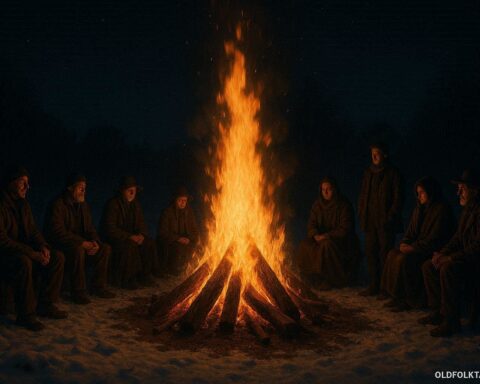
It was told among travelers, shared in camps and along routes where uncertainty was part of daily life. The idea that a map could shift its own paths captured the imagination, not because it was proven, but because it reflected the reality of exploration.
Nothing was ever fully fixed.
Routes changed.
Landmarks appeared and disappeared.
And every journey carried the possibility of the unexpected.
Over time, the legend became part of exploration-era folklore, preserved in collections such as those held by the Library of Congress. These archives document the evolution of maps and the challenges faced by those who relied on them.
Within that history, stories like this one add a human dimension.
They remind us that exploration was not only about geography, but also about perception, decision, and adaptation.
The map that changed its own paths may never be fully explained.
It may have been a misunderstanding, a reflection of uncertain conditions, or a story shaped over time.
But its meaning remains.
It speaks to the idea that not every path is fixed, and that sometimes, the direction we follow changes in ways we do not expect.
And in those moments, the journey continues, guided not only by what is known, but also by what is discovered along the way.
Explore how American legends shaped the nation — from frontier heroes to Revolutionary War tales.
Moral Lesson
Being open to change can lead to new opportunities, even when the path ahead is uncertain.
Knowledge Check
- What unusual object is central to the story?
A map that appeared to change its routes. - When did the changes usually occur?
Overnight. - Did the new paths lead to danger or safety?
Often to unexpected but helpful destinations. - What is one possible explanation for the changes?
Human error or misinterpretation. - What does the map symbolize in the story?
Uncertainty and the changing nature of exploration. - What is the main idea of the story?
That paths and decisions can change, leading to new outcomes.
Source
Adapted from materials preserved by Library of Congress
Cultural Origin
Exploration-era folklore