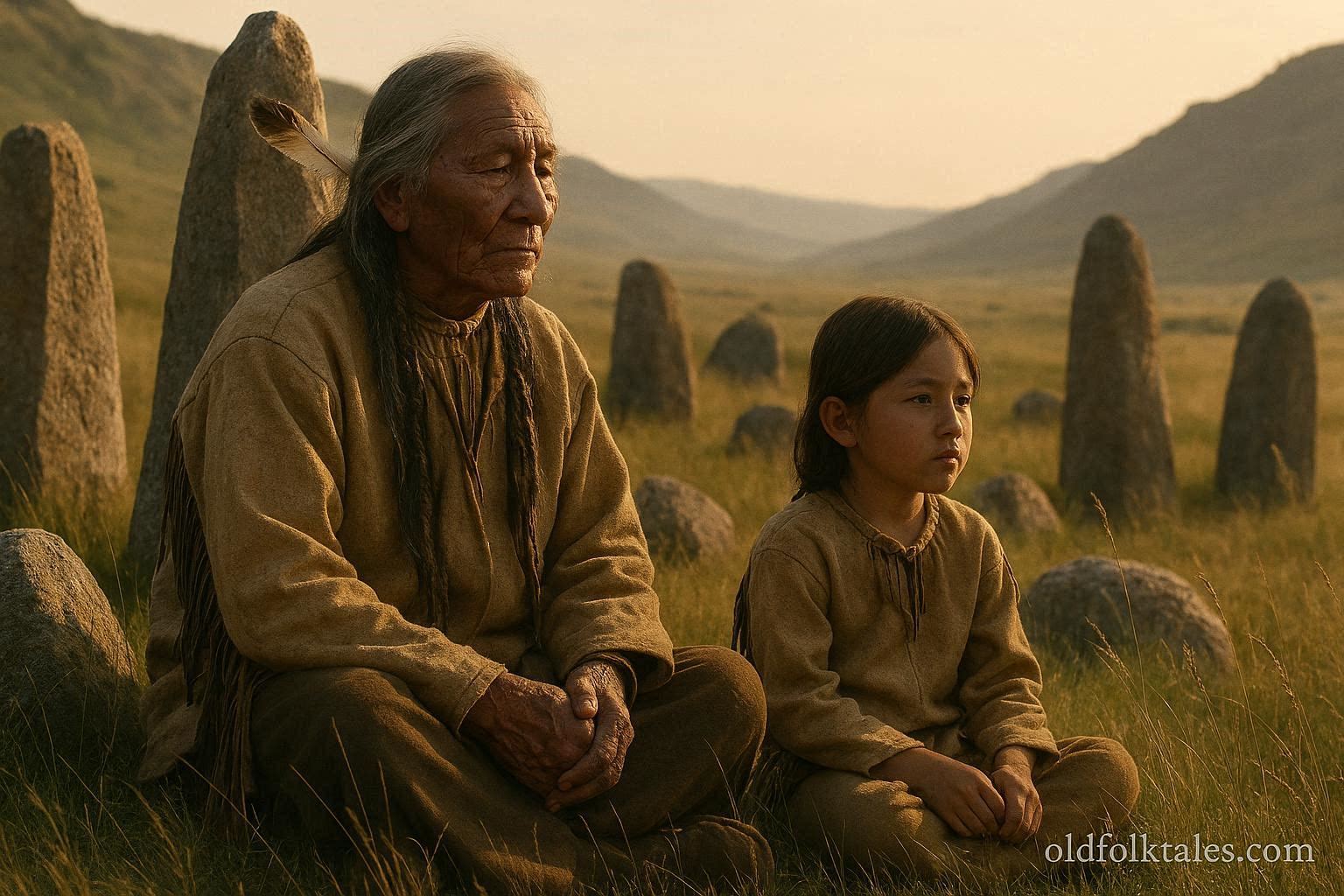
Long before towns and highways appeared on the plains, the Blackfoot people lived in deep connection with the land. They understood that every river, mountain, animal, and stone carried memory and meaning. Life was guided by observation, patience, and respect for the natural world. Among the people lived an elder known simply as the Quiet Old Man. He was not like the others. He rarely joined hunting parties or the daily bustle of the village. Instead, he spent his time walking to a secluded valley filled with stones of all shapes and sizes. Some were tall and smooth, shaped by centuries of wind and rain, while others were small and half buried in the earth.
The villagers were puzzled by his habit. Most ignored him, assuming he was eccentric or foolish. Young hunters sometimes laughed at him when they saw him sitting among the rocks for hours on end. They would say to one another that stones could not speak and that the elder was wasting his time. The Quiet Old Man never responded. He simply continued his routine, convinced that the stones held stories for anyone who would listen.
One day, a young boy who was curious about the elder decided to follow him. The boy had always been quiet and observant, often wandering along the edges of the camp to watch birds, insects, and clouds. He admired the elder’s patience and wanted to know why he spent so much time among stones. When he arrived at the valley, the elder greeted him with a nod and motioned to a large, flat stone.
Explore how American legends shaped the nation — from frontier heroes to Revolutionary War tales.
“Sit here and be quiet,” the elder said. “Listen and observe.”
The boy did as he was told. For long minutes, all he could hear was the soft wind moving through the tall grass and the distant calls of birds. The valley seemed ordinary, yet the elder’s presence gave it a sense of calm and purpose.
The elder placed his hands on the stone beside him. “Do you feel it?” he asked.
The boy shook his head.
“Stones remember,” the elder explained. “They remember the footsteps of animals, the movements of our ancestors, the rains and winds that shaped this land. If you listen carefully, they will teach you what we cannot see with our eyes.”
At first, the boy could not understand. How could stones remember anything? How could they teach? But he remained patient, watching the elder closely. Over the hours, he began to notice subtle changes in the air and the way the sun illuminated the stones. He began to imagine the paths of buffalo that had crossed the plains long ago, the footsteps of hunters who had walked with care, and storms that had carved rivers and valleys. He imagined generations of his people living, traveling, and leaving traces that the land quietly preserved.
The elder spoke gently, “The world has memory. You do not need words to hear it. You simply need to observe, respect, and understand.”
Days turned into weeks, and the boy returned often. He learned to watch the wind and grass, to notice the shapes of stones and the patterns of shadows. He learned that wisdom was not always spoken. Sometimes it was felt, imagined, or discovered by connecting with the land. The elder taught him that patience and respect were the keys to listening to the Earth.
Over time, the boy became known in the village for his attentiveness. He would quietly guide other children to the valley, showing them how to sit among the stones, to close their eyes, and to imagine the world that had existed before them. Villagers slowly began to understand the elder’s teachings. They realized that the land itself carried lessons that could not be found in stories or spoken words alone.
Years passed. The elder grew older and weaker, but he continued his daily walks to the valley. He no longer spoke as much, yet his presence inspired respect. One morning, he sat beside a particularly large stone as the sun rose over the plains. Golden light spilled across the valley, and the grass swayed gently in the breeze. The young man, now grown, joined him there.
“Grandfather,” he asked, “why do the stones matter so much?”
The elder rested his hand on the stone and said, “Because they remember everything. They remember life, storms, joy, sorrow, and the footsteps of all who walked before us. They are the keepers of memory and wisdom. To listen to them is to connect with the past, understand the present, and prepare for the future.”
Not long after that day, the elder passed away quietly, leaving the young man to carry on his teachings. The valley of stones became a place of learning for generations, where children and adults alike were taught to sit, observe, and listen. They learned that every stone, river, and tree had a story, and that the Earth itself was alive with memory.
The young man never forgot the lessons he had learned. He reminded the villagers that true wisdom required patience, attentiveness, and respect for the natural world. The stories of the stones endured because those who listened carefully passed them on. The valley remained a sacred place, a connection between the people and the land, and a reminder that knowledge could be found in the most silent and unassuming places.
Through his teachings, the Blackfoot people came to see the world as alive, patient, and wise. The Quiet Old Man’s lessons were not just about stones. They were about living with care, observing deeply, and understanding that the world itself holds secrets and stories that can guide those willing to hear them.
Click to read all American Folktales — timeless oral stories passed through generations across the United States.
Moral Lesson
Patience, respect, and careful observation of the natural world reveal wisdom and guidance that cannot be taught through words alone. Listening to the land teaches humility and connects us to the past and future.
Knowledge Check
- Why did the old man spend hours sitting among the stones?
He believed the stones held memories of the land and the ancestors. - How did most villagers initially view the elder?
They laughed at him and thought his behavior was strange or foolish. - What did the boy learn by observing the stones and the valley?
He learned that the land carries stories and wisdom that can be understood through patience. - How did the elder describe the way stones communicate?
He explained that they communicate through memory, observation, and presence, not through words. - How did the young man continue the elder’s teachings?
He guided children and villagers to observe and respect the land, sharing the elder’s lessons. - What overarching lesson does the story convey about human interaction with nature?
That respecting and listening to the natural world fosters understanding, wisdom, and a deeper connection to life.
Source
Adapted from materials preserved in the Newberry Library American Indian and Indigenous Studies Collection
Cultural Origin
Blackfoot traditions