Long before the desert lands of the American Southwest were dotted with pueblos and trading paths, the region endured long periods of drought. Rivers ran shallow, springs dried, crops withered in the soil, and animals wandered far in search of water. The people of the Hopi and Pueblo communities looked to the skies and prayed for relief, understanding that survival depended on the balance of the natural world. It was during one such harsh season that a wandering spirit appeared, carrying a flute that would bring life, abundance, and joy to the land. This was Kokopelli, the hunchbacked flute player, a spirit known for mischief, guidance, and renewal.
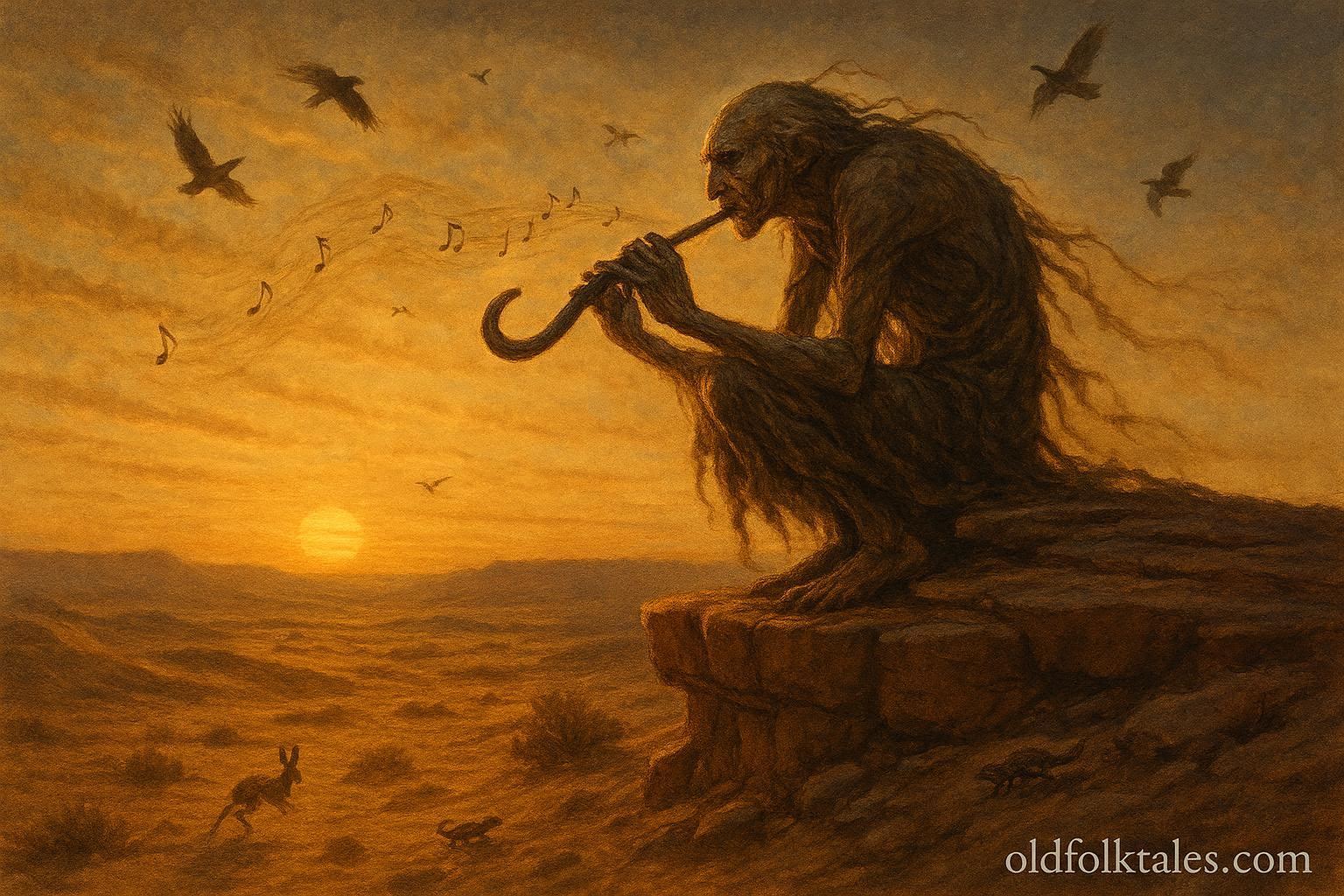
Kokopelli’s presence was unmistakable. His small, curved flute could be heard for miles as he moved across mesas, canyons, and desert plains. Each note carried more than a melody; it was a pulse of energy that stirred the earth, coaxed clouds to form, and encouraged seeds to sprout. Animals, once scarce due to lack of water, returned to the rivers and fields, following the invisible trail of music that promised nourishment and safety. Wherever Kokopelli went, life bloomed in the desert, restoring balance to a land that had been parched for months.
One story recounts a small Pueblo village enduring its third year without sufficient rain. The elders gathered to offer prayers, but their chants seemed to echo into empty skies. One evening, as the sun set and the horizon blazed in brilliant red, a slender figure appeared along the ridge above the village. The people watched as he carried a curved flute and danced lightly across the rocks. As the first notes drifted from the instrument, a gentle wind stirred, carrying the sound through the canyon. The villagers felt hope rekindle within their hearts. Clouds began to gather, and before long, rain fell softly, soaking the cracked earth and nourishing the crops. The people rejoiced, dancing and singing alongside Kokopelli, understanding that his music had transformed despair into life.
Explore how American legends shaped the nation — from frontier heroes to Revolutionary War tales.
Kokopelli’s influence was not limited to rain and fertility. His playful nature taught important lessons about balance, joy, and attentiveness to the land. He would sometimes appear during festivals, encouraging children to chase after his dancing figure or join in his music. Elders explained that this was a form of teaching: the desert could be harsh and unforgiving, but with attentiveness, respect, and creativity, humans could thrive alongside the natural world. His music carried messages of patience and observation, guiding people not only through drought but through the rhythms of daily life.
Travelers and hunters who ventured through the desert reported glimpses of Kokopelli on ridges, atop sandstone cliffs, or near sacred springs. They described a small figure with a humped back, animated movements, and a flute that seemed to sing with the wind itself. Wherever he appeared, the land responded: plants flourished, animals returned, and rivers and springs swelled with fresh water. The Spirit’s influence reminded humans that they were never truly separate from the natural world but part of an interconnected system where every act of care and respect mattered.
In some tales, Kokopelli would play longer, more intricate melodies to teach communities the importance of cooperation. Villagers following his music learned to irrigate fields efficiently, plant seeds according to the changing seasons, and watch for signs of animal migration. The flute became a tool not only for renewal but for education, carrying the wisdom of the spirit into every corner of the community.
As generations passed, Kokopelli became a cultural icon. His image was carved onto pottery, painted on walls, and depicted in ceremonial dances. His music, once ephemeral, was celebrated in ritual and story, connecting the people to a past where the harmony between humans and nature was crucial for survival. The Hopi and Pueblo people came to see him as a symbol of fertility, abundance, joy, and the enduring power of the natural world.
Even in modern times, Kokopelli’s story continues to inspire. Children hear of the hunchbacked flute player who brings life to the desert, and adults remember that prosperity and survival require care, respect, and attentiveness. The legend emphasizes that guidance and protection are often woven into the natural and spiritual worlds. Music, dance, and play are not merely for amusement but are ways of aligning with the rhythms of life itself.
Through Kokopelli, the Hopi and Pueblo traditions teach that abundance is not guaranteed but earned through harmony with the land, mindfulness of natural cycles, and joy in the process of living. The desert may appear harsh and unforgiving, yet the Spirit’s flute demonstrates that even the most barren lands can bloom when approached with care and reverence. Every note of Kokopelli’s music carries a promise: that the world is alive, and humans have a role in its renewal.
The legend of Kokopelli reminds us that creativity, attentiveness, and respect are as vital as rainfall and fertile soil. Life thrives when humans act in harmony with nature, and guidance can come from unexpected sources — even a playful, hunchbacked spirit carrying a simple flute. The story endures not only as myth but as a teaching about survival, cooperation, and the enduring magic of the natural world.
Explore ancient Native American creation myths and the symbolic tales that shaped America’s belief systems.
Moral Lesson
The legend teaches that humans must live in harmony with nature, respect its cycles, and approach challenges with creativity, patience, and joy. Abundance and renewal are gifts that come to those who act thoughtfully and reverently.
Knowledge Check
- Which cultures tell the story of Kokopelli?
Hopi and Pueblo peoples - What does Kokopelli carry?
A curved flute that brings rain, fertility, and abundance - How does his music affect the land?
It causes rivers to swell, crops to grow, and animals to return - How does Kokopelli teach people beyond bringing rain?
Through playful tricks, music, dance, and lessons in respect and joy - What does the legend emphasize about human-nature relationships?
Harmony with the land ensures survival, prosperity, and renewal - Why is Kokopelli’s image significant today?
As a symbol of fertility, abundance, creativity, and the connection between humans and nature
Source
Adapted from materials preserved in the Arizona State Museum
Cultural Origin
Hopi and Pueblo traditions of the American Southwest