Night settles softly on St. Helena Island. The marsh grass lowers its rustling. Cicadas slow their rhythm. The tide draws back from the shore with careful patience. Sound travels differently here, carried by water and memory alike. In that quiet, something else sometimes rises. A layered sound. Human voices, blended and measured, moving together as if guided by a shared breath.
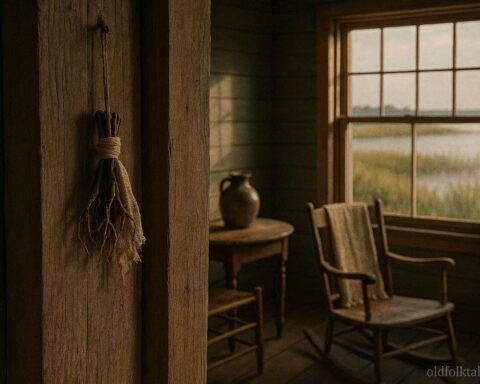
The singing does not come from homes or churches still in use. It drifts from praise houses that have stood empty for generations.
These small wooden structures once formed the spiritual heart of Gullah Geechee communities. Built close to the land and water, praise houses were spaces of worship, gathering, teaching, and survival. Enslaved Africans and their descendants shaped these places according to inherited traditions, blending Christian belief with West and Central African spiritual practices. Song was central. Voices carried history when written records were denied. Harmony became memory.
Explore the heart of America’s storytelling — from tall tales and tricksters to fireside family legends.
After emancipation and migration, many praise houses were left unused. Some collapsed. Others remained standing, their doors closed, their benches worn smooth by decades of presence. Time moved forward, but not everything moved with it.
The first reports of the phantom choir came from elders who knew the old songs by heart. They spoke of hearing hymns sung correctly, not loosely remembered but precise in rhythm and structure. Call and response patterns returned intact. Harmonies followed traditional lines. The songs were not random. They belonged.
Younger listeners described it differently. They heard singing without words they could clearly understand. The sound felt welcoming, not frightening. It rose gently and faded without urgency. No single voice dominated. The choir functioned as one body.
The singing is most often heard after sunset, especially on nights when the air is heavy and still. It carries farther during high tide, when water presses close to the island’s edges. Those who follow the sound find the praise houses dark and empty. No candles. No movement. No warmth. Only the echo of voices that vanish upon arrival.
Some say the choir sings on dates associated with community gatherings long past. Others believe the voices return during moments of cultural threat, when land, language, or memory faces erosion. There is no consensus. Only repetition.
Researchers working with the University of South Carolina Gullah Geechee cultural heritage archives have documented oral histories describing similar phenomena across the Sea Islands. The details vary, but the tone remains consistent. The singing does not demand attention. It offers continuity.
The belief held by many elders is that ancestors remain tied to sacred spaces shaped by collective devotion. Praise houses absorbed the voices of generations. They learned the songs. When the living grew quiet, the houses remembered.
Unlike other hauntings, the phantom choir does not attach to tragedy alone. It connects to endurance. To faith practiced under pressure. To community formed through shared sound.
One caretaker tasked with maintaining an abandoned praise house reported hearing singing while repairing floorboards. He described the sound as coming from above and within the walls at once. He did not feel afraid. He worked more slowly, carefully, as if not to interrupt.
Visitors unfamiliar with the tradition sometimes mistake the singing for nearby gatherings. They search for people and find none. Those who recognize the hymns often stop moving altogether. They listen.
There are stories of individuals who joined the singing instinctively, humming or whispering responses. In these accounts, the choir does not grow louder. It simply continues until the living voice stops, then fades.
The phenomenon does not occur during festivals or reenactments. It does not perform. It exists independently of audience.
For Gullah Geechee communities, the phantom choir affirms that ancestral presence is not confined to the past. Memory remains active. Sacred spaces retain function even when formal use ends. Worship, once practiced deeply enough, does not require bodies to continue.
The praise houses stand as vessels. Wood and nails shaped by hands that carried generations forward. The singing honors that labor.
Modern preservation efforts have stabilized some of these structures. Interpretive signs explain their history. Yet the choir does not respond to explanation. It responds to stillness.
Those who hear it often leave offerings of silence rather than objects. They lower their voices. They step lightly. They remember names.
The singing never reaches a climax. It does not resolve. It fades gradually, as if the choir is always mid song, always continuing elsewhere.
On St. Helena Island, the living and the remembered share the same air. And when the night is quiet enough, the ancestors sing themselves back into being.
Click to explore all American Ghost Stories — haunting legends of spirits, lost souls, and mysterious places across the U.S.
Moral Lesson
When community is built through shared belief and voice, its spirit endures beyond physical presence and continues to guide future generations.
Knowledge Check
1. Where is the phantom choir heard?
Near abandoned praise houses on St. Helena Island.
2. What kind of songs does the choir sing?
Traditional hymns rooted in Gullah Geechee worship practices.
3. When is the singing most often heard?
At night, especially during still air and high tide.
4. Are any physical figures seen with the singing?
No, the sound occurs without visible people.
5. What does the choir represent to the community?
Ancestral presence, continuity, and sacred memory.
6. Why is the haunting considered sacred rather than frightening?
Because it reflects endurance of faith and communal identity.
Source
Adapted from University of South Carolina Gullah Geechee cultural heritage archives and Sea Islands oral tradition documentation.
Cultural Origin
Gullah Geechee communities of the South Carolina Sea Islands.