The village stretched across the plains under a wide, pale sky, where the wind carried the soft scent of dry earth. Life moved in its usual rhythm, and the villagers went about their chores with quiet determination. Children played near the paths, elders observed the land, and the fields waited patiently for rain. There had been little water in recent weeks, and the people hoped for clouds to bring relief.
One morning, dark clouds appeared on the horizon, gathering as if in anticipation. The villagers looked up with expectation, waiting for the long-awaited rainfall to reach the thirsty soil. They noticed that the clouds seemed to drift slowly toward the village, their shadows stretching across the ground like fingers reaching for the earth. The air grew heavy with moisture, and everyone felt a sense of hope rising within them.
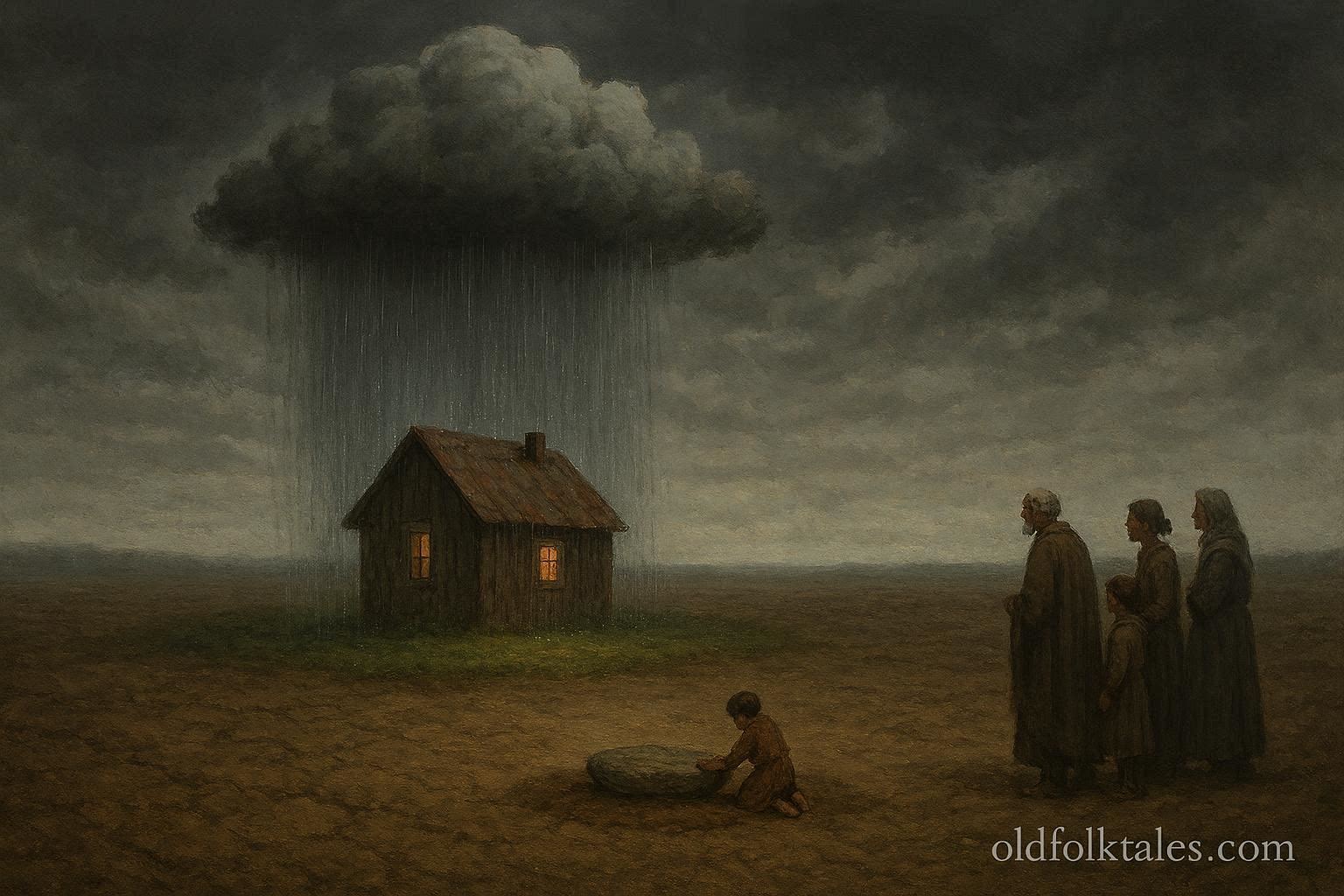
Then something extraordinary happened. Rain began to fall, but only on one house at the edge of the village. The family inside heard the first drops striking the roof and walls, their soft rhythm echoing through the quiet rooms. Curious, they stepped outside and realized that their home was entirely surrounded by a small dark cloud. Rain poured down steadily, drenching the house and soaking the ground beneath it. Beyond the boundary of the cloud, however, the land remained completely dry. No drop touched the neighboring homes, fields, or paths.
Explore ancient Native American creation myths and the symbolic tales that shaped America’s belief systems.
The villagers gathered at a distance, murmuring among themselves. They watched the rain fall on the isolated house as if it had been chosen by some unseen force. Some approached the home, stretching out their hands to feel the water, but the moment they stepped beyond the edge of the soaked area, the rain stopped touching them. The cloud remained perfectly over the house, unwavering, giving the impression that it had been deliberately placed there for a reason that no one yet understood.
The family inside the house felt a mix of confusion and unease. The rain was gentle, almost soothing, yet the situation seemed unnatural. As hours turned into days, the cloud continued to hover, moving only to follow the house, never expanding or drifting away. The surrounding village remained completely dry, and whispers began to spread. Some villagers believed it was a blessing, a sign that the family had been specially chosen. Others feared that it was a warning, a message sent from the spirit world that required attention.
The elders were summoned to investigate. They arrived slowly, observing the phenomenon without speaking. They watched the cloud, the rain, and the family, taking in every detail. In their traditions, unusual occurrences were never random; they were messages. Each small sign carried meaning, and understanding it required thought, reflection, and respect. The elders began to ask the family questions, seeking to uncover any recent events or actions that might have disturbed the balance between the people and the natural world.
As the family recounted recent activities, small details emerged that at first seemed insignificant. They had traveled to a sacred site in the forest, exploring areas that were traditionally protected. While there, they had taken a small stone as a keepsake, believing it to be harmless. The elders listened intently, their expressions growing serious. The seemingly ordinary stone was not ordinary at all. Its removal had disturbed the balance that maintained harmony between the village, the land, and the spirits who watched over it.
The elders explained that the rain cloud was a response to this disturbance. It was not meant to punish the family but to draw attention to the broken balance. The rain falling only on their home symbolized isolation and reflection, signaling that a correction was needed before normalcy could return. The family began to understand the connection between their actions and the extraordinary rain. They felt a growing responsibility to restore what had been disrupted.
A plan was made to return the stone to its rightful place. The family, guided by the elders, traveled back to the sacred site with care and reverence. The journey was deliberate, each step taken with thoughtfulness and respect. When they arrived, they placed the stone back exactly where it had been taken and offered words of apology and acknowledgment of the mistake. They spoke softly to the land, promising to honor it and maintain the proper balance in the future.
Meanwhile, back in the village, the cloud above the house remained, heavy and dark. But slowly, almost imperceptibly, it began to thin. The steady rainfall became lighter, softening into scattered drops. By the time the family returned from the sacred site, the cloud had completely disappeared, leaving the house wet but free from any lingering storm. The rest of the village, which had remained dry all along, resumed its normal rhythm, and a quiet sense of relief settled over the community.
The story of the rain that fell on only one house became part of the village’s oral history, retold to each generation as a lesson about respect, balance, and connection with the natural world. It was not remembered as a tale of punishment, but as a reminder that every action has consequences and that harmony with the land requires mindfulness and care. Whenever unexpected rain appears in small, isolated areas, villagers remember the tale and reflect on their own actions, asking whether balance has been maintained or disrupted.
This legend emphasizes that nature communicates in subtle, precise ways. The selective rainfall was not random, nor was it cruel. It was deliberate and purposeful, a message from the world that requires attention. By observing, understanding, and responding with respect, people can maintain harmony with the forces that sustain life and ensure that blessings such as rain continue to nourish the land.
Click to read all American Traditions & Beliefs — the living folklore of daily life, customs, and superstitions.
Moral Lesson
Actions have consequences, especially when respect for nature and sacred places is ignored. Restoring balance begins with acknowledgment, reflection, and sincere effort to correct mistakes.
Knowledge Check
- What made the rain unusual in the story?
It fell only on one house while the rest of the village remained dry. - How did the villagers initially react to the rain?
They were confused and observed the phenomenon from a distance. - Why did the rain target that particular house?
The family had taken a sacred stone without proper respect, disturbing balance. - What object had been taken from the sacred place?
A small stone. - How was balance restored?
The stone was returned with reverence, and the family acknowledged their mistake. - What is the overall lesson of the story?
Respect for nature and sacred traditions is essential; ignoring them can bring consequences.
Source
Adapted from materials preserved in the Harvard University Peabody Museum Archives
Cultural Origin
Northeastern tribal traditions