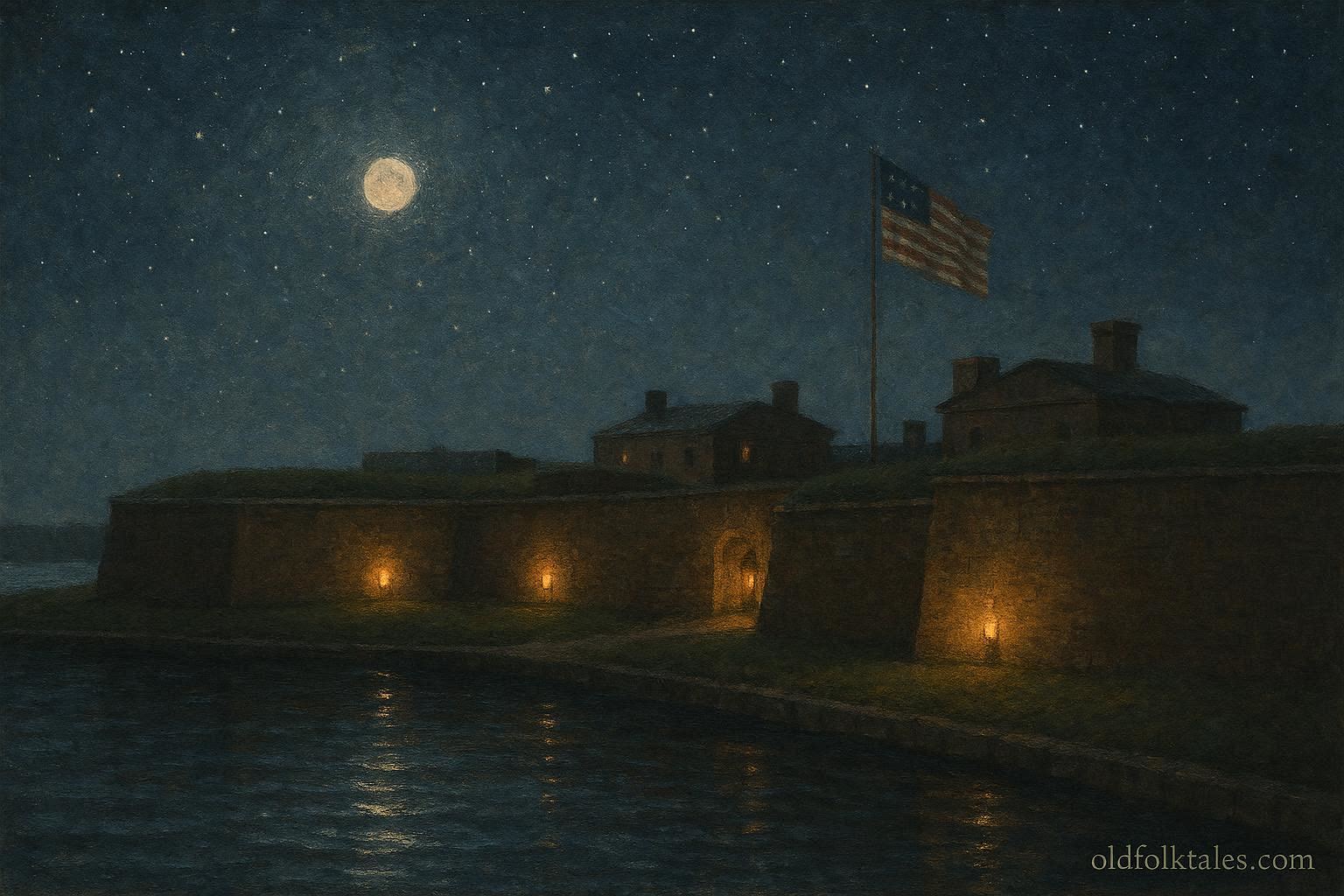
Smoke reached the water before the sound arrived. Long before the cannons spoke, the harbor carried the warning of what was coming. Ships lay anchored under uneasy skies, lanterns dimmed, crews hushed. Across the dark expanse of water stood Fort McHenry, silent and resolute, guarding the city beyond like a locked door whose strength would soon be tested.
Among those watching was a lawyer who had not come to fight.
His purpose had been legal, almost routine. He carried papers and letters, not weapons. He had crossed enemy lines under a flag of truce to negotiate the release of a civilian prisoner. The discussions were tense but successful. The man was freed. The duty was complete. Yet timing turned obligation into confinement. British commanders, preparing for an imminent assault, refused to allow the lawyer’s return to shore. He had overheard too much. The harbor became his prison.
As evening settled, the lawyer found himself standing on the deck of a small vessel, unable to move closer or farther from the coming storm. He could see the fort only faintly, its outline swallowed by darkness. He could hear the water lap against the hull, steady and indifferent. The city behind the fort lay quiet, unaware of how near devastation hovered.
Discover African American wisdom, Native American spirit stories, and the humor of early pioneers in American Folktales.
When the bombardment began, it came without mercy.
Rockets streaked across the sky, painting brief red paths through the darkness. Shells arced high, paused, and then burst in blinding flashes before crashing down upon the fort. Each explosion shook the water beneath the ship, rattling wood and iron alike. Smoke rolled outward, thick and suffocating, masking the shoreline again and again.
The lawyer watched helplessly.
He counted the seconds between blasts. He listened for replies from the fort’s guns and feared each pause meant surrender. Rain began to fall, soaking his coat and slicking the deck beneath his boots. The British officers nearby spoke calmly, confident in their firepower and convinced that the fort could not withstand the assault through the night.
But the night refused to end.
Hour after hour, the sky burned. Each time the smoke cleared briefly, the lawyer searched for a single sign. Near the fort’s ramparts flew an enormous flag, sewn deliberately large so it could be seen from great distances. At times it vanished behind smoke and darkness. At other moments, illuminated by fire, it appeared again, still raised.
Those glimpses mattered more than the cannons.
The lawyer thought of the people beyond the fort walls. Families huddled indoors. Streets waiting for ruin or reprieve. A nation still young enough to doubt its own permanence. He thought of the law, of carefully written words meant to guide order and justice, and how fragile they felt against iron and flame.
He could do nothing to change the outcome. That helplessness pressed harder than fear. All he could do was witness and remember.
The bombardment continued through the long hours before dawn. The fort fired back when it could, its resistance stubborn but strained. Smoke drifted endlessly. Water reflected fire and shadow in restless patterns. The lawyer remained at the rail, eyes burning, body aching, refusing to retreat below deck.
As the sky finally began to pale, the cannons fell silent.
The sudden quiet felt unreal. No signal followed. No cheer rose from the ships. The harbor held its breath. Smoke thinned slowly, revealing fragments of shoreline. The lawyer leaned forward, searching the fort through the haze.
Then he saw it.
The flag still stood.
It was heavy with rain, torn by fire, darkened by smoke, but unmistakably present. The fort had not fallen. The city had endured. The night, for all its fury, had failed to break what it sought to destroy.
Relief struck first, sharp and breathless. Then came something deeper. Awe. Gratitude. A sense that the moment demanded record before memory could soften its edges. The lawyer reached for paper and pen and began to write, capturing not victory but survival. He wrote of rockets and bombs, of watching and waiting, of a banner that remained when everything else seemed uncertain.
The words came quickly, driven by emotion rather than polish.
When he finally returned to shore, the poem followed him. It was shared, printed, sung. Set to a familiar tune, it traveled faster than he ever could. People recognized themselves in it. Not as conquerors, but as witnesses to endurance.
The lawyer returned to his profession. He argued cases. He lived quietly. Yet the night he spent trapped in the harbor refused to fade. Over time, the song born from his words grew into something larger than its creator. It became a marker of national identity, called upon during moments of trial and remembrance.
What endured was not the image of battle but the image of persistence.
The story reminds generations that survival itself can be heroic. That unity can be forged not only through triumph, but through shared fear, shared hope, and shared memory. The midnight defender did not raise a sword or command troops. He watched. He remembered. He recorded.
And in doing so, he gave a nation a language for resilience.
Explore ancient Native American creation myths and the symbolic tales that shaped America’s belief systems.
Moral lesson
History is shaped not only by those who fight, but by those who bear witness with courage. Preserving memory during moments of fear can unite generations long after the danger has passed.
Knowledge Check
1. Why was the lawyer detained on the ship during the attack?
Because British commanders believed he knew details of their military plans.
2. What made the bombardment especially distressing to witness?
The inability to know whether the fort had surrendered or fallen.
3. Why was the flag significant during the night?
It served as the only visible sign that the fort still held.
4. What inspired the lawyer to write his account?
The emotional impact of witnessing endurance under fire.
5. How did the poem change over time?
It evolved from a personal reflection into a national symbol.
6. What does the story suggest about national strength?
That endurance and memory are as powerful as military victory.
Source
Adapted from Library of Congress early American wartime manuscripts and song history archives
Cultural Origin
Early 19th-century United States, War of 1812 era