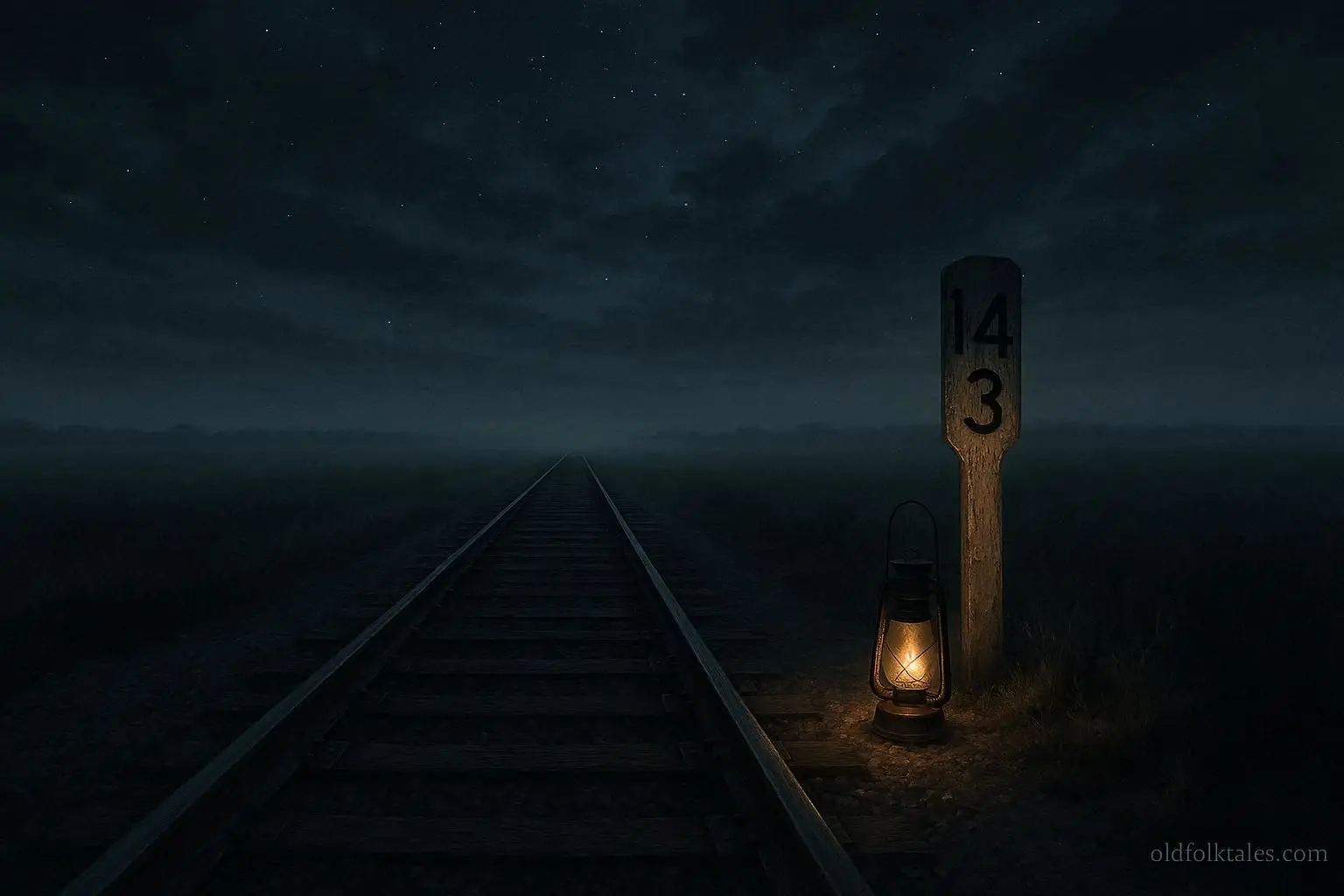
Night settles differently along the Northern Plains rail lines. The land flattens into long breaths of grass and gravel, and sound travels farther than sight. Engineers who run the late freights learn this quickly. A horn carries for miles. A loose coupling echoes like a knock on a door that no one answers. Somewhere beyond the glow of the headlamp, the track bends toward a place maps no longer mark, yet crews still whisper about it. Mile 143.
The junction once existed only to solve a problem. Two lines crossed here, one feeding grain eastward, the other pulling coal and timber west. Before automated signals and centralized control, the safety of every passing train depended on a single human decision. A switch had to be thrown by hand. A lantern had to be raised at exactly the right moment. The man assigned to that task lived alone beside the track, sleeping lightly and waking to the vibration of distant wheels.
His name appears only briefly in payroll records and maintenance logs. He was listed as a switchman, paid by the month, trusted with the lives of crews he might never meet face to face. Each evening he walked the length of the rails, checking bolts, clearing debris, listening for changes in the wind that might carry a train sooner than expected. When storms rolled in, he stayed outside longer, knowing rain and snow could hide danger.
Explore ancient Native American creation myths and the symbolic tales that shaped America’s belief systems
The junction closed quietly. Steel was rerouted, schedules adjusted, and the switch was removed. The small shack was boarded, then left to weather. Grass crept over the gravel bed. Eventually the rails themselves were lifted, leaving only a faint scar in the land. Mile 143 disappeared from official charts, yet the old milepost remained, leaning slightly, its numbers still visible beneath rust.
Years later, the first report came from a freight crew running an unfamiliar overnight route. The engineer swore he saw a lantern ahead, swinging slowly from side to side. Expecting a work crew or a signal error, he slowed. The light did not flicker like an electric lamp. It burned steady and warm, the way oil flames once did. Beside it stood a man in a long coat, arm raised, body angled toward a track that no longer branched.
When the train passed the spot, there was nothing there. No person, no light, no structure. Only grass bending back into place.
Stories like this tend to spread carefully among railroad workers. Too much detail invites ridicule. Too little leaves room for doubt. But the accounts kept repeating. Always at night. Always near Mile 143. Always during weather changes, when visibility dropped and mistakes were more likely. Some crews reported hearing the scrape of metal on metal, as if a switch were being thrown. Others felt the train slow without explanation, brakes responding before hands touched the controls.
Old timers began to talk. They remembered the junction, the man who worked it, the way he refused reassignment when automation threatened his post. He believed the crossing was dangerous even after traffic declined. He trusted his eyes and ears more than new systems. When he died, it was said he did so alone, during a blizzard, found beside the track with his lantern still lit.
Whether that detail is fact or embellishment no one can say. What remains consistent is the role he plays in every retelling. The switchman does not frighten. He does not chase or warn with anger. He simply does his job.
One winter night, a westbound train encountered heavy fog. Signals blurred into pale smudges. Radio chatter crackled with uncertainty. As the engineer leaned forward, straining to read the track ahead, a lantern appeared. It swung once, then steadied. The engineer eased off the throttle, reducing speed just enough to notice a fallen tree across the rails ahead. The stop prevented a derailment that would have stranded the crew for hours in subzero temperatures.
Maintenance teams later cleared the obstruction. No one admitted to placing a warning. The official report listed “operator caution” as the cause of the safe stop. But among the crew, the story settled differently. Someone had been watching.
The haunting of Mile 143 is not dramatic in the way popular ghost tales often are. There are no screams, no sudden apparitions in mirrors. There is repetition instead. A figure doing the same task, night after night, long after the need has passed. Responsibility made permanent by habit.
Railroad culture understands this kind of devotion. Tracks demand attention. Trains forgive nothing. Every rule exists because someone once failed to follow it. The switchman embodies that knowledge. He is a reminder shaped like a man.
New engineers hear the story during training runs. Veterans mention it casually, the way one might mention a sharp curve or a stretch prone to ice. They do not ask if it is real. They ask only whether anyone has seen the lantern recently.
Mile 143 remains quiet during the day. Sunlight reveals nothing but grass and ballast. But at night, when schedules slip and weather turns, when human error has room to grow, a light sometimes appears where no light should be. It does not speak. It does not judge. It guides.
And trains keep moving safely through a place that no longer exists, protected by a worker who never clocked out.
Click to explore all American Ghost Stories — haunting legends of spirits, lost souls, and mysterious places across the U.S.
Moral Lesson
True duty does not seek recognition. Responsibility carried with care can outlast systems, technology, and even life itself.
Knowledge Check
1. Where does the Switchman appear in the story?
He appears near Mile 143, an abandoned railroad junction no longer marked on maps.
2. What object signals his presence?
A hand carried lantern that burns steadily like an old oil light.
3. When is the Switchman most often seen?
During nighttime runs, especially in fog, storms, or changing weather conditions.
4. How does the Switchman protect train crews?
By signaling caution and prompting engineers to slow down before unseen dangers.
5. Why is the haunting considered calm rather than frightening?
Because the figure performs a protective duty rather than causing harm or fear.
6. What does the Switchman symbolize in railroad culture?
Enduring responsibility, vigilance, and respect for human labor.
Source
Adapted from Montana State University transportation folklore archives and Northern Plains railroad labor narratives.
Cultural Origin
Northern Plains railroad settlements of the United States.