The Alamo was never silent during the siege. Even at night, the air carried the sound of distant movement, whispered conversations, and the constant awareness that the walls were watched. Inside the mission, soldiers and volunteers prepared for battle, while a small number of civilians waited, uncertain of what the coming days would bring.
Among them was a widowed woman whose name was never preserved. She was not listed among the defenders, nor recorded as a casualty. She existed in the spaces between official accounts, remembered only through a ledger written in her steady hand.
She arrived before the siege fully closed, at a time when the mission still functioned as a place of gathering rather than confinement. Some believed she had followed her husband west, only to lose him shortly after arriving. Others said she had already been widowed and sought refuge where there were walls and people. No document confirms her story. What remains is the record she kept.
Explore the heart of America’s storytelling — from tall tales and tricksters to fireside family legends.
Inside the Alamo, order was difficult to maintain. Men came and went. Supplies were moved, rationed, and re counted. Information changed daily. Amid this uncertainty, the woman took it upon herself to write everything down.
She recorded names as men arrived. She noted how much food remained. She listed ammunition, medical supplies, and tools. Her ledger was plain, its pages filled with neat lines and careful numbers. It was not a diary. It was a working document meant to preserve clarity where confusion threatened survival.
As days passed, the siege tightened. Cannon fire became more frequent. The walls shook. Dust fell from the ceilings. The woman continued to write.
Her handwriting changed subtly over time. Early entries were spaced and deliberate. Later ones grew compact. Margins filled with corrections. Names were crossed out, rewritten, or marked in ways that suggested uncertainty. Some names appeared only once. Others returned again and again, attached to changing notes.
Those who later spoke of her remembered how little she spoke herself. She listened more than she talked. She watched the movement of people, the distribution of supplies, the quiet moments between bombardments. When asked questions, she answered briefly, then returned to her writing.
The ledger became a point of reference. Men checked it to confirm counts. Supplies were issued according to its pages. In a place where time blurred and fear distorted memory, the ledger offered structure.
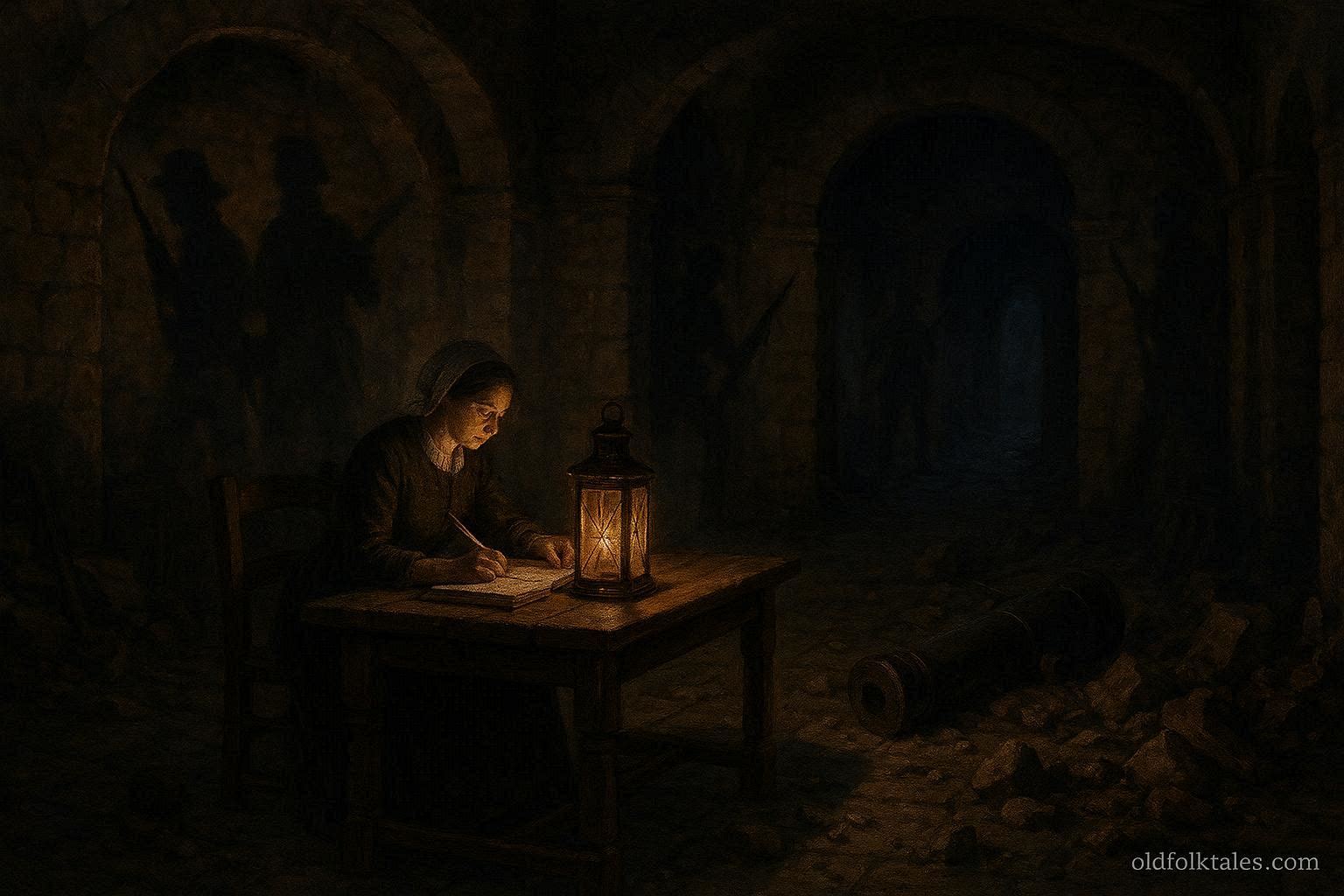
During heavy bombardment, the woman moved the ledger from room to room, keeping it away from falling debris and open flame. She wrapped it in cloth when dust filled the air. At night, she wrote by lantern light, long after others tried to sleep.
One account recalls seeing her pause mid sentence, listening intently, then continuing as if nothing had happened. Another remembers her carefully straightening a page after an explosion rattled the room, smoothing the paper before writing again.
As the final days approached, the ledger reflected the strain. Supplies dwindled. Names disappeared from daily counts. The entries grew shorter. The space between lines vanished entirely.
On the last night, she was seen still writing. The lantern beside her burned low. Outside, movement and noise hinted at what was coming. Inside, the woman wrote as if recording the present was the only way to resist its passing.
When the battle ended, the mission fell into ruin. Smoke, debris, and silence replaced the rhythms of daily life. Later, when the site was searched, the ledger was found beneath fallen timbers. Its edges were scorched. Its pages were dirty but legible.
The woman was gone.
No body could be identified as hers. No list named her among the dead. No account described her escape. She vanished completely, leaving behind only her handwriting.
In the years that followed, the ledger passed quietly through hands that recognized its importance. Families referenced it. Local historians relied on it. Names that appeared nowhere else survived because she had written them down.
Over time, the ledger shaped how the siege was remembered. Numbers repeated in later accounts traced back to its pages. Lists of defenders and supplies echoed her careful work. Yet the recorder herself remained unnamed.
Among local communities, the woman became a symbol. She represented those who witnessed history without shaping its outcome, and those whose labor preserved memory while erasing themselves.
Some legends say she never wrote her own name. Others claim the final page was left blank, as if waiting for something that never arrived. What remains certain is that without her ledger, much of what is remembered would have been lost.
The Widow of the Alamo Ledger endures not because of how she lived or died, but because she chose to record. Through her work, the siege became more than a battle. It became a record of people who might otherwise have vanished entirely.
Click now to read all American Legends — heroic tales where truth and imagination meet, defining the American spirit.
Moral Lesson
History survives because someone chooses to record it. The most enduring legacies often come from those who never seek recognition. Preserving memory is an act of courage and witness.
Knowledge Check
- What role did the Widow serve during the siege of the Alamo?
She documented names, rations, ammunition, and daily events in her ledger. - Why was the ledger important after the battle?
It preserved names and details of those inside the Alamo that would have been lost. - What details did she record in the ledger?
Soldier names, arrival dates, rations, medical needs, and casualties. - What happened to the Widow after the fall of the Alamo?
She vanished; no body or record of her death was found. - How did her work influence later historical memory?
Historians and families relied on her ledger to reconstruct the siege accurately. - What does the legend suggest about recognition and memory?
Recording history is more important than being remembered; memory can survive through documentation.
Source
University of Texas, Center for American History, Alamo and Texas Revolution archives
Cultural Origin
Mexican–Texan frontier communities