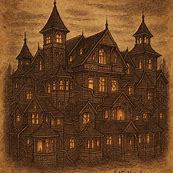
In the heart of San Jose stands a mansion unlike any other in the world. Its countless windows glitter beneath the California sun, and its towers stretch skyward in graceful confusion. Hallways twist and turn without sense, stairways rise into ceilings, and doors open onto walls or sudden drops into gardens below. This is the Winchester Mystery House, a place born of sorrow, guilt, and an unending conversation between the living and the dead.
The story begins with Sarah Winchester, the widow of William Wirt Winchester, heir to the fortune of the Winchester Repeating Arms Company. The Winchester rifle had become one of the most famous weapons in America, known as “the gun that won the West.” It also became a symbol of death and loss for countless lives it had taken in war and frontier conflicts.
Sarah lived a life of privilege, but her happiness was shadowed by tragedy. She lost her infant daughter to illness, and not long after, her husband succumbed to tuberculosis. Grief struck her deeply, leaving her lonely and uncertain. In her sorrow, she turned to spiritual guidance. One version of the story tells that she visited a medium in Boston who warned her that she was cursed by the spirits of those slain by the Winchester rifle. The only way to appease them, the medium said, was to build a home for them, a house that would never be finished.
Discover celestial myths of the sun, moon, and stars — and the heroes who bridged earth and sky.
Believing this to be her fate, Sarah left her home in New England and traveled west to California. There she purchased an eight-room farmhouse on the outskirts of San Jose and began to build. Day after day, year after year, the work continued. Carpenters labored by lantern light through the night. Materials arrived constantly. Rooms were torn down as quickly as they were built. The sound of hammers and saws echoed endlessly across the orchards.
Sarah Winchester herself designed many of the strange features of the house. She built staircases that led to nowhere, doors that opened into midair, and windows set into floors. Secret passages connected distant rooms, and mirrored walls reflected infinite corridors. Some said she built the maze to confuse the spirits that followed her. Others believed she wished to give them a home within the walls, a place to rest, if only for a moment.
Despite her isolation, Sarah Winchester was known for her kindness to those who worked for her. She paid her laborers well and provided meals and lodging for their families. Yet she remained deeply private, wandering her house at night by candlelight, sometimes pausing in her “seance room,” a small hidden chamber where she was said to speak with the spirits who guided her building plans. Every midnight, she would light a candle and wait in silence before ringing a bell that signaled the end of her vigil.
For thirty-eight years the construction continued without pause. When Sarah Winchester died in 1922, the work stopped immediately. The mansion stood as it does today, a sprawling maze of over one hundred and sixty rooms, including forty staircases, forty-seven fireplaces, and more than ten thousand panes of glass. It is said that even the best builders cannot fully map its secrets.
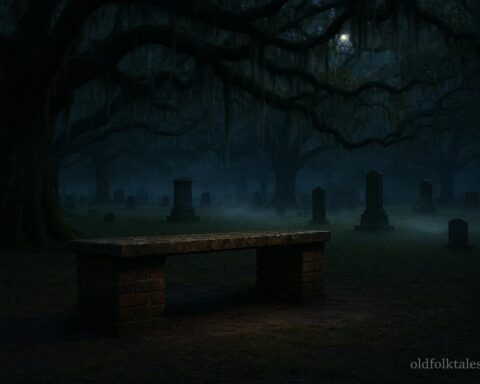
Visitors who have entered the house since her death often describe an unshakable feeling of being watched. Some have heard soft footsteps on the upper floors when no one was there. Others have felt sudden chills while standing in sunlit hallways. Tour guides speak of doors that refuse to open one day and swing wide the next, as if unseen hands control them.
In one of the parlors, the scent of roses sometimes fills the air without reason, and guests have claimed to see the figure of a small woman dressed in black walking through the gardens before fading into the shadows. Many believe this to be Sarah herself, still tending to her unfinished task.
Yet the Winchester Mystery House is not only a tale of fear. It is also a monument to human grief and the desire for redemption. Whether or not the spirits truly haunted Sarah, she carried their weight all her life, seeking peace through creation rather than destruction. Her endless building was both penance and protection, a way to make sense of tragedy through design.
Today the mansion stands preserved as a historical landmark and one of America’s most famous haunted places. Its halls remain a puzzle of memory and imagination, a physical embodiment of sorrow and superstition intertwined. Each visitor who walks its winding stairs and narrow passages feels a whisper of its story, the echo of hammer blows and the soft hum of the past.
The mystery of Sarah Winchester endures because it touches on something deeply human: the need to find meaning in loss, to create light out of darkness, and to believe that even the restless spirits of our mistakes can be guided toward peace. The Winchester House remains a reminder that the line between guilt and grace is as thin as the edge of a stair that leads to nowhere.
Click to explore all American Ghost Stories — haunting legends of spirits, lost souls, and mysterious places across the U.S.
Moral of the Story
The Winchester Mystery House teaches that grief can build both walls and understanding. Sarah Winchester’s endless mansion reminds us that guilt, when faced with compassion, can be transformed into a form of remembrance and atonement.
Knowledge Check
1. Who built the Winchester Mystery House and why?
Sarah Winchester built it after losing her family, believing she was haunted by spirits of those killed by the rifles her family produced.
2. Why did she keep building without stopping?
She was told by a spiritual medium that as long as she continued building, the spirits would not harm her.
3. What are some unusual features of the mansion?
Staircases that lead into ceilings, doors that open to nothing, secret rooms, and windows placed in odd locations.
4. When did the construction finally stop?
It ended in 1922 upon Sarah Winchester’s death.
5. What do visitors report experiencing today?
Unexplained footsteps, voices, sudden chills, and sightings of a woman believed to be Sarah Winchester herself.
6. What deeper meaning does the house represent?
It symbolizes grief, guilt, and the human attempt to find redemption through creation.
Source: Adapted from The Winchester Mystery House: The Story of Sarah Winchester, Heiress to the Rifle Fortune by Ben Winchester, Arcadia Publishing, 2013.
Cultural Origin: United States (California / Western haunted-house folklore)