Deep within the dense forests of the American South, where sunlight barely reached the forest floor, there lived a woman known to locals simply as the Witch. Few had seen her face, and those who did spoke in hushed tones about her piercing eyes that seemed to look into the soul. She was feared not because she sought to harm, but because she was known to test those who entered her woods, measuring the integrity, courage, and honesty of every traveler.
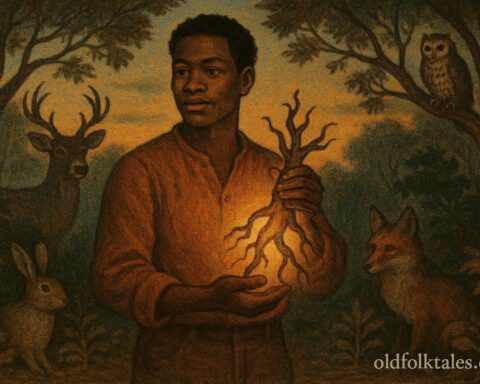
The Witch had lived in the woods for decades, her home a small cabin surrounded by herbs, roots, and talismans hung from trees. She moved silently, observing the people who dared walk her paths. Rumors abounded that anyone with selfish intent would never leave her domain the same way they entered. Some claimed that travelers were forced to confront truths about themselves; others said that the forest itself shifted to punish deceit or arrogance.
One hot summer morning, a young man named Elias, known for his pride, decided to journey through the forest to prove his bravery. He had heard stories of the Witch, but rather than fear her, he wished to show that no power, magical or otherwise, could intimidate him. As he entered the woods, the air grew heavy with the scent of pine and earth, and shadows danced unnaturally among the trees. He laughed nervously at first, mocking the stories, but soon he realized that the paths he followed seemed unfamiliar, looping in ways he had never noticed before.
Encounter the strange and the unseen — from Bigfoot to regional monsters hiding in America’s forests.
From a distance, the Witch observed Elias. She decided that he needed to face the consequence of his pride. The young man reached a clearing where a small stream flowed, but as he bent to drink, the water whispered questions in the rustle of leaves: Were you honest in your dealings with others? Have you helped those in need without seeking reward? Elias froze, unnerved by the sensation of being judged by the world around him. He tried to answer aloud, claiming he was a good man, but the words felt empty even to him.
The Witch emerged then, stepping silently from behind an oak tree. Her presence was commanding yet calm. “Many enter these woods seeking to prove themselves,” she said. “Few realize that the measure of courage is not in fearlessness but in knowing oneself.” Elias stammered, attempting to deny his arrogance, but he felt the weight of truth pressing on his conscience.
She gave him a challenge. “You must carry a bundle of herbs from this place to the edge of the forest, but only if you respect the plants and the path. If your heart wavers with selfishness, the woods will guide you back.” The task seemed simple, yet as he stepped forward, the forest grew denser, and the paths shifted. He struggled at first, trying to hurry and think only of reaching the end. Each time he grasped a plant carelessly or trampled a root, the path wound him back toward the center of the forest.
Hours passed, and Elias began to understand that the Witch’s tests were not meant to frighten him but to teach him humility, patience, and respect. He adjusted his pace, bending only when necessary, listening to the whispers of the leaves, and considering each step. Slowly, the forest guided him forward rather than backward. By the time he emerged at the edge of the woods, he carried the bundle with care, and his pride had diminished.
The Witch watched from afar, knowing that another lesson had been learned. The people of the nearby village often spoke of her not just in fear, but with reverence. Those who respected the forest and its guardian discovered that she could guide, heal, and reveal wisdom. Those who entered with deceit or arrogance found themselves lost until they reflected on their intentions.
Legends of the Witch remind the community that courage is not simply a display of boldness but the willingness to confront one’s flaws. Travelers who carry themselves with honesty, humility, and kindness find favor, while those driven by vanity, greed, or malice encounter obstacles that force reflection.
Even today, parents tell children to walk carefully in the woods, to honor the land and the unseen watchers within it. The Witch’s story endures as a moral compass, teaching that fear need not be paralyzing but can inspire careful thought, self-examination, and ethical conduct.
Click to read all American Folktales — timeless oral stories passed through generations across the United States.
Moral Lesson
True courage is measured by honesty, humility, and moral integrity, not by reckless bravado. Ethical behavior and respect for the unseen forces of the world ensure safe passage through life’s challenges.
Knowledge Check
1 What is the main purpose of the Witch’s tests?
Answer: To teach travelers humility, self-awareness, and moral responsibility
2 How did Elias first approach the forest?
Answer: With pride and a desire to prove his bravery
3 What happened when he acted selfishly or carelessly?
Answer: The forest redirected him, making him retrace his steps
4 What quality allowed Elias to complete the task successfully?
Answer: Patience, respect for nature, and honesty
5How do villagers perceive the Witch today?
Answer: With reverence, recognizing her as a moral guide and protector
6 What lesson does the legend convey about courage?
Answer: Courage is ethical and reflective, not merely fearless action
Source:
Adapted from African American folklore collections at the American Folklife Center.
Cultural Origin:
African American rural communities, Southern United States