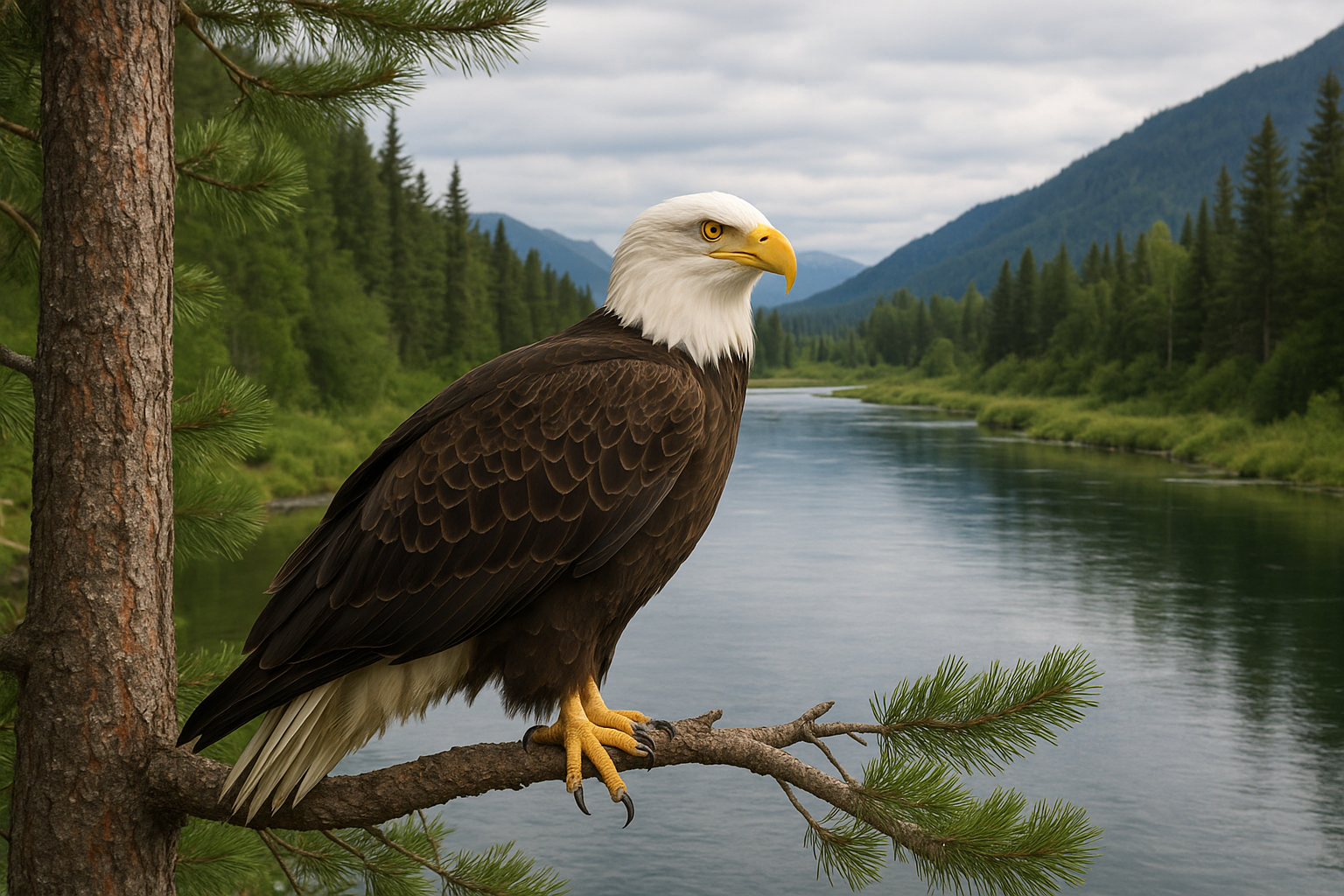
In the quiet stretch of an Alaskan river valley, where mountains stood like ancient sentinels and pine forests whispered secrets to the wind, a lone bald eagle returned each spring to the same weathered pine near the water’s bend. The tree stood taller than its neighbors, its branches reaching toward the sky like outstretched arms welcoming an old friend home.
The locals had come to know her over the years, this magnificent bird with her snow-white head and tail feathers that caught the morning light like polished ivory. They called her Grace. Her sharp amber eyes, fierce and knowing, never missed the silver flash of a salmon below the river’s rippling surface. When she dove, it was poetry wings folded tight, talons extended, the impact sending up a spray of crystal droplets that caught rainbows in the sun.
Explore Native American beings, swamp creatures, and modern cryptid sightings across the country.
Each spring, Grace returned to her work with the devotion of a master craftsman. She rebuilt her nest, a massive structure of sticks, branches, and soft moss, adding layer upon layer until it grew taller than a full-grown person and wider than a kitchen table. The nest sat high in the pine’s strongest fork, commanding a view of the entire valley. Grace and her mate, a powerful eagle with darker plumage, took turns guarding their home. Their calls sharp, piercing cries that echoed through the forest like distant trumpets announced their presence to all who would listen.
In that high cradle, cradled against the Alaskan sky, new life began each season. Two pale chicks would emerge from speckled eggs, their downy feathers soft as clouds, their voices loud and demanding. They were always hungry, always growing, their beaks open wide in constant expectation. Grace and her mate worked tirelessly, bringing fish after fish, teaching their young the ways of wind and water.
But life along the river was never easy. Spring storms rolled down from the mountains with fury, bringing winds that tore branches from even the strongest trees and rain that fell like stones. The nest swayed and groaned, but Grace held firm, sheltering her young beneath her broad wings. Black bears, their massive forms emerging from winter dens, wandered too close to the nesting tree, drawn by curiosity or the scent of fish remains below. Grace and her mate circled above, their warning cries sharp enough to turn even a bear away.
Then came the year when human threat arrived not with claws or teeth, but with orange flags and measuring tape. A logging company marked trees near the nesting site, their plans threatening to transform the quiet valley into a place of chainsaws and falling timber. For weeks, Grace’s fate hung uncertain in the balance. The eagles continued their routine, but the air felt different, charged with an invisible tension.
But Grace was not alone in her valley. When locals noticed her watching from above, her head turning to follow the workers below, they understood what was at stake. A small but determined group from town gathered fishermen, teachers, shopkeepers, elders who remembered when eagles were rare sights along these waters. They petitioned to protect the area, their voices united in a simple argument: if the eagles left, so too would part of what made their valley truly alive. The heart of the place would be gone.
Their efforts bore fruit. The nesting tree was spared. The orange flags came down, and the valley returned to its natural rhythms the sound of rushing water, wind through pine needles, and the trumpeting calls of eagles on the wing.
By the following spring, Grace’s young had grown strong enough to soar on their own. Their flight feathers, once stubby and awkward, now stretched wide and powerful. They learned to ride the thermals, those invisible rivers of warm air that carried them higher with barely a wingbeat. On clear days, when the sky stretched endlessly blue, people could spot Grace circling high above the river not as a symbol carved on coins or stitched on flags, but as a living, breathing creature: patient in her hunting, powerful in her flight, and utterly, magnificently free.
Watching her glide through the open air, her wings spanning seven feet from tip to tip, catching the light with each subtle adjustment of angle and feather, it was easy to understand why the bald eagle had become a national emblem. It wasn’t just her beauty, though she was beautiful. It wasn’t just her strength, though she was strong. It was the quiet reminder she carried on her wings with every flight: that true freedom depends on care, on persistence, on the willingness of a community to protect what matters. Freedom needs space to rise, room to soar, and watchful eyes below to ensure that space remains.
Grace still returns each spring. Her nest grows larger with each passing year, a testament to endurance. And the people of the valley watch and remember: some things are worth protecting, and in protecting them, we protect a part of ourselves.
Click to read all American Cryptids & Monsters — creatures of mystery and fear said to inhabit America’s wild landscapes.
The Moral of the Story
This tale reminds us that freedom and wildness are fragile gifts that require active protection. Just as Grace needed both her own resilience and the community’s advocacy to thrive, the natural world depends on human stewardship. True strength lies not only in individual power but in the collective choice to preserve what gives life meaning the wild places, the living creatures, and the connections that bind us to the land. When we protect nature, we protect the very essence of freedom itself.
Knowledge Check
Q1: Who is Grace in this Alaskan folktale?
A: Grace is a bald eagle who returns each spring to nest in the same tall pine tree near an Alaskan river valley. She represents resilience, maternal devotion, and the wild spirit of freedom that the community comes to cherish and protect.
Q2: What does the eagle’s nest symbolize in the story?
A: The nest symbolizes home, continuity, and the patient work of building something lasting. Growing larger each year, it represents the cumulative effort of survival and the importance of having a safe foundation from which to grow and thrive.
Q3: Why did the logging company threaten Grace’s home?
A: The logging company marked trees near Grace’s nesting site for cutting, which would have destroyed the eagles’ habitat and driven them from the valley. This represents the common conflict between commercial development and wildlife conservation.
Q4: What lesson does the community learn from protecting Grace?
A: The community learns that some things hold value beyond economics that the presence of wild eagles enriches their valley and their lives. They discover that protecting nature is protecting a part of what makes their home meaningful and alive.
Q5: What makes the bald eagle a fitting symbol of freedom in this story?
A: The eagle embodies freedom not just through her powerful flight, but through the reminder that freedom requires protection, space, and community care. Her story shows that true liberty depends on both individual strength and collective responsibility.
Q6: What is the cultural significance of this Alaskan eagle tale?
A: This story reflects Alaska’s deep connection to wildlife and the conservation ethic that emerged from seeing species like the bald eagle recover from near-extinction. It celebrates the relationship between indigenous respect for nature and modern environmental stewardship.
Cultural Origin: This contemporary nature tale originates from Alaska, United States, reflecting the American conservation movement and the special relationship between Alaskan communities and the bald eagle, the national bird whose recovery from endangered status represents one of environmental protection’s greatest success stories.