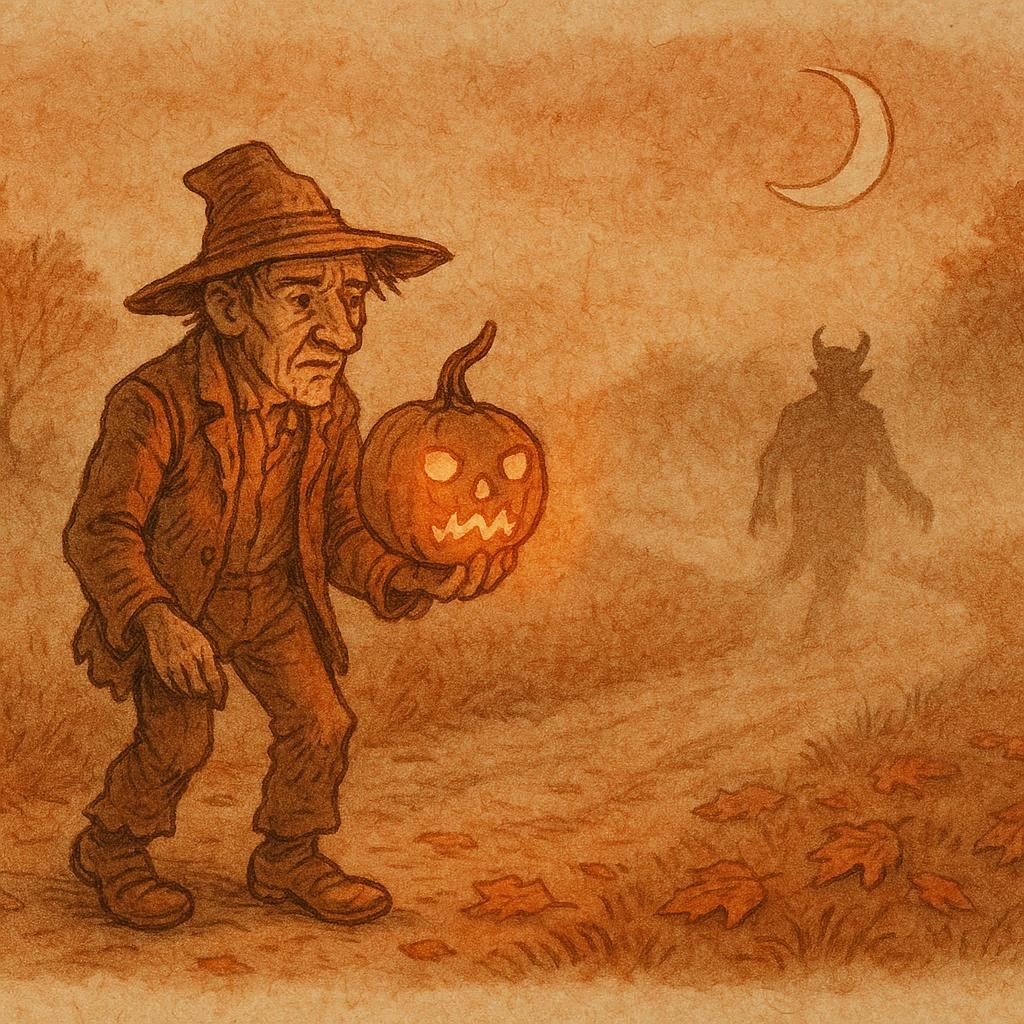
In the misty hills of New England and the shadowed valleys of the Appalachians, old Irish immigrants shared tales beside crackling fires each Halloween night. Among them was one story that sent both laughter and shivers through the room, the story of Jack, a man so cunning that he managed to deceive the Devil himself. This legend, passed down for generations, tells how a single ember of Hell’s fire became the symbol of the jack-o’-lantern, glowing on porches every All Hallows’ Eve.
Once, there lived a man named Jack, known far and wide for his greed and trickery. He was sharp-tongued, clever with his hands, and stingy with his coins. Some said he could bargain a soul out of its shadow. Others whispered that Jack had made a deal with the Devil himself, and outwitted him not once, but three times.
Click to explore all American Ghost Stories — haunting legends of spirits, lost souls, and mysterious places across the U.S.
The first time came one cold autumn night when the Devil appeared before Jack, ready to claim his soul. Jack, quick as ever, invited the Devil to join him for a drink. The Devil agreed, and they drank together at a tavern until the time came to pay. Jack, feigning poverty, turned to his infernal guest and said slyly, “Why not turn yourself into a coin, so we can pay the innkeeper?”
The Devil, amused by Jack’s clever tongue, transformed into a silver coin. But before he could escape, Jack snatched him up and stuffed him into his pocket, where he kept a small silver cross. Trapped beside the cross, the Devil could not regain his form. Jack laughed and made a bargain: the Devil would not take his soul for ten years. The Devil, furious but powerless, agreed.
Ten years passed, and Jack continued his greedy, cunning ways. True to his word, the Devil returned, ready to claim his prize. But Jack, ever the trickster, pointed to a nearby apple tree and asked for one last taste of life, a single apple from its highest branch. The Devil climbed up to fetch it, but before he could come down, Jack carved a cross into the bark, trapping him again. This time, Jack demanded a lifelong promise: that the Devil would never take his soul to Hell.
Defeated, the Devil swore the oath and vanished into the night. Jack, satisfied, went on living as he pleased, hoarding money and scorning the poor. But as all mortals must, Jack eventually died. When he reached Heaven’s gates, he was turned away,his life had been one of selfishness and deceit.
So Jack wandered to the gates of Hell. There stood the Devil, smirking behind the flames. “You may have bested me, Jack,” the Devil said, “but I keep my word. You will not enter here.” With that, the Devil tossed Jack a single ember from the fires of Hell, saying, “Take this to light your way.”
Jack hollowed out a turnip, placed the glowing ember inside, and began to wander the earth, a lost soul carrying his light through endless night. He became known as Jack of the Lantern, or, as the people said, Jack-o’-Lantern.
When Irish immigrants brought this story across the Atlantic to America, they found that pumpkins, large, soft, and bright, were easier to carve than turnips. Every Halloween, they carved faces into pumpkins, placing candles inside to honor Jack’s wandering spirit and to ward off evil from their homes. Thus, the glowing lanterns on porches became symbols of remembrance, protection, and the thin line between the living and the dead.
And so, each year, as October’s chill fills the air and shadows lengthen, families light their jack-o’-lanterns. The flickering light reminds us of clever Jack, whose wit could outsmart the Devil, but whose greed left him forever alone on dark roads.
Click to read all American Traditions & Beliefs — the living folklore of daily life, customs, and superstitions.
Moral Lesson
Cunning may win many battles, but without kindness and humility, it leads only to loneliness. True wisdom lies in balance, not trickery.
Knowledge Check
1. Who was Jack in the folktale?
Jack was a greedy, clever man who tricked the Devil three times to avoid losing his soul.
2. How did Jack first trap the Devil?
He convinced the Devil to turn into a coin and then trapped him beside a silver cross in his pocket.
3. What object did Jack carve to trap the Devil the second time?
Jack carved a cross into an apple tree, preventing the Devil from climbing down.
4. Why was Jack denied both Heaven and Hell after his death?
Heaven rejected him for his greed, and Hell refused him because of the Devil’s promise.
5. What did the Devil give Jack before sending him away?
A single ember from Hell’s fire to light his eternal wanderings.
6. How did pumpkins replace turnips in this folktale’s tradition?
Irish immigrants in America found pumpkins more plentiful and easier to carve than turnips.
Source: Adapted from Folktales, Fall Traditions, and the Supernatural, National Endowment for the Humanities.
Cultural Origin: Irish-American folklore (New England and Appalachian regions).