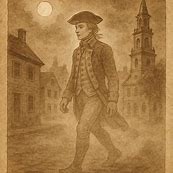
In the restless days of 1776, when the dream of American independence was still uncertain, a young man named Nathan Hale walked quietly through the darkened streets of Manhattan. The city lay under British occupation, and the air carried the weight of fear and secrecy. Hale was a schoolteacher by trade, a soldier by duty, and a patriot by conviction. He had volunteered for a mission that few dared to attempt to cross enemy lines and gather intelligence for General George Washington.
He was only twenty-one years old.
The war was still in its early and most desperate stages. The Continental Army had suffered defeat in New York, and the British now held the city with powerful numbers. Washington needed to know their plans, their movements, their weaknesses. But spies were despised by both sides, and the penalty for being caught was death. When the call went out for a volunteer, Nathan Hale stepped forward without hesitation.
Those who knew him said his courage came not from recklessness but from a quiet belief in duty. He had been educated at Yale, where his classmates admired him for his kindness, learning, and unwavering sense of honor. He believed deeply that liberty was worth any price, even life itself. And so he disguised himself as a Dutch schoolmaster and slipped into the occupied city.
Explore the heart of America’s storytelling — from tall tales and tricksters to fireside family legends.
For several days he gathered information, recording troop movements and military positions. But fate turned against him. As he prepared to return to his own lines, he was recognized by a Loyalist who betrayed him to the British. Hale was arrested and taken to the headquarters of General William Howe.
The young man was interrogated but refused to beg for mercy. When evidence of his spying was found among his belongings, his fate was sealed. There would be no trial. He was to be executed the following morning.
On the gray dawn of September twenty-second, 1776, Nathan Hale was led to an apple tree that stood near the British encampment in Manhattan. The air was cool, the sky still pale from the first light. Witnesses said he stood calm and upright, his uniform neat, his eyes steady. When the rope was placed around his neck, he asked only for paper and pen to write a final letter to his mother and friends. The British officer in charge refused.
Those who watched never forgot what happened next. Just before the order was given, Hale lifted his voice so that all could hear. His words would echo through history:
“I only regret that I have but one life to lose for my country.”
In that moment, a simple schoolteacher became a symbol of the spirit that would one day give birth to a nation.
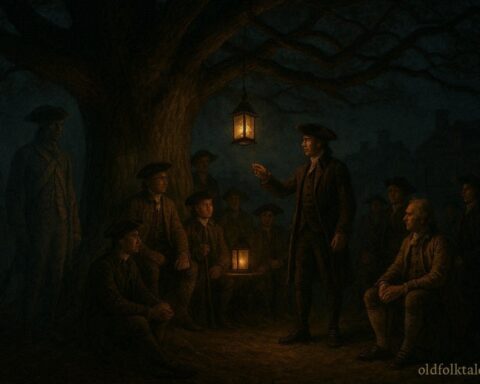
After his death, the place where he was executed was left unmarked, but his story spread like wildfire through the colonies. Soldiers told it by their campfires, mothers whispered it to their children, and preachers repeated it in their sermons. Nathan Hale’s name became a rallying cry for courage and sacrifice. Yet the story did not end with his final words.
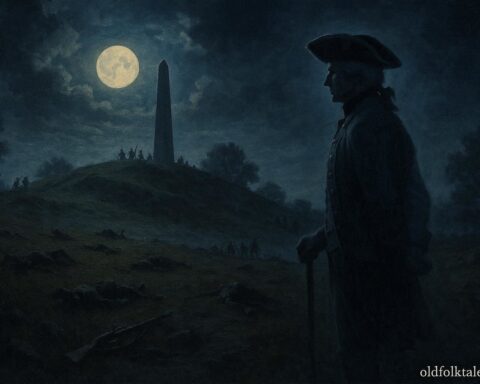
Years after the Revolution, strange tales began to circulate among sentries stationed in Manhattan. They spoke of seeing a figure walking silently beneath the moonlight near the old gallows site. He wore the uniform of a Continental officer, his coat immaculate, his hat tucked beneath one arm. Some said they saw him pause beneath the trees as if still awaiting his sentence. Others claimed they heard him speak softly, repeating the same haunting line that had carried across the field so many years before.
“I only regret that I have but one life to lose for my country.”
Sometimes he was seen near City Hall Park, where the hanging was said to have taken place. Other times, he appeared on the old post road, his face pale but calm, his eyes fixed on something unseen. The apparition never frightened those who saw it. Instead, witnesses described feeling a deep sadness and reverence, as if they were standing in the presence of a noble spirit who could not rest while freedom still required defenders.
One sentry in the early 1800s swore that the figure approached him and saluted before fading into mist. Another, a night watchman, said he followed the ghostly light of a lantern through the trees but found nothing when he reached the spot. Some visitors claimed that, on certain September nights, when the wind moves through the leaves, the faint sound of a voice carries through the stillness, solemn and resolute.
Whether spirit or memory, the Ghost of Nathan Hale became part of New England’s living folklore a story of devotion that refused to fade. Historians and storytellers alike came to see his legend not as superstition but as the echo of an ideal too pure to die. For in every age, people still look to his words for strength. They remind the living that patriotism is not measured by victories, but by the willingness to stand for what is right even at the greatest cost.
Today, a statue of Nathan Hale stands in City Hall Park in New York, his face young and calm, his hands bound behind him. The sculptor captured the moment before his death, the quiet dignity that has inspired generations. Visitors sometimes say that, at dusk, the expression on the statue seems to change, the bronze eyes glimmering faintly as if remembering that long-ago morning when he faced eternity with courage.
The legend endures not because of fear, but because of admiration. The ghost of Nathan Hale does not wander in torment. He walks in eternal honor, guarding the city where he gave his life for a new nation. His presence is a whisper to all who pass through a reminder that the price of liberty is eternal vigilance, and that true heroism never fades from the memory of a grateful people.
Journey through the lives of folk heroes, war legends, and hometown champions in our American Legends collection.
Moral of the Story
The Ghost of Nathan Hale teaches that honor and sacrifice are the foundation of true freedom. His courage reminds us that love of country can outlive death itself, and that devotion to a noble cause leaves a light that never goes out.
Knowledge Check
1. Who was Nathan Hale before joining the Continental Army?
He was a young schoolteacher from Connecticut who believed deeply in the cause of liberty.
2. What mission did he volunteer for during the Revolutionary War?
He volunteered to gather intelligence behind British lines in New York City.
3. What were Nathan Hale’s famous last words?
“I only regret that I have but one life to lose for my country.”
4. Where is his ghost said to appear?
Near the old execution site in Manhattan, especially around City Hall Park.
5. What does his apparition symbolize in American folklore?
It represents undying patriotism, honor, and the spirit of sacrifice for freedom.
6. What is the main lesson of this legend?
That true heroism is born from conviction and selflessness, not from glory or reward.
Source: Adapted from early American Revolutionary War folklore as found in American Legends and Lore (Charles M. Skinner, 1896) and The Heart of New England (Clifton Johnson, 1904).
Cultural Origin: United States (New England / Revolutionary War folklore)