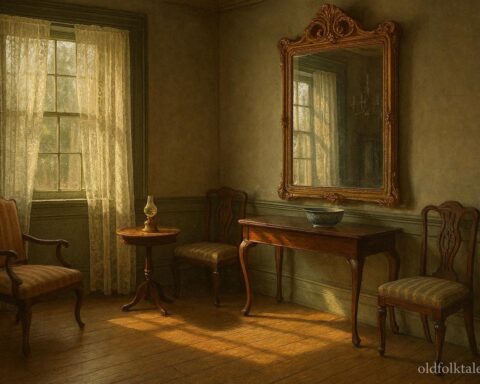
In the quiet corners of New England, where fog often drifts low over the hills and winter nights seem endless, there lived a woman named Prudence Hale. She was known throughout the Massachusetts village for her modest beauty and calm, measured ways. Prudence had inherited her grandmother’s mirror, a tall, oval glass framed in dark walnut, its surface faintly clouded with age. The villagers said the mirror had seen too much, that it was not just a reflection of light, but of soul.
Whispers surrounded it. Some claimed the mirror belonged to a woman who had stayed young long after her sisters had grown old. Others said that anyone who looked into it on a moonless night would find time stolen from their face, their youth fading in the silence between heartbeats. But Prudence, a practical woman raised on reason and scripture, dismissed such gossip as foolish superstition.
Click now to read all American Legends — heroic tales where truth and imagination meet, defining the American spirit.
One bitter winter evening, as wind clawed at the shutters and the fire burned low, Prudence sat alone by candlelight. The house was silent except for the creak of old boards and the sigh of the hearth. Her eyes fell on the mirror, half-hidden beneath a linen cover. A strange curiosity took hold of her. She remembered her grandmother’s words, “Never meet your own eyes in darkness, child; the mirror knows what the light does not.”
With a nervous smile, Prudence lifted the linen and struck a single match. The candle’s flame flickered, trembling in the draft, and her reflection came into view, pale, composed, familiar.
“Show me the truth,” she whispered, her voice barely more than breath.
At first, nothing stirred. But then the flame quivered, bending as if some unseen hand passed before it. The air thickened, and the glass seemed to deepen, as though she stared into a well with no bottom. Her reflection smiled back, yet it was not her smile. Slowly, her face began to age before her eyes. Her cheeks hollowed, her hair silvered, and the sparkle in her gaze dimmed. In a heartbeat, the woman in the glass had become a frail, grey spectre, and then she vanished.
The candle guttered and went out.
When morning came, the villagers saw Prudence walking to market, her shawl drawn tightly around her. But those who looked closely noticed something strange, the faint silver streaks in her hair, the weary tone in her once-bright voice. She never mentioned what happened that night, though she covered the mirror with a heavy black cloth and forbade anyone to uncover it.
Years passed. The tale of Prudence’s mirror spread through the region. Mothers warned their daughters never to look into a mirror after dark, especially on a night without moonlight. They said mirrors were more than glass, they were thresholds, hungry for what they could not keep.
Children would whisper to each other by lamplight, daring one another to stand before a mirror and speak to their reflection. Yet no one ever did.
Even long after Prudence’s death, her house remained empty. Travellers passing through claimed to see a faint glow in the upper window, as if a candle still burned before that shrouded mirror. The villagers said it was Prudence’s reflection, forever searching for the youth she lost to her own disbelief.
Click to read all American Traditions & Beliefs — the living folklore of daily life, customs, and superstitions.
Moral
Vanity and disbelief in old wisdom can open doors best left closed. Respect the unseen, for superstition often hides ancient truth.
Knowledge Check
-
Who was the main character in the story?
Prudence Hale, a woman from Massachusetts who inherited her grandmother’s mysterious mirror. -
What was the superstition about the mirror?
That anyone who gazed into it on a moonless night would lose their youth. -
What happened when Prudence looked into the mirror?
Her reflection aged before her eyes and vanished, leaving her physically older by morning. -
Why did the villagers avoid mirrors at night afterward?
They believed the mirror could “drink” their vitality or attract spirits. -
What lesson does this folktale teach?
To respect traditional beliefs and the unseen forces that guard them. -
Where did this superstition originate?
Among 19th-century New England villagers, especially in Massachusetts.
Source: Adapted from Current Superstitions by Fanny D. Bergen, No. 49 “Mirror Beliefs,” pp. 12–13.
Cultural Origin: United States – New England (19th Century Household Folklore)