Water changes the rules of the Missouri River Valley without asking permission. Fields flatten into mirrors. Fence lines vanish. Roads dissolve into currents that remember older paths. During flood season, familiar distances stretch and twist, and what was once solid ground becomes something uncertain and alive.
Long before levees and warning sirens, people learned to watch the river closely. A rising line on a tree trunk meant time was short. Livestock were moved first. Then tools. Then people. Yet floods never followed schedules, and sometimes travelers found themselves trapped between rising water and disappearing shore.
It was during such moments that stories of the ferrywoman began to surface.
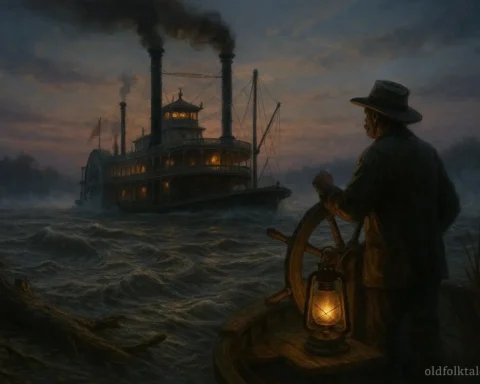
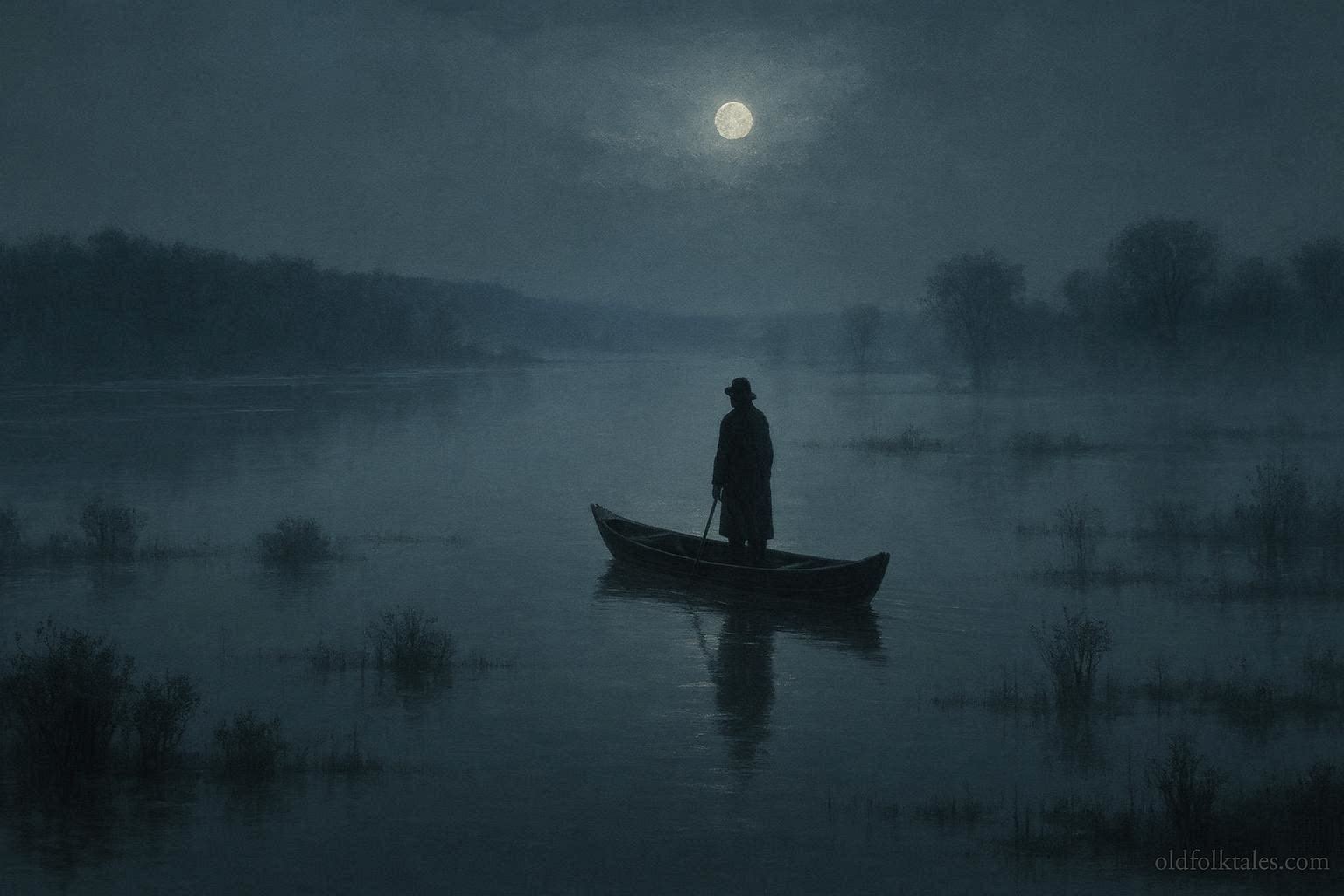
She did not appear at docks or towns. She was seen at the edges of the floodplain, where land surrendered quietly to water. Witnesses described a narrow boat emerging from mist, its hull dark and low in the water. At the stern stood a woman holding a pole, dressed plainly, her face calm and unreadable. She did not call out. She did not wave. She simply waited.
Click now to read all American Legends — heroic tales where truth and imagination meet, defining the American spirit.
Those who encountered her spoke of fear at first. Floodwater carried debris, snakes, broken timbers. Accepting help from a stranger seemed dangerous. Yet something about the ferrywoman stilled panic. The water around her boat moved differently, smoothing as if guided.
She ferried people across places where no crossing should exist. From one submerged ridge to another. From a farmhouse roof to higher ground. From a wagon stranded on a shallow rise to the safety of trees beyond the flood’s reach.
She asked no payment. She spoke no words.
After the crossing, the boat would drift back into mist. When people turned to thank her, she was gone.
The earliest accounts came from the nineteenth century, when floods regularly reshaped the Missouri’s course. River workers, farmers, and travelers shared the valley’s risks. Drownings were common. Rescue was uncertain. Boats were scarce during sudden rises, and many who entered floodwaters never emerged.
Some believed the ferrywoman had once been a real ferrier. A woman who operated a small crossing during seasonal high water, guiding wagons and livestock when ferries were needed most. According to local memory, she drowned during a flood while helping others reach safety. Her body was never recovered.
Others insisted she was older than that. A spirit tied not to a single life but to the act of crossing itself. A guardian of thresholds, appearing when people stood between survival and loss.
The ferrywoman never transported those who wished to test her. Men who sought her out during calm water found nothing but river and fog. She appeared only when need was genuine, when fear was earned.
One account tells of a family stranded overnight on a narrow strip of land as water rose around them. Lantern light barely pierced the rain. Just before dawn, a boat emerged from the mist. The woman gestured once. They climbed aboard, holding children close. The crossing felt unnaturally smooth. When they stepped onto dry ground, the river seemed quieter. Turning back, they saw only fog rolling across empty water.
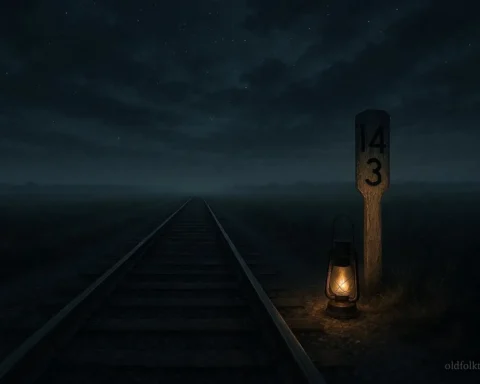
Another story came from a rail worker caught between a flooded track and collapsing embankment. He later swore a boat appeared where the current was strongest. He hesitated, knowing such water should pull anything under. The ferrywoman waited. When he finally stepped aboard, the boat moved as if the river itself made space.
The ferrywoman never appears twice to the same person. Those she helps carry the memory like a mark. They speak of it carefully, aware that not all crossings are meant to be understood.
Over time, the haunting became associated with mercy rather than death. Unlike many river spirits, she did not lure or punish. She offered passage. Choice remained with the traveler.
River communities came to respect her presence. During floods, people left lanterns burning at the edges of high ground. Not as signals, but as acknowledgments. Some whispered thanks to the river before retreating, honoring the unseen forces that decided who crossed and who waited.
Modern flood controls reduced the ferrywoman’s appearances, but they did not end them. During major floods in the late twentieth century, reports resurfaced. Emergency workers dismissed them as stress or misidentification. Yet survivors described the same details recorded a century earlier. Silent guidance. Calm water. A crossing that should not have been possible.
The ferrywoman belongs to the space between certainty and surrender. She does not promise safety beyond the crossing. She does not interfere with the river’s will. She appears only to offer a chance.
And when floodwaters recede, leaving behind silt and silence, people sometimes find shallow impressions near the bank. Marks that resemble where a pole once pressed into mud. No footprints. No trace of a boat. Just evidence that something waited there, briefly, when the river was wide and mercy was needed.
Step into shadowy legends of restless spirits and ghostly travelers in American Ghost Stories.
Moral Lesson
Help often arrives quietly and without explanation. Survival depends not only on strength, but on recognizing when to accept guidance at life’s thresholds.
Knowledge Check
1. When does the ferrywoman appear?
She appears during floods when travelers are stranded by rising water.
2. Where is she usually seen?
At the edges of floodplains where land transitions into river.
3. Does the ferrywoman speak to those she helps?
No, she offers silent passage without words.
4. What is her purpose in the stories?
To provide safe crossing during moments of danger and uncertainty.
5. Why can she not be summoned intentionally?
She appears only when need is genuine and danger is present.
6. What does the ferrywoman symbolize?
Mercy, transition, and respect for natural forces.
Source
Adapted from University of Missouri river folklore and flood history archives.
Cultural Origin
Missouri River Valley communities.