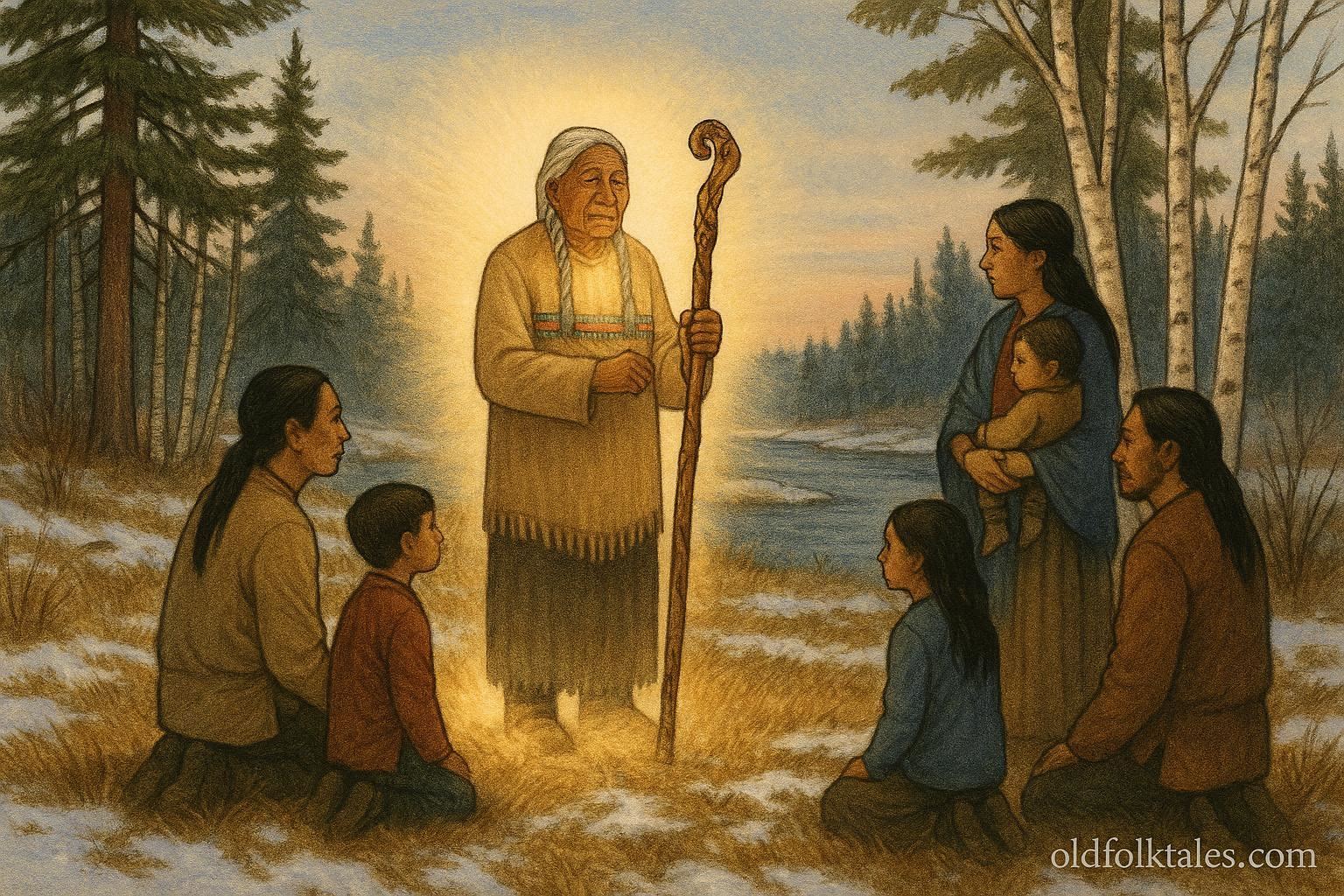
Long before chiefs were chosen and councils formed, the Anishinaabe people lived according to a set of unwritten rules, known simply as the Law That Existed Before Chiefs. These rules were not carved in stone or written on parchment. They were carried in memory, taught by elders through stories, and passed from parent to child as the very foundation of community life.
In one village near the edge of the great lake, tension grew over a dispute between two families. They had argued over the boundaries of fishing rights along the river, each claiming the best spots were theirs. Tempers flared, and the village began to whisper that violence might follow.
Before blood was spilled, an elder named Migisi stepped forward. His eyes were sharp, but his voice was gentle. “We have a law older than any chief,” he said. “It is the law of respect and balance. We listen first, we speak second, and we act with fairness. This is the Law That Existed Before Chiefs.”
Encounter the strange and the unseen — from Bigfoot to regional monsters hiding in America’s forests.
Migisi gathered the two families in a circle beneath the towering pines. He reminded them of the teachings of their ancestors that the land belonged to no single person, that each creature, river, and tree had its own spirit, and that the community itself was a sacred network of relationships. “If you take without regard,” Migisi said, “you break not only the law but the trust that binds us all.”
The families listened, though reluctantly at first. They were angry, their pride wounded. Yet as the elder spoke, he asked each family to recount the history of the river and the ways it had sustained them. Stories were told of great-grandparents who had shared fish freely, of winters when neighbors helped each other store food, and of nights when everyone relied on one another to survive storms.
Slowly, understanding began to settle. The families realized that their ancestors had lived by these same unwritten laws that existed long before any chief or council had authority. It was not a law enforced by punishment but by shared ethics, by the understanding that harming another harmed the community and the spirits of the land.
Migisi proposed a solution. The families would share the river in a pattern that rotated access weekly. No one family would take more than its need, and all catches would be used wisely. The arrangement was not written down but memorized and witnessed by the elders. Everyone present swore to honor it, and in that way, the Law That Existed Before Chiefs had guided them without conflict.
Seasons changed, and the river’s pattern became part of village life. Children grew up learning the stories of the river, of the elder Migisi, and of the great principle that no law needed a chief to be real — it existed in the hearts and minds of those who followed it. When disputes arose, the elders reminded everyone of the law’s core tenets: fairness, respect, and the understanding that every action had consequences for both humans and the land.
Years later, a neighboring village faced a similar conflict. They had heard of the Anishinaabe village and its unwritten law. Elders from both villages met to share the principles, teaching that justice and order could exist even without a formal leader. The story spread further, traveling across lakes and forests, showing the power of memory, ethics, and collective responsibility.
Even today, elders recount the tale of the Law That Existed Before Chiefs to children. They speak of the balance between people and the land, of listening before acting, and of the strength found in shared understanding. The river still flows, carrying with it the memory of those who lived by the law, and reminding every generation that leadership begins not with titles but with the wisdom to live together in harmony.
Click to read all American Folktales — timeless oral stories passed through generations across the United States.
Moral Lesson:
True governance comes from shared ethics, respect for one another, and understanding that the community itself is stronger than any single leader.
Knowledge Check :
- Q: What was the Law That Existed Before Chiefs?
A: An unwritten set of rules guiding fairness, respect, and balance in the community. - Q: Who reminded the families of this law during the dispute?
A: The elder Migisi. - Q: How did the families resolve their conflict?
A: By sharing the river on a rotating schedule and taking only what was needed. - Q: Why was the law effective without written records or a chief?
A: Because it relied on memory, ethics, and collective responsibility. - Q: How did the law influence neighboring villages?
A: Elders shared its principles, showing that justice could exist without formal leaders. - Q: What lesson is taught to children today?
A: That leadership begins with wisdom, fairness, and living in harmony with others.
Source:
Adapted from University of Minnesota Indigenous governance folklore archives
Cultural Origin:
Anishinaabe communities