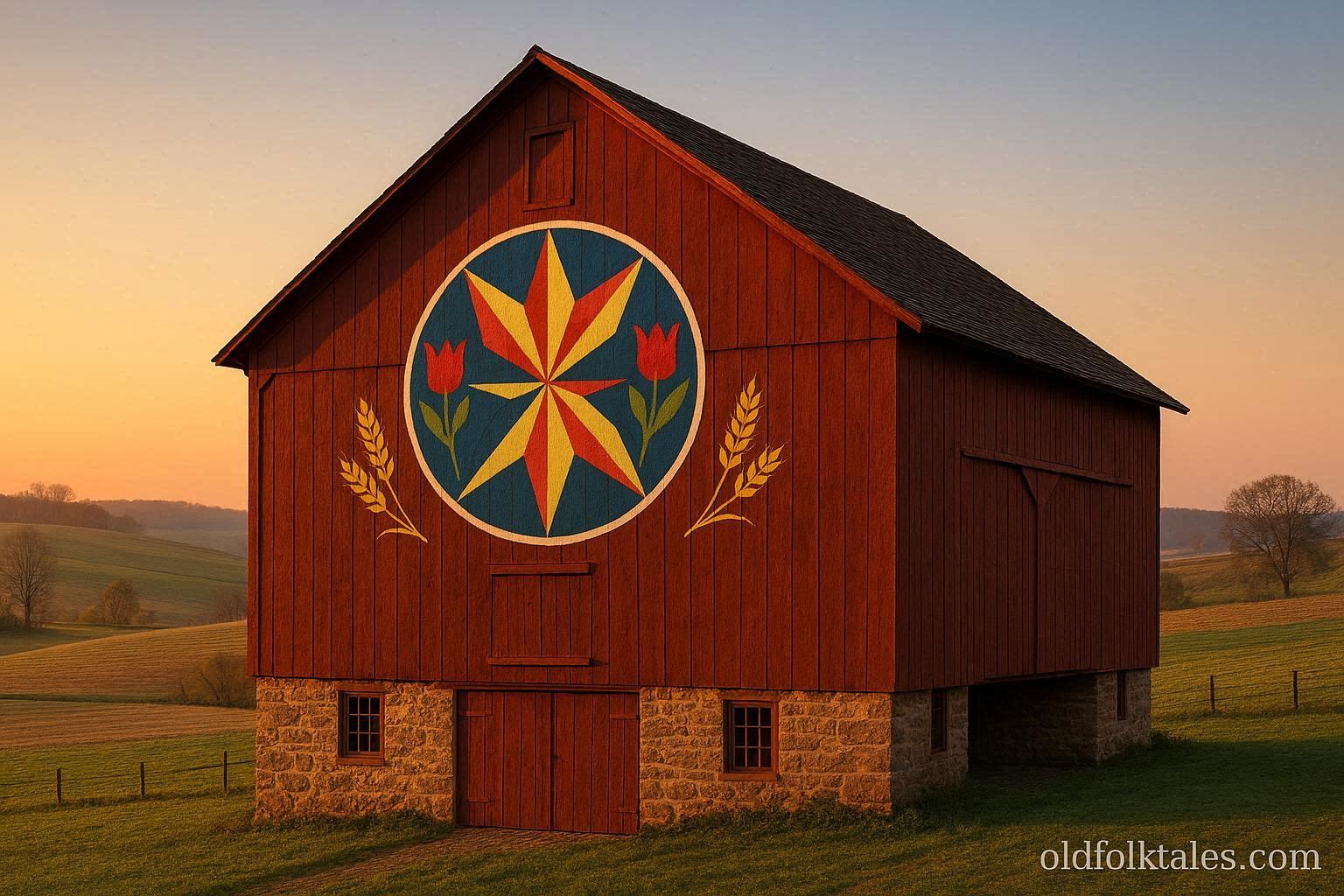
The morning sun rose slowly over the rolling farmland of southeastern Pennsylvania. Fields of corn and wheat stretched toward the horizon, their leaves shimmering with dew. Red barns stood proudly against the green landscape, their broad sides catching the first golden light of day. On many of those barns, painted boldly and precisely, were circular bursts of color. Stars, tulips, distelfinks, and hearts radiated outward in symmetrical beauty. These were hex signs.
For generations within Pennsylvania Dutch communities, these vibrant geometric designs carried layered meaning. Though some outsiders dismissed them as simple decoration, many families believed the symbols offered protection and blessing. A barn was not merely a structure. It housed animals, stored harvests, and safeguarded a family’s livelihood. Protection mattered deeply.
One such barn belonged to the Bauer family. Its wide wooden boards had weathered decades of wind and rain. Yet at the center of its facade, freshly painted in careful strokes, was a brilliant eight-pointed star enclosed in a circle of deep blue. Around it bloomed stylized red tulips and golden sheaves of wheat.
Encounter the strange and the unseen — from Bigfoot to regional monsters hiding in America’s forests.
Jakob Bauer stood at the base of a ladder, brush in hand, studying his work. His father had taught him how to measure each segment carefully before applying paint. Precision was essential. Balance within the design reflected harmony in life.
The Pennsylvania Dutch, descendants of German-speaking immigrants who settled in Pennsylvania during the eighteenth and nineteenth centuries, brought rich folk traditions with them. Their language, foodways, and art blended European heritage with American rural experience. Hex signs emerged from this cultural landscape, combining symbolism, craftsmanship, and agricultural identity.
The eight-pointed star on Jakob’s barn symbolized abundance and good fortune. The tulips represented faith and hope. The distelfink, a stylized goldfinch often included in other designs, signified happiness and good luck. Hearts suggested love and family unity. Each element was chosen intentionally.
When Jakob was a boy, he once asked his grandfather whether the signs truly protected the barn.
His grandfather smiled thoughtfully before answering. “Protection begins in the heart,” he said. “But symbols remind us what we’re asking for.”
Throughout rural Pennsylvania, barns bearing hex signs dotted the countryside. Some farmers painted them directly onto wood. Others hung large circular boards adorned with intricate designs. The act of painting became both artistic expression and ritual practice.
One spring, after an especially harsh winter, anxiety spread through the farming community. Livestock had struggled, and late frosts threatened young crops. Jakob decided to repaint the family’s hex sign as a gesture of renewal. He chose brighter pigments and added a ring of green oak leaves symbolizing strength and endurance.
Neighbors stopped to watch as he worked. Children pointed at the emerging pattern. The painting process itself became communal. Stories were shared. Seeds were exchanged. The barn wall, once plain, transformed into a vibrant emblem of shared hope.
Though historians debate whether hex signs were ever universally believed to hold supernatural power, within many families they carried protective intention. Symbols have long shaped human understanding. Across cultures, geometric forms and stylized flowers have represented harmony, fertility, and divine order.
The word “hex” itself has sparked discussion. Some link it to the German word for witch, while others trace it to the word for six, referencing six-pointed stars common in early designs. Within Pennsylvania Dutch tradition, however, the emphasis rests more on blessing than malice.
For the Bauer family, the sign was never about fear. It was about gratitude and aspiration.
During harvest season, when wagons rolled heavy with corn and apples, Jakob often glanced at the painted star as he entered the barn. It served as reminder. Hard work and faith walked together. The symbol overhead reinforced continuity with ancestors who had once crossed oceans seeking farmland and freedom.
As decades passed, commercialization introduced factory-made hex sign plaques sold to tourists. Some worried that deeper meaning might fade. Yet within households that preserved the tradition thoughtfully, the practice retained significance. Parents explained each symbol’s meaning to children. Painting days remained occasions of storytelling.
One autumn evening, dark clouds gathered suddenly over the valley. Wind swept through fields, bending tall corn stalks. Rain hammered rooftops and lightning split the sky. Inside the barn, livestock shifted nervously.
Jakob stood at the doorway, watching the storm approach. His eyes lifted to the painted star glowing faintly in the dim light. He knew that wood and paint could not physically repel lightning. Yet the sign reminded him of something steadier than weather. It represented resilience built through generations.
The storm passed by midnight. By morning, fields were damp but intact. Livestock remained safe. Jakob placed his hand briefly against the barn wall beneath the hex sign, offering silent thanks.
Hex signs of Pennsylvania barn protection endure today as both folk art and cultural emblem. They appear on quilts, postcards, and roadside stands. Yet in quiet farming communities, their presence still marks belonging. They symbolize immigrant roots, agricultural perseverance, and belief in blessing.
The circular designs, with their perfect symmetry, reflect a worldview grounded in order and harmony. In painting them, families affirm connection to land and lineage. Each stroke of color carries memory.
As sunrise spreads once more across Pennsylvania farmland, the barns stand steady. Their painted symbols gleam against red boards. Whether viewed as art, charm, or cultural marker, hex signs continue to guard more than livestock. They guard story, identity, and hope.
Click to read all American Traditions & Beliefs — the living folklore of daily life, customs, and superstitions.
Moral Lesson
Symbols rooted in heritage can strengthen community identity, gratitude, and resilience.
Knowledge Check
- What are hex signs commonly painted on?
Barns in Pennsylvania Dutch communities - What does the eight-pointed star often symbolize?
Abundance and good fortune - Why are tulips included in many designs?
They represent faith and hope - What purpose do hex signs serve for many families?
They symbolize protection and blessing - Why is balance important in the design?
It reflects harmony and order in life - How do hex signs preserve cultural heritage?
They connect present generations with immigrant ancestors
Source
Adapted from Pennsylvania German Cultural Heritage Center; Kutztown University folklore archives
Cultural Origin
Pennsylvania Dutch communities