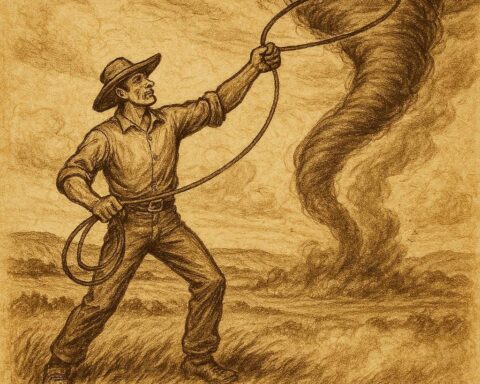
On the endless, golden prairies of Nebraska, where the horizon melts into sky and the wind carries the scent of dry earth and wildflowers, there lived a farmer named Febold Feboldson.
He was tall, broad-shouldered, and as weather-worn as the fence posts he built. Yet his eyes carried a spark of something unusual, an understanding of the land that went beyond simple farming. Some said Febold could talk to the wind. Others whispered that he could persuade the clouds themselves to cry when the fields thirsted.
Feboldson’s reputation began in a year of relentless drought. Streams had dried to mud, corn leaves curled like paper, and cattle grazed on brittle grass. Neighbors despaired, throwing their hands up to the sun, cursing the sky, and shaking their heads at the withering fields.
Encounter the strange and the unseen — from Bigfoot to regional monsters hiding in America’s forests.
Febold, however, merely wiped his brow, tipped his hat, and stepped into the middle of his parched land. He whistled a low, rolling tune. At first, nothing happened. The wind stirred, carrying dust across the dry soil. Then the sound grew, rising in pitch and echoing across the prairie. The clouds, thick and gray, drifted closer as if pulled by invisible strings. By midday, soft droplets began to fall. By evening, the prairie was soaked in a gentle rain.
Neighbors rushed to witness the miracle. Corn stalks straightened. Wheat bent under the weight of renewed growth. Even the stubborn sugar beets in the back field seemed to stand taller. Feboldson shrugged. “Just doing what anyone would,” he said with a quiet smile.
His fame grew quickly. Tales spread of a man who could make a barren field bloom overnight, whose whistle summoned rain from a cloudless sky, and whose touch could coax seeds into sprouts faster than nature intended. Traveling traders recorded these stories. Families from distant counties spoke of his arrival and the fields that gleamed like green oceans after a single visit.
Feboldson’s magic was not limited to rain. One summer, a fierce prairie fire swept across neighboring counties. Febold placed his hands on the scorched earth and whistled a melody known only to him. The flames seemed to hesitate, then bend away from his homestead as if respecting some invisible boundary. By sunrise, the worst had passed, leaving blackened edges but preserving the heart of his land.
Despite the extraordinary powers attributed to him, Febold was humble. He helped neighbors repair fences, taught children how to plant corn rows straight and deep, and always encouraged respect for the prairie. “The land has rules,” he said. “We don’t break them. We learn them.”
Stories of Feboldson also carried humor. Once, he is said to have grown a row of pumpkins overnight that were so large a dozen men had to roll them into the barn. Another time, wheat sprouted so quickly that chickens mistook it for jungle and hid among the stalks, clucking in confusion until humans rescued them. The tales blended exaggeration with the admiration of his neighbors, creating a legend larger than the man himself.
Feboldson’s methods, according to folklore, were never forced or cruel. He did not command nature with anger. He whispered to it. He listened. Children reported that if they watched quietly, they could see him bending down to talk to the soil, the wind carrying his words gently across the fields. Rain and growth responded, not because of magic alone, but because Feboldson understood patience, timing, and harmony with the prairie ecosystem.
During one particularly harsh winter, when frost threatened stored crops, Feboldson reportedly coaxed a small mist over his granaries, softening the ice and protecting the grain. Villagers visiting the farm found him tending firewood or repairing barn doors, yet the whispers of his abilities made the simple chores appear miraculous.
As years passed, Febold Feboldson became a symbol of hope and resilience for the Great Plains. Farmers facing dry spells would speak his name in encouragement, children would play games pretending to whistle clouds into the sky, and storytellers would embellish his deeds for festivals and county fairs.
Even after Feboldson’s death, the legend endured. People swore that on days when drought threatened, a faint whistle would drift across the prairie at dawn. Corn would straighten, wheat would sway, and families would remember the man who had taught them that courage, patience, and deep understanding of the land could bend fortune itself.
His story became more than folklore. It became a reminder that survival on the plains was as much about wisdom and respect as it was about labor and strength. Febold Feboldson exemplified the ideal of the Great Plains farmer not just a worker of the land, but a friend to it, attuned to its moods, capable of extraordinary feats when the need arose.
Discover African American wisdom, Native American spirit stories, and the humor of early pioneers in American Folktales.
Moral Lesson
True resilience comes from harmony with one’s environment, patience, and dedication. Febold Feboldson’s story teaches that extraordinary results are not only achieved through force or effort, but through understanding, respect, and cooperation with nature. He shows that wisdom, timing, and perseverance can transform hardship into opportunity and ensure the well-being of both community and land.
Knowledge Check
- Who was Febold Feboldson?
A Nebraska farmer with legendary abilities to summon rain and grow crops - How did he end droughts according to legend?
By whistling melodies that persuaded clouds to release rain - What other feats was Feboldson said to accomplish?
Stopping prairie fires and protecting crops from frost - How did Feboldson interact with his neighbors and community?
He shared knowledge, helped with farming, and encouraged respect for the land - Why did Feboldson’s legend endure after his death?
Because his story symbolized hope, resilience, and harmony with nature - What is the main lesson of Feboldson’s story?
Understanding and working with nature creates extraordinary results
Source
Adapted from Nebraska state folklore archives; Plains folklore anthologies
Cultural Origin
Nebraska and Great Plains communities