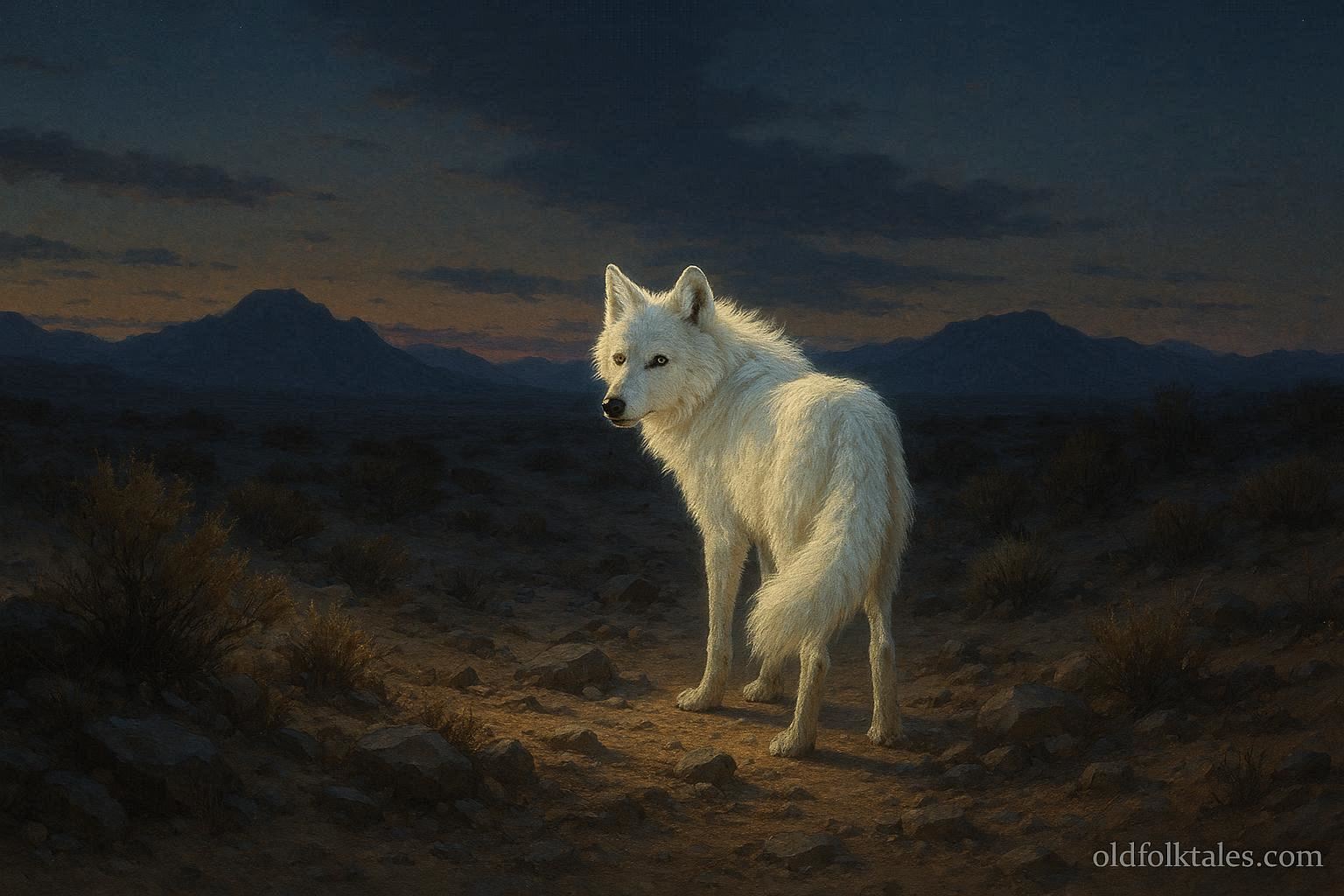
Among the Navajo people, stories have long been told of a spirit wolf that watches over travelers in the deserts and forests of the Southwest. This was no ordinary wolf, but a majestic white creature, larger than any known wolf, whose luminous coat seemed to shine in both sunlight and moonlight. Its eyes carried a calm intelligence, and its presence often brought comfort to those in peril. The Spirit Wolf guided the lost, teaching respect for nature and patience in times of danger.
The legend begins with a young Navajo hunter who set out before dawn, following a herd of deer across the rugged desert terrain. As the morning sun rose, he realized he had wandered far from familiar landmarks. The desert stretched endlessly, and every dune, rock, and scrub looked the same. The hunter’s heart pounded as he searched for a trail that could lead him back to his village. Anxiety and fear grew, and he considered calling out, but his voice was swallowed by the vast openness.
At that moment, a figure appeared along a distant ridge. A large white wolf stepped into view, its fur gleaming like freshly fallen snow, even under the desert sun. Its eyes met the hunter’s, and he felt an unspoken understanding pass between them. The wolf began to move slowly, deliberately, pausing now and then to ensure the hunter was following. He instinctively knew this was no ordinary animal; it was the Spirit Wolf, appearing to protect and guide him.
Discover chilling ghost tales and haunted places that echo through America’s towns and countryside.
As the hunter followed, the wolf led him across rocky slopes and narrow gullies, over sand that shifted beneath his feet and through thickets of desert shrubs that would have slowed him greatly on his own. The wolf’s movements were purposeful, almost intuitive, knowing exactly where to step and when to pause. Each time the hunter struggled with the difficult terrain, the wolf waited patiently, giving him time to regain his footing.
The journey took hours, and the landscape shifted as the sun moved across the sky. Shadows grew long, and the hunter began to feel fatigue, yet the wolf’s steady presence gave him strength and reassurance. The wolf paused at a small canyon, looking back with piercing eyes that seemed to communicate a silent instruction. The hunter understood that he must climb a certain ridge ahead to see the familiar smoke from his village. With renewed determination, he followed the wolf, reaching the top just as twilight descended. Below, he glimpsed the flickering lights of the village, safe and inviting. The wolf lifted its head, let out a low, echoing howl that carried through the canyon, and vanished into the growing darkness.
Stories like this were common among the Navajo. The Spirit Wolf appeared to those who had lost their way, whether in deserts, forests, or mountain passes. Hunters, travelers, and even children who wandered from camps were sometimes guided back to safety by the luminous wolf. Importantly, the wolf never harmed anyone. Its purpose was to teach respect for the land, to reward careful observation, and to protect those who acted with humility and reverence toward nature.
Elders also told that the Spirit Wolf was a reminder of the interconnectedness between humans and the natural world. The wolf’s guidance emphasized that survival depended not solely on human skill, but on awareness, patience, and cooperation with the environment. The Spirit Wolf acted as both guardian and teacher, showing that even in moments of fear or uncertainty, attentiveness and respect could ensure safety.
The wolf also served as a moral symbol. According to Navajo teaching, the Spirit Wolf would only appear to those who treated the land and its creatures with care. Those who were reckless, disrespectful, or greedy might never encounter the wolf. The legend reinforced the importance of humility, patience, and the recognition that humans are part of a larger ecological and spiritual system.
Even in modern times, stories of white wolves in Navajo territories continue to be told. Travelers and hikers report sudden glimpses of a striking white wolf that disappears as quickly as it appears. Though such sightings are rare, they carry the same lessons as the ancient stories: guidance often comes from unexpected sources, survival requires respect for nature, and wisdom can be found in even the wildest places.
The Spirit Wolf also reminds people that courage and calmness are essential when facing uncertainty. By following signs in the environment and listening to the subtle messages of nature, humans can navigate dangers that might otherwise overwhelm them. This legend bridges the natural and spiritual worlds, teaching that guardianship, patience, and observation are intertwined with the rhythms of the land.
The story of the Spirit Wolf continues to inspire. Children learn to recognize its significance, elders pass down its lessons, and travelers are reminded that the land itself can protect those who move thoughtfully and respectfully. The white wolf embodies trust, guidance, and the protective power of nature, ensuring that those who honor the land are never truly alone.
Moral Lesson
The legend teaches that survival and safety depend on respecting nature, observing its signs, and approaching the unknown with humility. Guardians may appear in unexpected forms, and guidance often comes to those who act with patience and reverence.
Knowledge Check
- Which tribe tells the story of the Spirit Wolf?
The Navajo people - Where does the Spirit Wolf appear?
In forests, deserts, and mountains to guide lost travelers - What role does the wolf play in the legend?
It guides humans safely back to their homes or camps - How did the hunter reach safety?
By following the Spirit Wolf across challenging terrain - What moral does the story emphasize?
Humans should respect nature and remain humble in the wilderness - What qualities are attributed to the Spirit Wolf?
Intelligence, patience, protective guidance, and connection to the natural world
Source
Adapted from materials preserved by the University of New Mexico Center for Southwest Research
Cultural Origin
Navajo traditions of the American Southwest